Singh Rajani
Department of Anatomy, CSM Medical University, Lucknow, UP, India.
Anat Cell Biol. 2011 Mar;44(1):79-83. doi: 10.5115/acb.2011.44.1.79. Epub 2011 Mar 31.
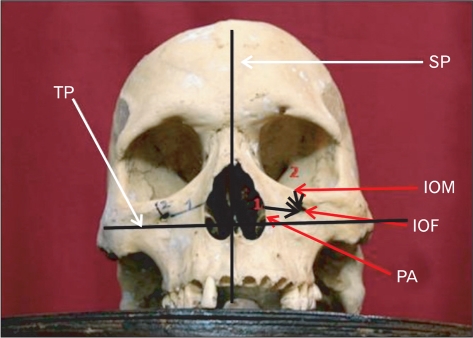
We analyzed the variability in position, shape, size and incidence of the infraorbital foramen in Indian dry skulls as little literature is available on this foramen in Indians to prevent clinical complications during maxillofacial surgery and regional block anesthesia. Fifty-five Indian skulls from the Department of Anatomy CSM Medical University were examined. The 110 sides (left and right) of the skulls were analyzed by measuring the infraorbital foramina distances from infraorbital margin and the piriform aperture on both sides. The vertical and horizontal dimensions were also measured. All measurements were taken with a compass transferred to calipers and analyzed statistically. The mean distances between the infraorbital foramen and the infraorbital margin on the right and left side were 6.12 mm and 6.19 mm, respectively. The mean distances between the infraorbital foramen and the piriform aperture were 15.31 mm and 15.80 mm on the right and left sides, respectively. The mean vertical dimensions on the right and left side were 3.39 mm and 3.75 mm, respectively. The mean horizontal dimensions on the two sides were 3.19 mm and 3.52 mm. These results provide detailed knowledge of the anatomical characteristics and clinical importance of the infraorbital foramina which are of paramount importance for surgeons when performing maxillofacial surgery and regional block anesthesia.
由于关于印度人眶下孔的文献较少,为防止颌面外科手术和区域阻滞麻醉期间出现临床并发症,我们分析了印度干燥颅骨中眶下孔的位置、形状、大小和发生率。对CSM医科大学解剖学系的55个印度颅骨进行了检查。通过测量颅骨两侧眶下孔到眶下缘和梨状孔的距离,对颅骨的110个侧面(左右)进行了分析。还测量了垂直和水平尺寸。所有测量均使用转移到卡尺上的圆规进行,并进行统计学分析。右侧和左侧眶下孔与眶下缘之间的平均距离分别为6.12毫米和6.19毫米。右侧和左侧眶下孔与梨状孔之间的平均距离分别为15.31毫米和15.80毫米。右侧和左侧的平均垂直尺寸分别为3.39毫米和3.75毫米。两侧的平均水平尺寸为3.19毫米和3.52毫米。这些结果提供了眶下孔解剖特征和临床重要性的详细知识,这对颌面外科手术和区域阻滞麻醉的外科医生至关重要。