Centro Hispano-Luso de Investigaciones Agrarias (CIALE), Departamento de Microbiología y Genética, Universidad de Salamanca, Río Duero 12, Campus de Villamayor, 37185 Salamanca, Spain.
BMC Microbiol. 2011 Apr 26;11:84. doi: 10.1186/1471-2180-11-84.
The entomopathogenic anamorphic fungus Beauveria bassiana is currently used as a biocontrol agent (BCA) of insects. Fifty-seven Beauveria bassiana isolates -53 from Spain- were characterized, integrating group I intron insertion patterns at the 3'-end of the nuclear large subunit ribosomal gene (LSU rDNA) and elongation factor 1-alpha (EF1-α) phylogenetic information, in order to assess the genetic structure and diversity of this Spanish collection of B. bassiana.
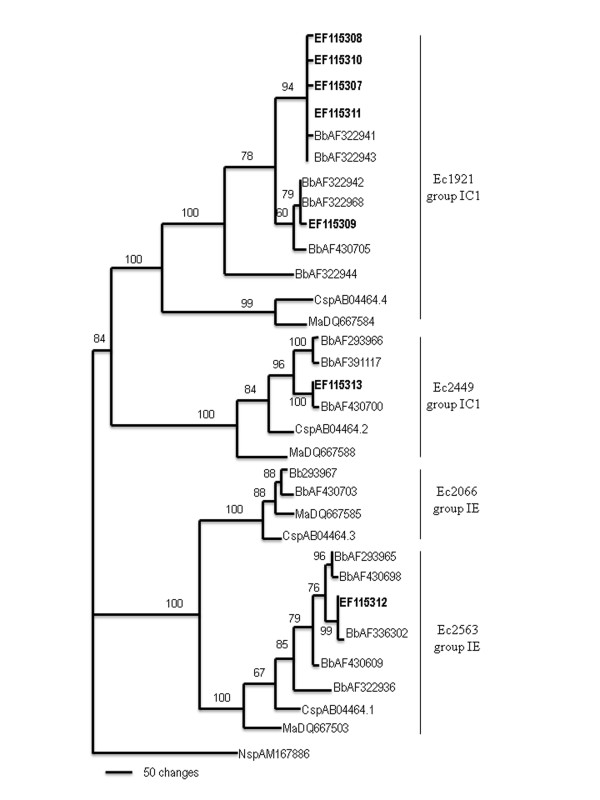
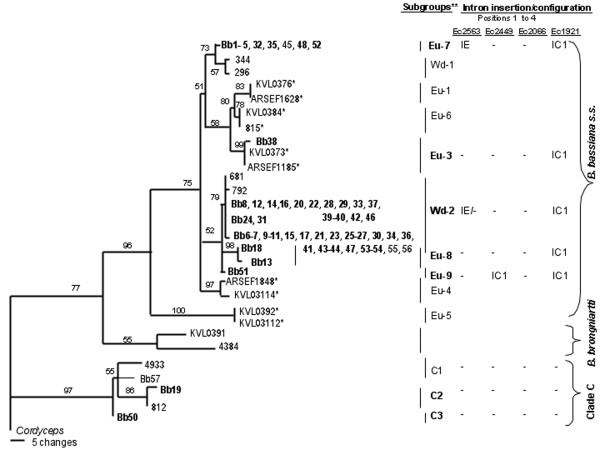
Group I intron genotype analysis was based on the four highly conserved insertion sites of the LSU (Ec2653, Ec2449, Ec2066, Ec1921). Of the 16 possible combinations/genotypes, only four were detected, two of which were predominant, containing 44 and 9 members out of 57 isolates, respectively. Interestingly, the members of the latter two genotypes showed unique differences in their growth temperatures. In follow, EF1-α phylogeny served to classify most of the strains in the B. bassiana s.s. (sensu stricto) group and separate them into 5 molecular subgroups, all of which contained a group I intron belonging to the IC1 subtype at the Ec1921 position. A number of parameters such as thermal growth or origin (host, geographic location and climatic conditions) were also examined but in general no association could be found.
Most Spanish B. bassiana isolates (77.2%) are grouped into a major phylogenetic subgroup with word-wide distribution. However, high phylogenetic diversity was also detected among Spanish isolates from close geographic zones with low climatic variation. In general, no correlation was observed between the molecular distribution and geographic origin or climatic characteristics where the Spanish B. bassiana isolates were sampled.
虫生真菌球孢白僵菌目前被用作昆虫的生物防治剂(BCA)。为了评估该西班牙球孢白僵菌种群的遗传结构和多样性,对 57 个球孢白僵菌分离株(53 个来自西班牙)进行了特征描述,整合了核大亚基核糖体基因(LSU rDNA)3'末端的第 I 组内含子插入模式和延伸因子 1-α(EF1-α)系统发育信息。
基于 LSU 的 4 个高度保守的插入位点(Ec2653、Ec2449、Ec2066、Ec1921)进行 I 组内含子基因型分析。在 16 种可能的组合/基因型中,仅检测到 4 种,其中两种占优势,分别包含 57 个分离株中的 44 个和 9 个成员。有趣的是,后两种基因型的成员在其生长温度上表现出独特的差异。随后,EF1-α 系统发育用于将大多数菌株分类为球孢白僵菌 s.s.(严格意义上的)组,并将它们分为 5 个分子亚群,其中所有亚群在 Ec1921 位置都包含属于 IC1 亚型的 I 组内含子。还检查了一些参数,如热生长或起源(宿主、地理位置和气候条件),但总体上没有发现关联。
大多数西班牙球孢白僵菌分离株(77.2%)分为具有全球分布的主要系统发育亚群。然而,在地理区域接近且气候变化较小的西班牙分离株中也检测到了较高的系统发育多样性。一般来说,西班牙球孢白僵菌分离株采样的地理起源或气候特征与分子分布之间没有相关性。