West Midlands Cancer Intelligence Unit, University of Birmingham, Birmingham B15 2TT, UK.
Br J Cancer. 2011 Apr 26;104(9):1505-10. doi: 10.1038/bjc.2011.68.
Endometrial cancer is the most common gynaecological cancer in the western world, the incidence increasing in the United Kingdom by over 40% since 1993. Two types of endometrial cancer exist - oestrogen-dependent type 1 with good prognosis and non-oestrogen-dependent type 2 with poor prognosis. The histopathological distribution of the increase in endometrial cancer is unknown. This study investigates the observed incidence trends of the two types, the age, stage, and socioeconomic distribution of this increase and survival outcome.
Data were analysed from 6867 women with endometrial cancer registered between 1994 and 2006, at a UK population-based cancer registry.
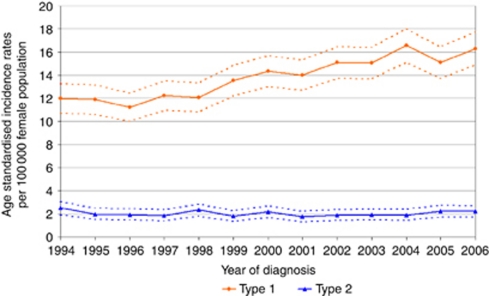
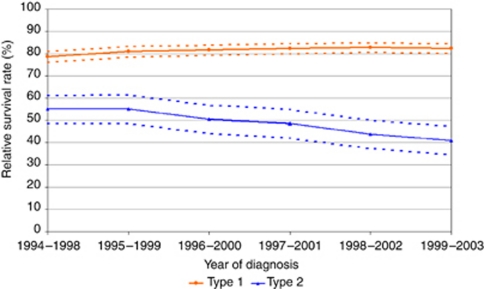
Increased endometrial cancer incidence is confined to type 1 cancers with a significant increase in age standardised incidence rate (ASR) from 12.0 per 100,000 (confidence interval (CI) 10.7-13.2) in 1994 to 16.3 per 100,000 (CI 14.9-17.7), P<0.001 in 2006, while ASR of type 2 cancer changed from 2.5 per 100,000 (CI 2.0-3.1) in 1994 to 2.2 per 100,000 (CI 1.7-2.7) in 2006, which was not statistically significant P>0.05. Increase in type 1 cancer is most marked in age groups 60-69 years (P<0.001) and 70-79 years (P<0.001) and distributed equally among socioeconomic quintiles. While outcome for type 1 cancer has improved, 1-year survival in type 2 cancer is unchanged from 73.1% in 1994 to 74.3%, P=0.089 and 5-year survival decreased from 55.1% to 40.9%, P=0.001.
Increased incidence in endometrial cancer is confined to type 1 cancers, seen most in the 60-79 age groups and across all socioeconomic quintiles. Survival in type 2 cancer has decreased significantly. Urgent research is needed to investigate prevention strategies in type 1 and improve therapy in type 2 cancers.
子宫内膜癌是西方世界最常见的妇科癌症,自 1993 年以来,英国的发病率上升了 40%以上。存在两种类型的子宫内膜癌——雌激素依赖性 1 型预后良好,非雌激素依赖性 2 型预后不良。子宫内膜癌的组织病理学分布增加尚不清楚。本研究调查了这两种类型的观察到的发病率趋势、这种增加的年龄、阶段和社会经济分布以及生存结果。
对英国基于人群的癌症登记处 1994 年至 2006 年间登记的 6867 名子宫内膜癌女性患者的数据进行了分析。
子宫内膜癌发病率的增加仅限于 1 型癌症,年龄标准化发病率(ASR)从 1994 年的每 100,000 人 12.0(置信区间 10.7-13.2)显著增加到 2006 年的每 100,000 人 16.3(置信区间 14.9-17.7),P<0.001,而 2 型癌症的 ASR 从 1994 年的每 100,000 人 2.5(置信区间 2.0-3.1)变为 2006 年的每 100,000 人 2.2(置信区间 1.7-2.7),差异无统计学意义(P>0.05)。1 型癌症的增加在 60-69 岁(P<0.001)和 70-79 岁(P<0.001)年龄组最为明显,并且在社会经济五分位数中分布均匀。尽管 1 型癌症的治疗结果有所改善,但 2 型癌症的 1 年生存率仍保持不变,从 1994 年的 73.1%到 74.3%,P=0.089,5 年生存率从 55.1%降至 40.9%,P=0.001。
子宫内膜癌发病率的增加仅限于 1 型癌症,在 60-79 岁年龄组和所有社会经济五分位数中均可见。2 型癌症的生存率显著下降。迫切需要研究 1 型癌症的预防策略,并改善 2 型癌症的治疗。