Kessler Henrik, Doyen-Waldecker Cornelia, Hofer Christian, Hoffmann Holger, Traue Harald C, Abler Birgit
Department of Psychosomatic Medicine and Psychotherapy, Medical Psychology, University of Ulm, Germany.
Psychosoc Med. 2011 Apr 20;8:Doc03. doi: 10.3205/psm000072.
This study investigated brain areas involved in the perception of dynamic facial expressions of emotion.
A group of 30 healthy subjects was measured with fMRI when passively viewing prototypical facial expressions of fear, disgust, sadness and happiness. Using morphing techniques, all faces were displayed as still images and also dynamically as a film clip with the expressions evolving from neutral to emotional.
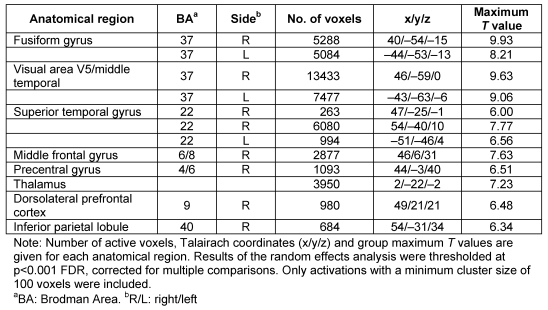
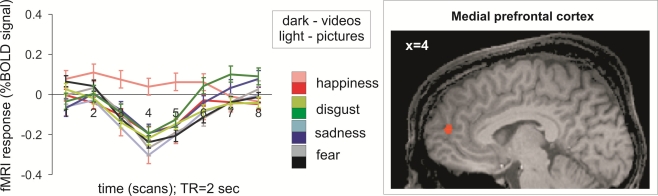
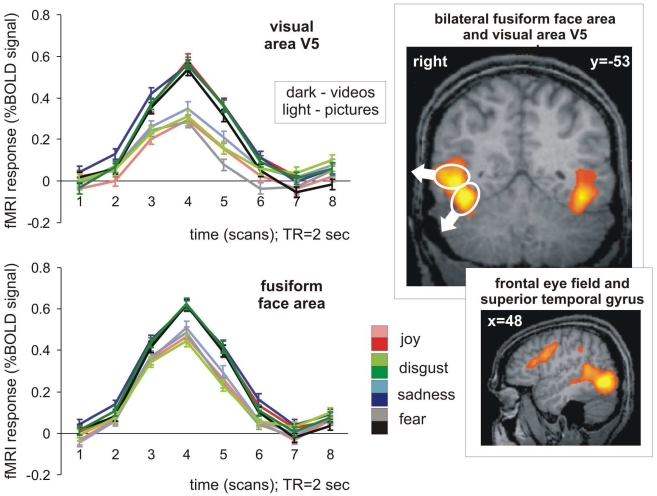
Irrespective of a specific emotion, dynamic stimuli selectively activated bilateral superior temporal sulcus, visual area V5, fusiform gyrus, thalamus and other frontal and parietal areas. Interaction effects of emotion and mode of presentation (static/dynamic) were only found for the expression of happiness, where static faces evoked greater activity in the medial prefrontal cortex.
Our results confirm previous findings on neural correlates of the perception of dynamic facial expressions and are in line with studies showing the importance of the superior temporal sulcus and V5 in the perception of biological motion. Differential activation in the fusiform gyrus for dynamic stimuli stands in contrast to classical models of face perception but is coherent with new findings arguing for a more general role of the fusiform gyrus in the processing of socially relevant stimuli.
本研究调查了参与动态面部表情情绪感知的脑区。
一组30名健康受试者在被动观看恐惧、厌恶、悲伤和快乐等典型面部表情时,接受功能磁共振成像(fMRI)测量。使用变形技术,所有面孔既以静态图像形式呈现,也以电影剪辑的动态形式呈现,表情从中性逐渐演变为情绪化。
无论具体情绪如何,动态刺激均选择性激活双侧颞上沟、视觉区域V5、梭状回、丘脑以及其他额叶和顶叶区域。情绪与呈现方式(静态/动态)的交互作用仅在快乐表情中发现,静态面孔在内侧前额叶皮层引发更强的活动。
我们的结果证实了先前关于动态面部表情感知神经关联的研究发现,并且与表明颞上沟和V5在生物运动感知中重要性的研究一致。动态刺激下梭状回的差异激活与经典面部感知模型形成对比,但与认为梭状回在社会相关刺激处理中具有更广泛作用的新发现一致。