Department of Infectious Diseases, Cleveland Clinic Foundation, Cleveland, Ohio, United States of America.
PLoS One. 2011 Apr 15;6(4):e18165. doi: 10.1371/journal.pone.0018165.
The potential for emergence and spread of HIV drug resistance from rollout of antiretroviral (ARV) pre-exposure prophylaxis (PrEP) is an important public health concern. We investigated determinants of HIV drug resistance prevalence after PrEP implementation through mathematical modeling.
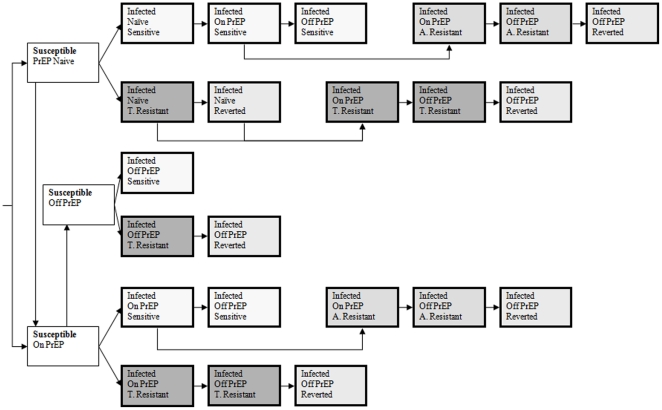
A model incorporating heterogeneity in age, gender, sexual activity, HIV infection status, stage of disease, PrEP coverage/discontinuation, and HIV drug susceptibility, was designed to simulate the impact of PrEP on HIV prevention and drug resistance in a sub-Saharan epidemic.
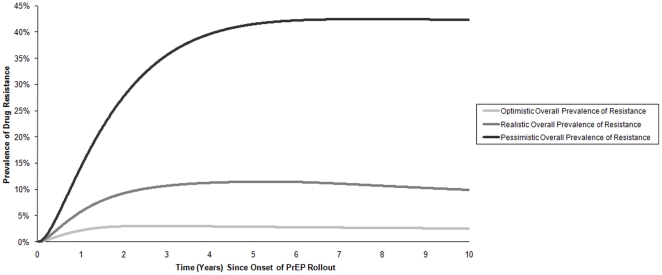
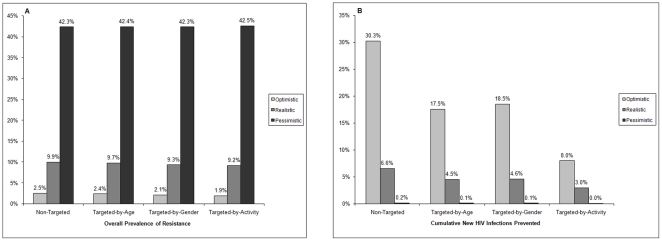
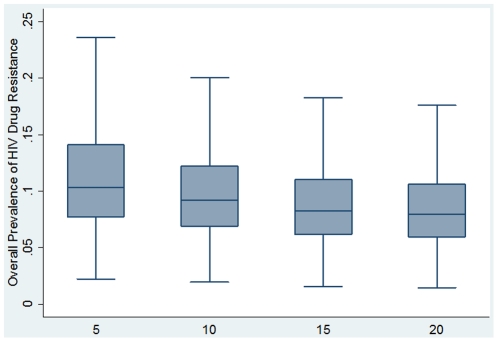
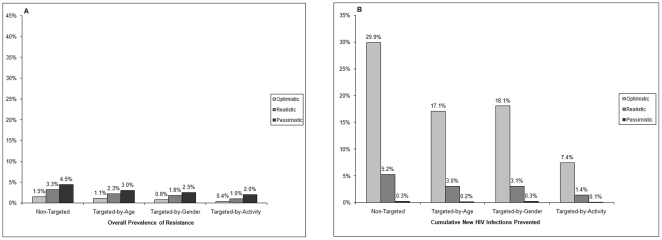
Analyses suggest that the prevalence of HIV drug resistance is influenced most by the extent and duration of inadvertent PrEP use in individuals already infected with HIV. Other key factors affecting drug resistance prevalence include the persistence time of transmitted resistance and the duration of inadvertent PrEP use in individuals who become infected on PrEP. From uncertainty analysis, the median overall prevalence of drug resistance at 10 years was predicted to be 9.2% (interquartile range 6.9%-12.2%). An optimistic scenario of 75% PrEP efficacy, 60% coverage of the susceptible population, and 5% inadvertent PrEP use predicts a rise in HIV drug resistance prevalence to only 2.5% after 10 years. By contrast, in a pessimistic scenario of 25% PrEP efficacy, 15% population coverage, and 25% inadvertent PrEP use, resistance prevalence increased to over 40%.
Inadvertent PrEP use in previously-infected individuals is the major determinant of HIV drug resistance prevalence arising from PrEP. Both the rate and duration of inadvertent PrEP use are key factors. PrEP rollout programs should include routine monitoring of HIV infection status to limit the spread of drug resistance.
抗逆转录病毒(ARV)暴露前预防(PrEP)的推出可能会导致 HIV 耐药性的出现和传播,这是一个重要的公共卫生关注点。我们通过数学建模研究了 PrEP 实施后 HIV 耐药性流行的决定因素。
设计了一个模型,该模型结合了年龄、性别、性活动、HIV 感染状态、疾病阶段、PrEP 覆盖率/中断、以及 HIV 药物敏感性的异质性,以模拟 PrEP 在撒哈拉以南非洲流行地区对 HIV 预防和耐药性的影响。
分析表明,HIV 耐药性的流行受已经感染 HIV 的个体中无意 PrEP 使用的程度和持续时间的影响最大。其他影响耐药性流行的关键因素包括传播耐药性的持续时间以及在 PrEP 感染个体中无意 PrEP 使用的持续时间。通过不确定性分析,预测在 10 年内耐药性的总体中位流行率为 9.2%(四分位间距为 6.9%-12.2%)。在乐观的情况下,PrEP 有效性为 75%,易感人群的覆盖率为 60%,无意 PrEP 使用率为 5%,则 10 年后 HIV 耐药性的流行率仅上升 2.5%。相比之下,在 PrEP 有效性为 25%、人群覆盖率为 15%和无意 PrEP 使用率为 25%的悲观情况下,耐药性流行率增加到 40%以上。
在已感染个体中无意使用 PrEP 是 PrEP 导致 HIV 耐药性流行的主要决定因素。无意 PrEP 使用的速度和持续时间是关键因素。PrEP 推出计划应包括对 HIV 感染状况的常规监测,以限制耐药性的传播。