Department of Traumatology, Medical University of Vienna, Waehringer Guertel 18-20, Vienna, Austria.
Injury. 2011 Aug;42(8):833-7. doi: 10.1016/j.injury.2011.03.055. Epub 2011 May 6.
Transforming growth factor-beta 1(TGF-β1) is a regulatory protein, involved in bone fracture healing. Circulating TGF-β1 levels have been reported to be a predictor of delayed bone healing and non-union, suggesting active relationship between tissue and circulating TGF-β1 in fracture healing. The purpose of this study was to analyse TGF-β1 local and serum concentrations in fracture healing to further contribute to the understanding of molecular regulation of fracture healing.
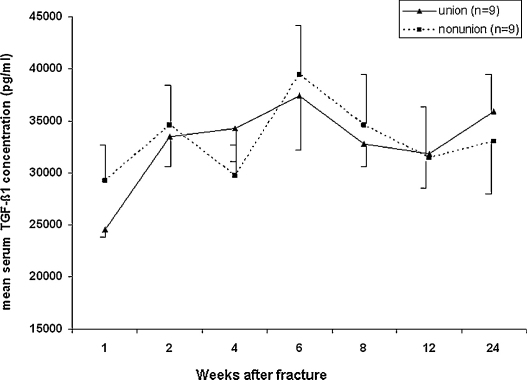
Serum samples of 113 patients with long bone fractures were collected over a period of 6 months following a standardised time schedule. TGF-β1 serum concentrations were measured using ELISA. Patients were assigned to 2 groups: Group 1 contained 103 patients with physiological healing. Group 2 contained 10 patients with impaired healing. Patients in both groups were matched. One patient of the group 2 had to be excluded because of missing match partner. In addition, fracture haematoma from 11 patients of group 1 was obtained to analyse local TGF-β1 concentrations. 33 volunteers donated serum which served as control.
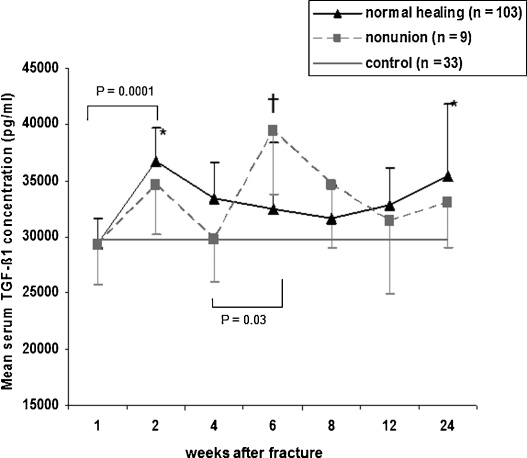
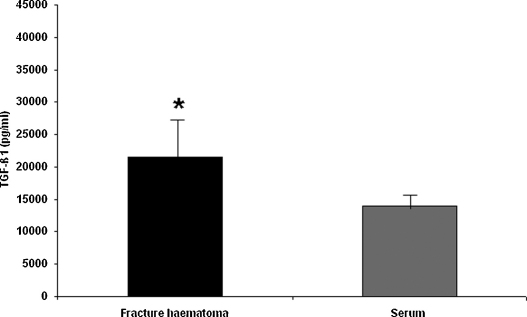
TGF-β1 serum concentrations increased during the early healing period and were significantly higher in patients with physiological healing compared to controls (P=0.04). Thereafter, it decreased continuously between weeks 2 and 8 and fell again after week 8. TGF-β1 serum concentrations in patients with physiological healing were significantly higher at week 24 compared to controls (P=0.05). In non-unions, serum concentrations differed significantly from those of controls at week 6 (P=0.01). No significant difference in between patients with physiological and impaired fracture healing was observed. Fracture haematoma contained significantly higher TGF-β1 concentrations than peripheral serum of the patients (P=0.017).
Elevated levels of TGF-β1 in haematoma and in serum after bone fracture especially during the entire healing process indicate its importance for fracture healing.
转化生长因子-β1(TGF-β1)是一种调节蛋白,参与骨骨折愈合。已经报道循环 TGF-β1 水平是延迟骨愈合和骨不连的预测因子,这表明组织和循环 TGF-β1 在骨折愈合中有积极的关系。本研究的目的是分析骨折愈合中 TGF-β1 的局部和血清浓度,以进一步了解骨折愈合的分子调控。
收集 113 例长骨骨折患者的血清样本,在标准化时间安排后随访 6 个月。使用 ELISA 测量 TGF-β1 血清浓度。将患者分为 2 组:第 1 组包含 103 例生理愈合患者。第 2 组包含 10 例愈合不良的患者。两组患者相匹配。由于缺少匹配的对照组,第 2 组的 1 例患者被排除。此外,还从第 1 组的 11 名患者中获得骨折血肿以分析局部 TGF-β1 浓度。33 名志愿者捐献血清作为对照。
TGF-β1 血清浓度在早期愈合期间增加,生理愈合患者明显高于对照组(P=0.04)。此后,它在第 2 周和第 8 周之间持续下降,并在第 8 周后再次下降。生理愈合患者的 TGF-β1 血清浓度在第 24 周明显高于对照组(P=0.05)。在骨不连患者中,血清浓度在第 6 周与对照组相比有显著差异(P=0.01)。生理愈合和愈合不良的患者之间没有观察到显著差异。骨折血肿中的 TGF-β1 浓度明显高于患者外周血清中的浓度(P=0.017)。
骨骨折后尤其是在整个愈合过程中,血肿和血清中 TGF-β1 水平升高表明其对骨折愈合的重要性。