Sibal Latika, Agarwal Sharad C, Home Philip D, Boger Rainer H
Institute of Cellular Medicine, Newcastle University, Newcastle upon Tyne, UK.
Curr Cardiol Rev. 2010 May;6(2):82-90. doi: 10.2174/157340310791162659.
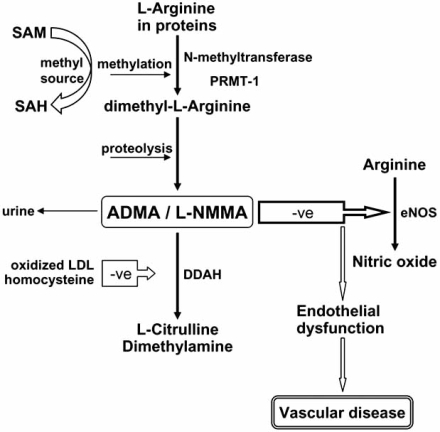
Endothelium plays a crucial role in the maintenance of vascular tone and structure. Endothelial dysfunction is known to precede overt coronary artery disease. A number of cardiovascular risk factors, as well as metabolic diseases and systemic or local inflammation cause endothelial dysfunction. Nitric oxide (NO) is one of the major endothelium derived vaso-active substances whose role is of prime importance in maintaining endothelial homeostasis. Low levels of NO are associated with impaired endothelial function. Asymmetric dimethylarginine (ADMA), an analogue of L-arginine, is a naturally occurring product of metabolism found in human circulation. Elevated levels of ADMA inhibit NO synthesis and therefore impair endothelial function and thus promote atherosclerosis. ADMA levels are increased in people with hypercholesterolemia, atherosclerosis, hypertension, chronic heart failure, diabetes mellitus and chronic renal failure. A number of studies have reported ADMA as a novel risk marker of cardiovascular disease. Increased levels of ADMA have been shown to be the strongest risk predictor, beyond traditional risk factors, of cardiovascular events and all-cause and cardiovascular mortality in people with coronary artery disease. Interventions such as treatment with L-arginine have been shown to improve endothelium-mediated vasodilatation in people with high ADMA levels. However the clinical utility of modifying circulating ADMA levels remains uncertain.
内皮在维持血管张力和结构方面发挥着关键作用。已知内皮功能障碍先于明显的冠状动脉疾病出现。多种心血管危险因素以及代谢性疾病和全身或局部炎症都会导致内皮功能障碍。一氧化氮(NO)是主要的内皮源性血管活性物质之一,其在维持内皮稳态中起着至关重要的作用。NO水平降低与内皮功能受损有关。不对称二甲基精氨酸(ADMA)是L-精氨酸的类似物,是人体循环中天然存在的代谢产物。ADMA水平升高会抑制NO合成,从而损害内皮功能,进而促进动脉粥样硬化。高胆固醇血症、动脉粥样硬化、高血压、慢性心力衰竭、糖尿病和慢性肾衰竭患者的ADMA水平会升高。多项研究报告称ADMA是心血管疾病的一种新型风险标志物。已证明,ADMA水平升高是冠状动脉疾病患者心血管事件、全因死亡率和心血管死亡率的最强风险预测指标,超过了传统风险因素。诸如用L-精氨酸治疗等干预措施已被证明可改善ADMA水平高的患者的内皮介导的血管舒张功能。然而,改变循环ADMA水平的临床效用仍不确定。