VIP Department, Shanxi Provincial People's Hospital, Taiyuan, China.
Department of Exercise Rehabilitation, Shanghai University of Sport, Shanghai, 200438, China.
Nitric Oxide. 2018 Aug 1;78:113-120. doi: 10.1016/j.niox.2018.06.004. Epub 2018 Jun 19.
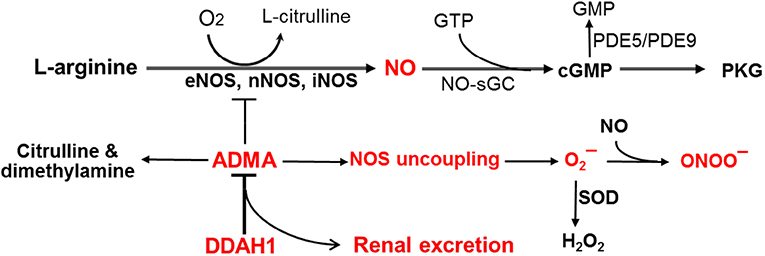
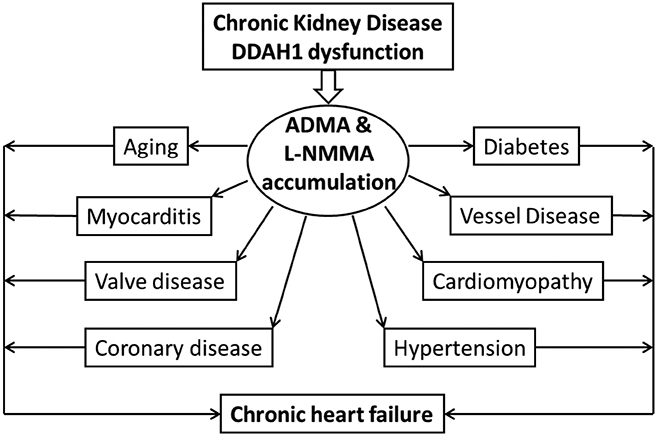
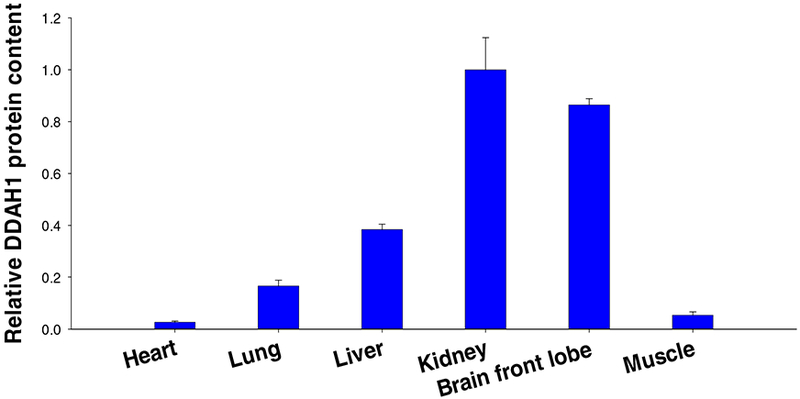
Patients with chronic kidney disease have an increased cardiovascular morbidity and mortality. It has been recognized that the traditional cardiovascular risk factors could only partially explain the increased cardiovascular morbidity and mortality in patients with chronic kidney disease. Asymmetric dimethylarginine (ADMA) and N-monomethy l-arginine (L-NMMA) are endogenous inhibitors of nitric oxide synthases that attenuate nitric oxide production and enhance reactive oxidative specie generation. Increased plasma ADMA and/or L-NMMA are strong and independent risk factor for chronic kidney disease, and various cardiovascular diseases such as hypertension, coronary artery disease, atherosclerosis, diabetes, and heart failure. Both ADMA and L-NMMA are also eliminated from the body through either degradation by dimethylarginine dimethylaminohydrolase-1 (DDAH1) or urine excretion. This short review will exam the literature of ADMA and L-NMMA degradation and urine excretion, and the role of chronic kidney diseases in ADMA and L-NMMA accumulation and the increased cardiovascular disease risk. Based on all available data, it appears that the increased cardiovascular morbidity in chronic kidney disease may relate to the dramatic increase of systemic ADMA and L-NMMA after kidney failure.
慢性肾脏病患者的心血管发病率和死亡率增加。人们已经认识到,传统的心血管危险因素只能部分解释慢性肾脏病患者心血管发病率和死亡率的增加。不对称二甲基精氨酸(ADMA)和 N-单甲基精氨酸(L-NMMA)是一氧化氮合酶的内源性抑制剂,可减弱一氧化氮的产生并增强活性氧物质的产生。血浆 ADMA 和/或 L-NMMA 水平升高是慢性肾脏病以及高血压、冠状动脉疾病、动脉粥样硬化、糖尿病和心力衰竭等各种心血管疾病的强烈且独立的危险因素。ADMA 和 L-NMMA 也可以通过二甲基精氨酸二甲氨基水解酶-1(DDAH1)降解或尿液排泄从体内清除。这篇简短的综述将检查 ADMA 和 L-NMMA 降解和尿液排泄的文献,以及慢性肾脏病在 ADMA 和 L-NMMA 积累和增加心血管疾病风险中的作用。根据所有现有数据,似乎慢性肾脏病患者心血管发病率的增加可能与肾衰竭后全身 ADMA 和 L-NMMA 的急剧增加有关。