Neuroimmunology and Neuromuscular Disorders Unit, Foundation IRCCS Neurological Institute Carlo Besta, Milan, Italy.
PLoS One. 2011 Apr 21;6(4):e18660. doi: 10.1371/journal.pone.0018660.
Genome-wide association studies (gwas) are invaluable in revealing the common variants predisposing to complex human diseases. Yet, until now, the large volumes of data generated from such analyses have not been explored extensively enough to identify the molecular and functional framework hosting the susceptibility genes.
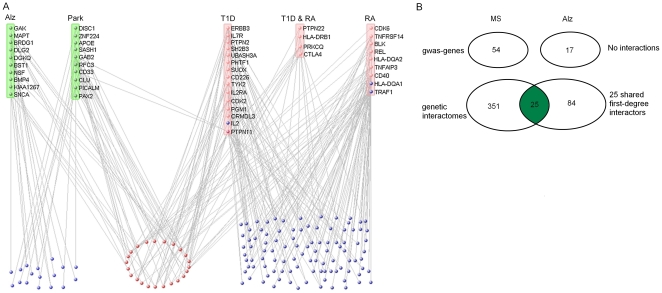
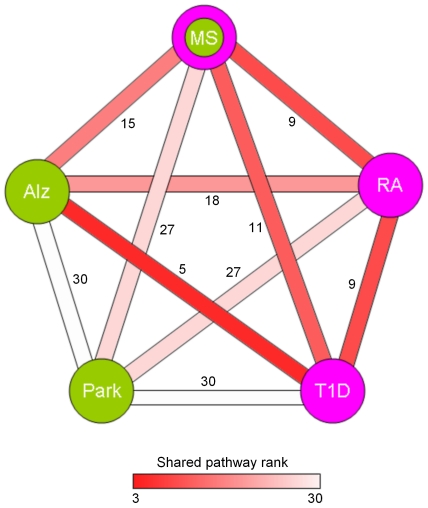
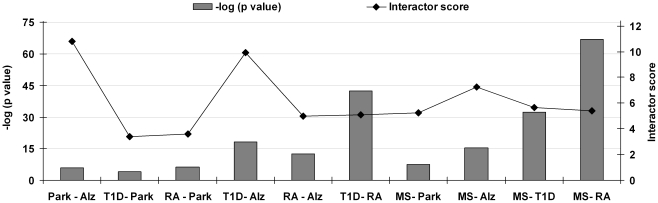
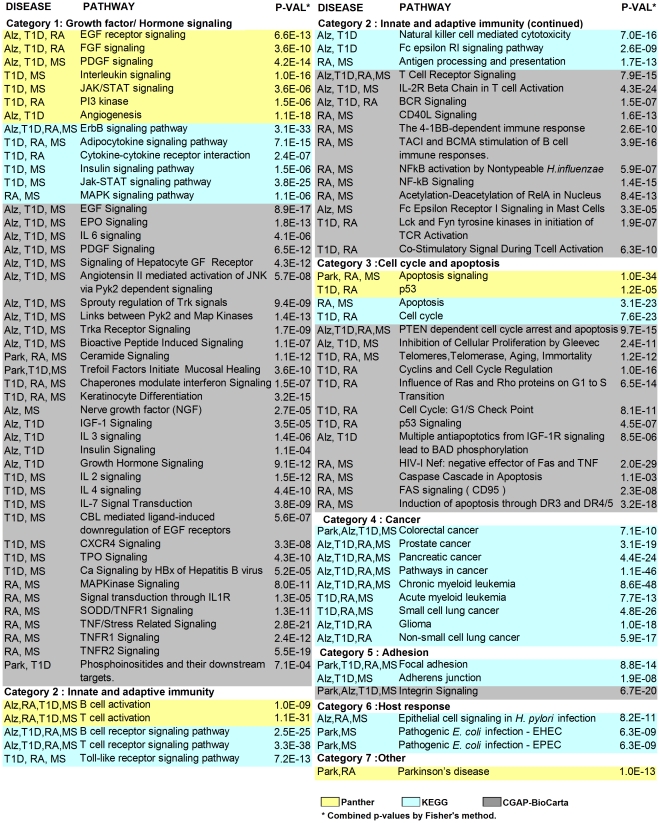
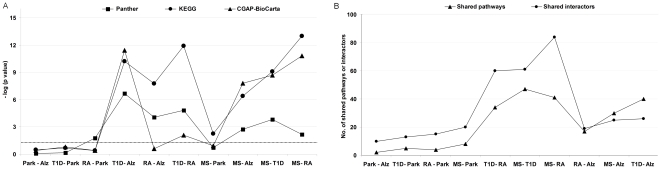
METHODOLOGY/PRINCIPAL FINDINGS: We investigated the relationships among five neurodegenerative and/or autoimmune complex human diseases (Parkinson's disease--Park, Alzheimer's disease--Alz, multiple sclerosis--MS, rheumatoid arthritis--RA and Type 1 diabetes--T1D) by characterising the interactomes linked to their gwas-genes. An initial study on the MS interactome indicated that several genes predisposing to the other autoimmune or neurodegenerative disorders may come into contact with it, suggesting that susceptibility to distinct diseases may converge towards common molecular and biological networks. In order to test this hypothesis, we performed pathway enrichment analyses on each disease interactome independently. Several issues related to immune function and growth factor signalling pathways appeared in all autoimmune diseases, and, surprisingly, in Alzheimer's disease. Furthermore, the paired analyses of disease interactomes revealed significant molecular and functional relatedness among autoimmune diseases, and, unexpectedly, between T1D and Alz.
CONCLUSIONS/SIGNIFICANCE: The systems biology approach highlighted several known pathogenic processes, indicating that changes in these functions might be driven or sustained by the framework linked to genetic susceptibility. Moreover, the comparative analyses among the five genetic interactomes revealed unexpected genetic relationships, which await further biological validation. Overall, this study outlines the potential of systems biology to uncover links between genetics and pathogenesis of complex human disorders.
全基因组关联研究(GWAS)在揭示导致复杂人类疾病的常见变异方面具有不可估量的价值。然而,到目前为止,从这些分析中产生的大量数据还没有被充分探索,以确定容纳易感基因的分子和功能框架。
方法/主要发现:我们通过研究与 GWAS 基因相关的互作网络,调查了五种神经退行性和/或自身免疫性复杂人类疾病(帕金森病 - Park、阿尔茨海默病 - Alz、多发性硬化症 - MS、类风湿关节炎 - RA 和 1 型糖尿病 - T1D)之间的关系。对 MS 互作网络的初步研究表明,导致其他自身免疫或神经退行性疾病的几个易感基因可能与之接触,这表明不同疾病的易感性可能趋同于共同的分子和生物学网络。为了验证这一假设,我们对每个疾病互作网络分别进行了通路富集分析。几种与免疫功能和生长因子信号通路相关的问题出现在所有自身免疫性疾病中,令人惊讶的是,在阿尔茨海默病中也出现了这些问题。此外,对疾病互作网络的成对分析揭示了自身免疫性疾病之间以及 T1D 和 Alz 之间存在显著的分子和功能相关性。
结论/意义:系统生物学方法强调了几个已知的致病过程,表明这些功能的变化可能是由与遗传易感性相关的框架驱动或维持的。此外,对五个遗传互作网络的比较分析揭示了意想不到的遗传关系,有待进一步的生物学验证。总的来说,这项研究概述了系统生物学在揭示复杂人类疾病的遗传和发病机制之间联系的潜力。