Zhong Qifan, Wang Shenglong
Department of Neurology, The Affiliated Jiangsu Shengze Hospital of Nanjing Medical University, Suzhou, Jiangsu, China.
Front Aging Neurosci. 2023 Mar 16;15:1109914. doi: 10.3389/fnagi.2023.1109914. eCollection 2023.
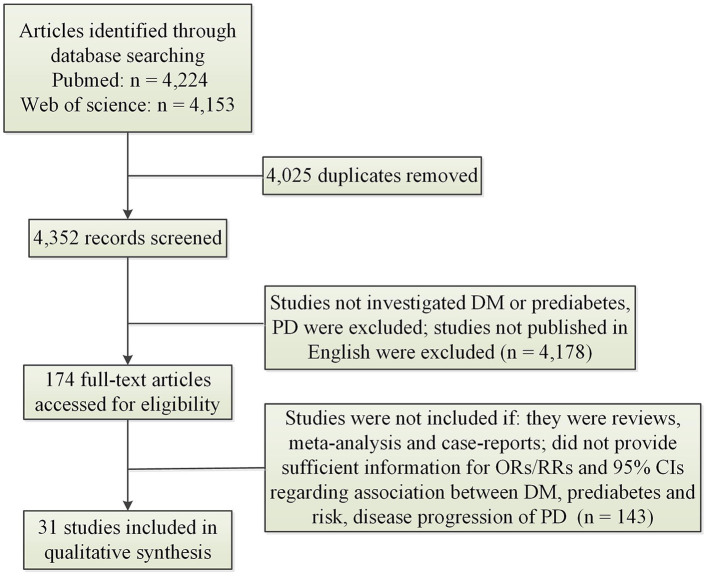
Previous studies reported inconsistent results regarding association between diabetes mellitus (DM), prediabetes and risk, disease progression of Parkinson's disease (PD). The meta-analysis was made to investigate association between DM, prediabetes and risk, disease progression of PD.
Literatures investigating association between DM, prediabetes and risk, disease progression of PD were searched in these databases: PubMed and Web of Science. Included literatures were published before October 2022. STATA 12.0 software was used to compute odds ratios (ORs)/relative risks (RRs) or standard mean differences (SMDs).
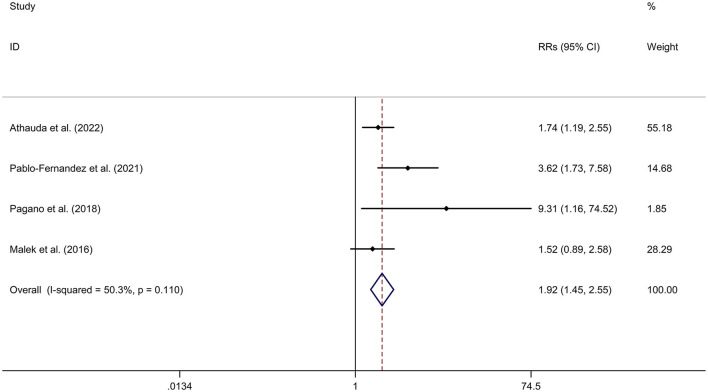
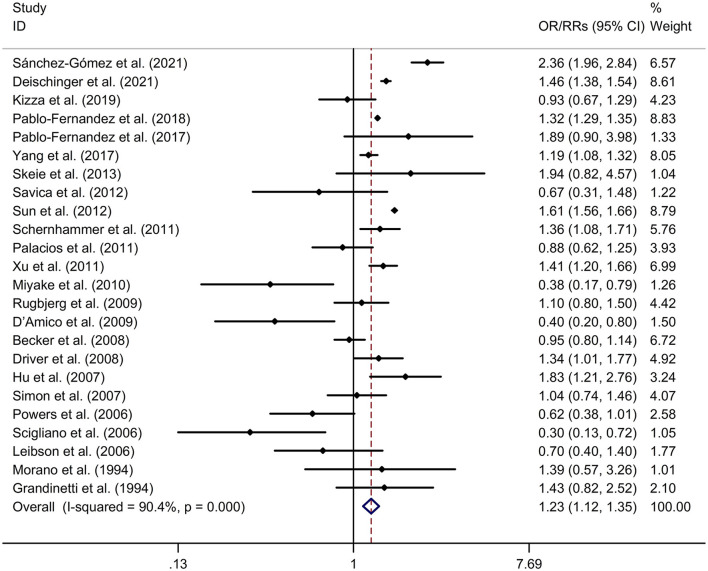
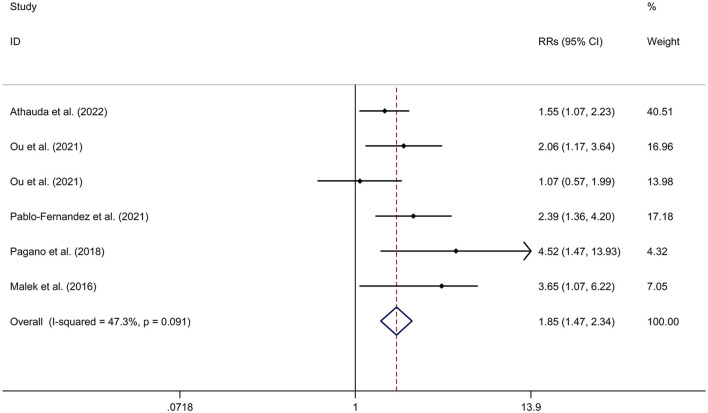
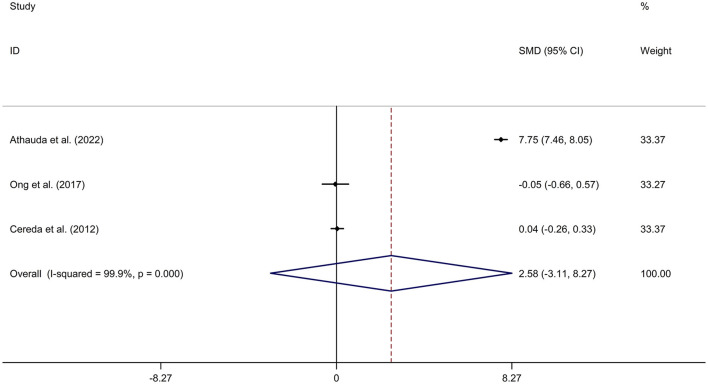
DM was associated with a higher risk of PD, compared to non-diabetic participants with a random effects model (OR/RR = 1.23, 95% CI 1.12-1.35, = 90.4%, < 0.001). PD with DM (PD-DM) was associated with a faster motor progression compared to PD without DM (PD-noDM) with a fixed effects model (RR = 1.85, 95% CI 1.47-2.34, = 47.3%, = 0.091). However, meta-analysis for comparison in change rate of United Rating Scale (UPDRS) III scores from baseline to follow-up time between PD-DM and PD-noDM reported no difference in motor progression between PD-DM and PD-noDM with a random effects model (SMD = 2.58, 95% CI = -3.11 to 8.27, = 99.9%, < 0.001). PD-DM was associated with a faster cognitive decline compared to PD-noDM with a fixed effects model (OR/RR = 1.92, 95% CI 1.45-2.55, = 50.3%, = 0.110).
In conclusion, DM was associated with a higher risk and faster disease decline of PD. More large-scale cohort studies should be adopted to evaluate the association between DM, prediabetes and PD.
先前的研究报告了糖尿病(DM)、糖尿病前期与帕金森病(PD)风险及疾病进展之间的关联结果不一致。进行荟萃分析以研究DM、糖尿病前期与PD风险及疾病进展之间的关联。
在PubMed和Web of Science等数据库中检索调查DM、糖尿病前期与PD风险及疾病进展之间关联的文献。纳入的文献发表于2022年10月之前。使用STATA 12.0软件计算比值比(ORs)/相对风险(RRs)或标准化均值差(SMDs)。
与非糖尿病参与者相比,采用随机效应模型时,DM与更高的PD风险相关(OR/RR = 1.23,95%CI 1.12 - 1.35,I² = 90.4%,P < 0.001)。采用固定效应模型时,与无DM的PD(PD-noDM)相比,合并DM的PD(PD-DM)与更快的运动进展相关(RR = (此处原文有误,可能是重复输入了RR,推测应该是SMD之类的正确指标值,暂按原文翻译)1.85,95%CI 1.47 - 2.34,I² = 47.3%,P = 0.091)。然而,对PD-DM和PD-noDM从基线到随访时间的统一帕金森病评定量表(UPDRS)III评分变化率进行比较的荟萃分析显示,采用随机效应模型时,PD-DM和PD-noDM之间的运动进展无差异(SMD = 2.58,95%CI = -3.11至8.27,I² = 99.9%,P < 0.001)。采用固定效应模型时,与PD-noDM相比,PD-DM与更快的认知衰退相关(OR/RR = 1.92,95%CI 1.45 - 2.55,I² = 50.3%,P = 0.110)。
总之,DM与更高的PD风险和更快的疾病衰退相关。应采用更多大规模队列研究来评估DM、糖尿病前期与PD之间的关联。