Unidade de Xenética, Departamento de Anatomía Patolóxica e Ciencias Forenses, Instituto de Medicina Legal, Facultade de Medicina, Universidade de Santiago de Compostela, CIBERER, Galicia, Spain.
PLoS One. 2011 Apr 20;6(4):e18682. doi: 10.1371/journal.pone.0018682.
Located in the Sudan belt, the Chad Basin forms a remarkable ecosystem, where several unique agricultural and pastoral techniques have been developed. Both from an archaeological and a genetic point of view, this region has been interpreted to be the center of a bidirectional corridor connecting West and East Africa, as well as a meeting point for populations coming from North Africa through the Saharan desert.
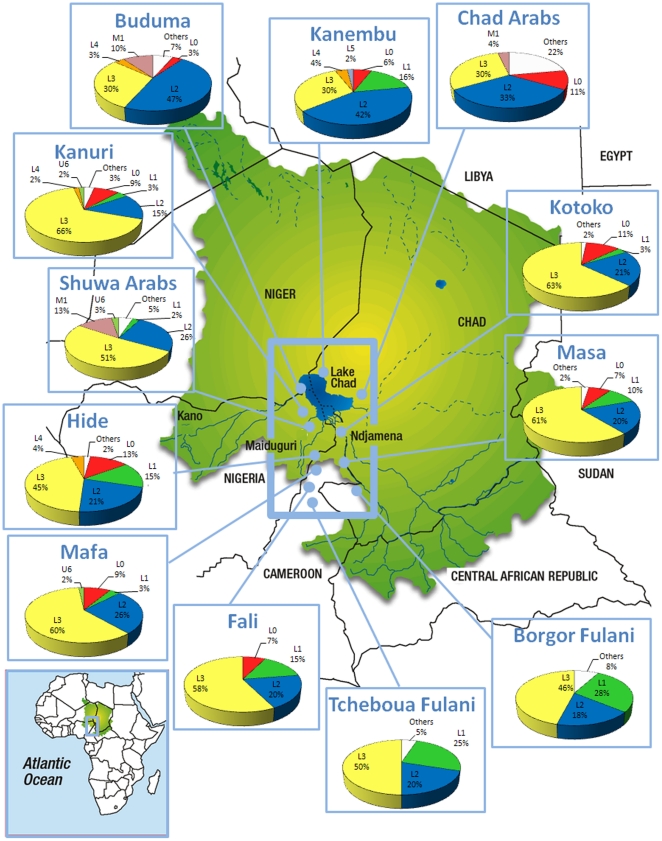
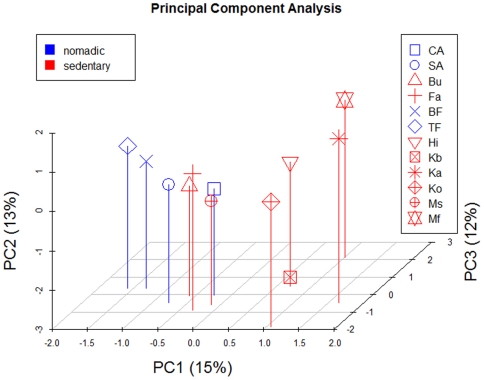
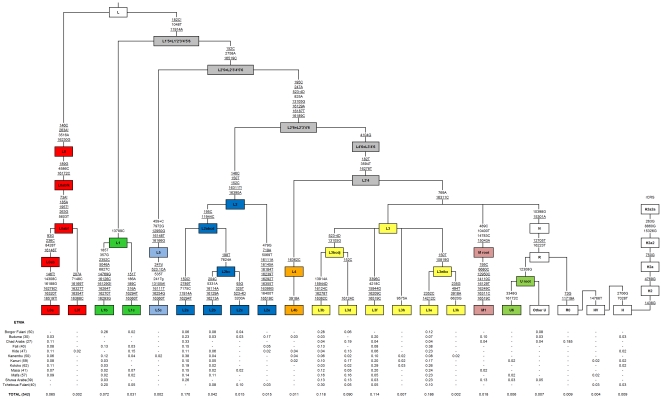
METHODOLOGY/PRINCIPAL FINDINGS: Samples from twelve ethnic groups from the Chad Basin (n = 542) have been high-throughput genotyped for 230 coding region mitochondrial DNA (mtDNA) Single Nucleotide Polymorphisms (mtSNPs) using Matrix-Assisted Laser Desorption/Ionization Time-Of-Flight (MALDI-TOF) mass spectrometry. This set of mtSNPs allowed for much better phylogenetic resolution than previous studies of this geographic region, enabling new insights into its population history. Notable haplogroup (hg) heterogeneity has been observed in the Chad Basin mirroring the different demographic histories of these ethnic groups. As estimated using a Bayesian framework, nomadic populations showed negative growth which was not always correlated to their estimated effective population sizes. Nomads also showed lower diversity values than sedentary groups.
CONCLUSIONS/SIGNIFICANCE: Compared to sedentary population, nomads showed signals of stronger genetic drift occurring in their ancestral populations. These populations, however, retained more haplotype diversity in their hypervariable segments I (HVS-I), but not their mtSNPs, suggesting a more ancestral ethnogenesis. Whereas the nomadic population showed a higher Mediterranean influence signaled mainly by sub-lineages of M1, R0, U6, and U5, the other populations showed a more consistent sub-Saharan pattern. Although lifestyle may have an influence on diversity patterns and hg composition, analysis of molecular variance has not identified these differences. The present study indicates that analysis of mtSNPs at high resolution could be a fast and extensive approach for screening variation in population studies where labor-intensive techniques such as entire genome sequencing remain unfeasible.
乍得盆地位于苏丹带,形成了一个显著的生态系统,发展出了几种独特的农业和畜牧业技术。从考古学和遗传学的角度来看,该地区被认为是连接西非和东非的双向走廊的中心,也是来自北非通过撒哈拉沙漠的人群的交汇点。
方法/主要发现:对乍得盆地 12 个民族的 542 人进行了高通量基因分型,使用基质辅助激光解吸/电离时间飞行(MALDI-TOF)质谱法对 230 个编码区线粒体 DNA(mtDNA)单核苷酸多态性(mtSNP)进行了检测。这组 mtSNP 比以前对该地理区域的研究提供了更好的系统发育分辨率,使我们对其人口历史有了新的认识。乍得盆地的显著单倍群(hg)异质性反映了这些民族不同的人口历史。使用贝叶斯框架估计,游牧人口显示出负增长,这并不总是与其估计的有效种群大小相关。游牧人口的多样性值也低于定居群体。
结论/意义:与定居人口相比,游牧人口显示出其祖先群体中发生的更强遗传漂变的信号。然而,这些群体在其高变区 I(HVS-I)中保留了更多的单倍型多样性,但在其 mtSNP 中没有,这表明其民族起源更为古老。虽然生活方式可能对多样性模式和 hg 组成有影响,但分析分子方差并未发现这些差异。本研究表明,在劳动密集型技术如全基因组测序不可行的人群研究中,高分辨率 mtSNP 分析可以是一种快速而广泛的筛选变异的方法。