Department of Behavioural Biology, University of Vienna, Vienna, Austria.
PLoS One. 2011 Apr 12;6(4):e18511. doi: 10.1371/journal.pone.0018511.
The weberian apparatus of otophysine fishes facilitates sound transmission from the swimbladder to the inner ear to increase hearing sensitivity. It has been of great interest to biologists since the 19(th) century. No studies, however, are available on the development of the weberian ossicles and its effect on the development of hearing in catfishes.
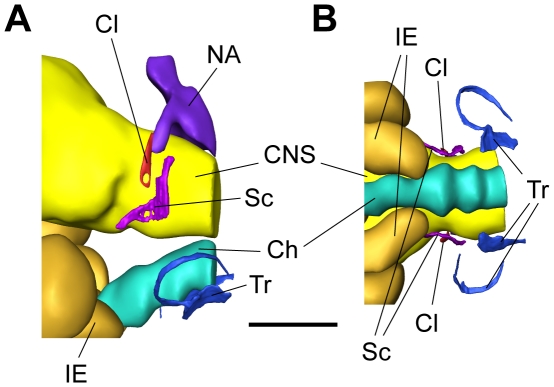
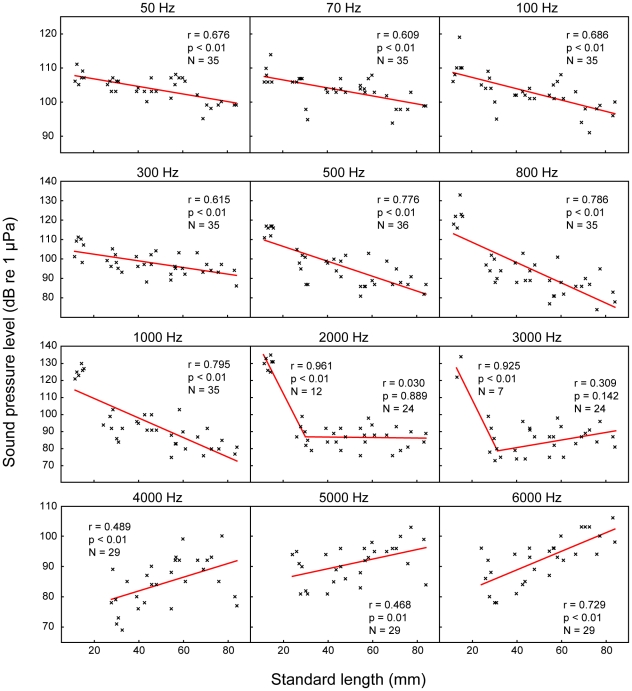
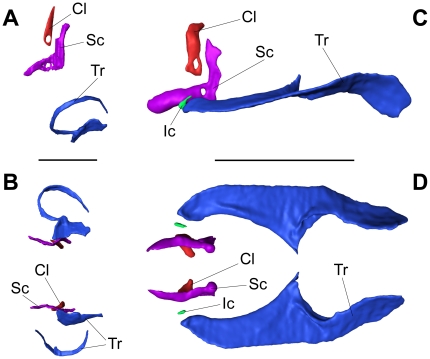
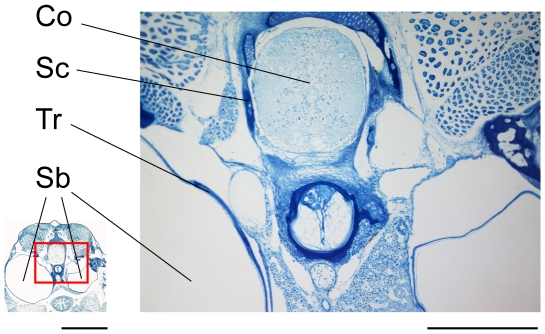
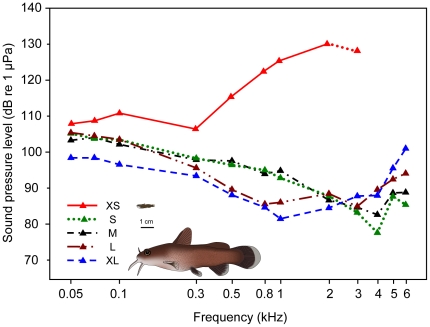
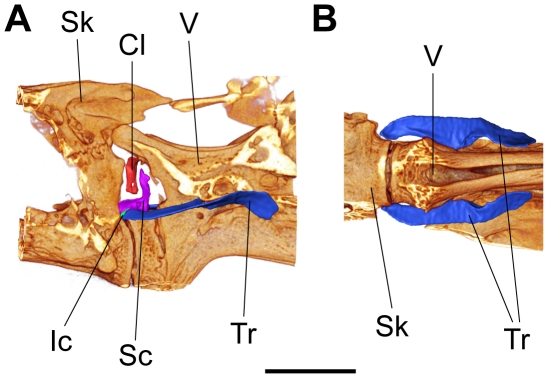
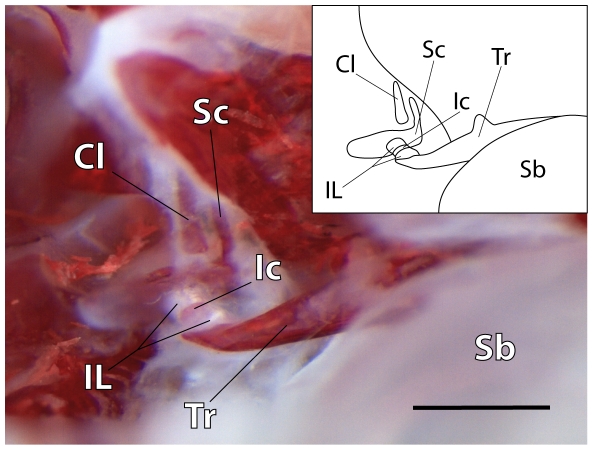
METHODOLOGY/PRINCIPAL FINDINGS: We investigated the development of the weberian apparatus and auditory sensitivity in the catfish Lophiobagrus cyclurus. Specimens from 11.3 mm to 85.5 mm in standard length were studied. Morphology was assessed using sectioning, histology, and X-ray computed tomography, along with 3D reconstruction. Hearing thresholds were measured utilizing the auditory evoked potentials recording technique. Weberian ossicles and interossicular ligaments were fully developed in all stages investigated except in the smallest size group. In the smallest catfish, the intercalarium and the interossicular ligaments were still missing and the tripus was not yet fully developed. Smallest juveniles revealed lowest auditory sensitivity and were unable to detect frequencies higher than 2 or 3 kHz; sensitivity increased in larger specimens by up to 40 dB, and frequency detection up to 6 kHz. In the size groups capable of perceiving frequencies up to 6 kHz, larger individuals had better hearing abilities at low frequencies (0.05-2 kHz), whereas smaller individuals showed better hearing at the highest frequencies (4-6 kHz).
CONCLUSIONS/SIGNIFICANCE: Our data indicate that the ability of otophysine fish to detect sounds at low levels and high frequencies largely depends on the development of the weberian apparatus. A significant increase in auditory sensitivity was observed as soon as all weberian ossicles and interossicular ligaments are present and the chain for transmitting sounds from the swimbladder to the inner ear is complete. This contrasts with findings in another otophysine, the zebrafish, where no threshold changes have been observed.
韦伯氏器是硬骨鱼类的听觉器官,它将鳔内气体压力变化传递给内耳,从而增加听觉敏感度。自 19 世纪以来,它一直引起生物学家的兴趣。然而,目前还没有关于韦伯氏骨和其对鲶形目鱼类听觉发育影响的研究。
方法/主要发现:我们研究了鲶形目鱼类长臀鮠韦伯氏器的发育和听觉敏感度。研究了从 11.3 毫米到 85.5 毫米标准体长的标本。通过切片、组织学和 X 射线计算机断层扫描以及 3D 重建来评估形态。利用听觉诱发电位记录技术测量听觉阈值。除了最小的体型组外,所有研究阶段的韦伯氏骨和骨间韧带都已完全发育。在最小的鲶鱼中,连鳃骨和骨间韧带仍然缺失,三叉骨尚未完全发育。最小的幼鱼表现出最低的听觉敏感度,无法检测到高于 2 或 3 kHz 的频率;随着体型的增大,敏感度增加了 40 dB,频率检测范围增加到 6 kHz。在能够感知高达 6 kHz 频率的体型组中,较大的个体在低频(0.05-2 kHz)时具有更好的听力能力,而较小的个体在最高频率(4-6 kHz)时具有更好的听力能力。
结论/意义:我们的数据表明,韦伯氏器的发育在很大程度上决定了硬骨鱼类探测低频和高频声音的能力。一旦所有的韦伯氏骨和骨间韧带存在,并且将鳔内气体压力变化传递给内耳的链条完整,听觉敏感度就会显著增加。这与另一种硬骨鱼——斑马鱼的发现形成对比,在斑马鱼中没有观察到阈值变化。