Twelves C J, Souhami R L, Harper P G, Ash C M, Spiro S G, Earl H M, Tobias J S, Quinn H, Geddes D M
Clinical Oncology Unit, Guy's Hospital, London, UK.
Br J Cancer. 1990 Jan;61(1):147-50. doi: 10.1038/bjc.1990.30.
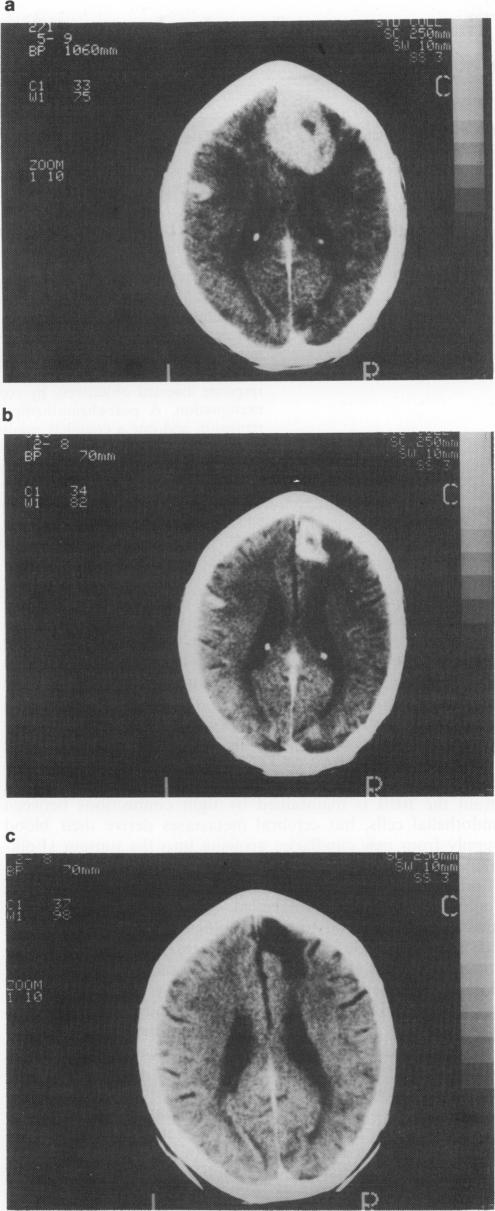
Although small cell lung cancer (SCLC) is very chemosensitive, cerebral metastases are treated with radiotherapy in the belief that they are protected from chemotherapy by the blood-brain barrier (BBB). The validity of this assumption has not been tested in clinical practice. In a randomised trial of treatment in 610 patients with SCLC, 19 patients who had symptomatic cerebral metastases at presentation were treated initially with chemotherapy, and cranial irradiation withheld. Chemotherapy was cyclophosphamide 1 g m-2 i.v. day 1, vincristine 2 mg i.v. day 1 and etoposide 100 mg tds p.o. days 1-3, repeated every 21 days, with response assessed objectively by computerised tomography (CT) or radionuclide brain scan, and by clinical examination. A post-chemotherapy scan was obtained in 14 patients, eight of whom achieved a partial remission and one a complete remission of the cerebral metastases. The radiologically proven responses were sustained and accompanied by rapid neurological improvement. Of the remaining five patients who were assessed by clinical examination alone, one had improved neurological function after chemotherapy. The response rate for SCLC cerebral metastases treated with chemotherapy was therefore 10/19 (53%). Chemotherapy has the advantage over cranial irradiation of simultaneously treating both cerebral metastases and extracranial disease. The place of chemotherapy in the management of cerebral metastases in this and other chemosensitive tumours should be reconsidered since these findings indicate that the BBB does not prevent response to chemotherapy.
尽管小细胞肺癌(SCLC)对化疗非常敏感,但脑转移瘤通常采用放射治疗,原因是人们认为血脑屏障(BBB)会使它们免受化疗的影响。这一假设的有效性在临床实践中尚未得到验证。在一项针对610例SCLC患者的随机治疗试验中,19例初诊时有症状性脑转移瘤的患者首先接受化疗,暂不进行颅脑照射。化疗方案为环磷酰胺1 g m-2静脉注射第1天,长春新碱2 mg静脉注射第1天,依托泊苷100 mg每日3次口服第1 - 3天,每21天重复一次,通过计算机断层扫描(CT)或放射性核素脑扫描以及临床检查客观评估疗效。14例患者进行了化疗后扫描,其中8例脑转移瘤部分缓解,1例完全缓解。经影像学证实的缓解持续存在,并伴有神经功能迅速改善。其余5例仅通过临床检查评估的患者中,1例化疗后神经功能有所改善。因此,采用化疗治疗SCLC脑转移瘤的缓解率为10/19(53%)。化疗优于颅脑照射之处在于它能同时治疗脑转移瘤和颅外疾病。鉴于这些发现表明血脑屏障并不妨碍对化疗的反应,在这种以及其他对化疗敏感的肿瘤的脑转移瘤治疗中,化疗的地位应重新考虑。