Centre for Experimental Medicine and Rheumatology, William Harvey Research Institute, Barts and the London School of Medicine and Dentistry, London EC1M6BQ, England, UK.
J Cell Biol. 2011 May 2;193(3):551-64. doi: 10.1083/jcb.201011051.
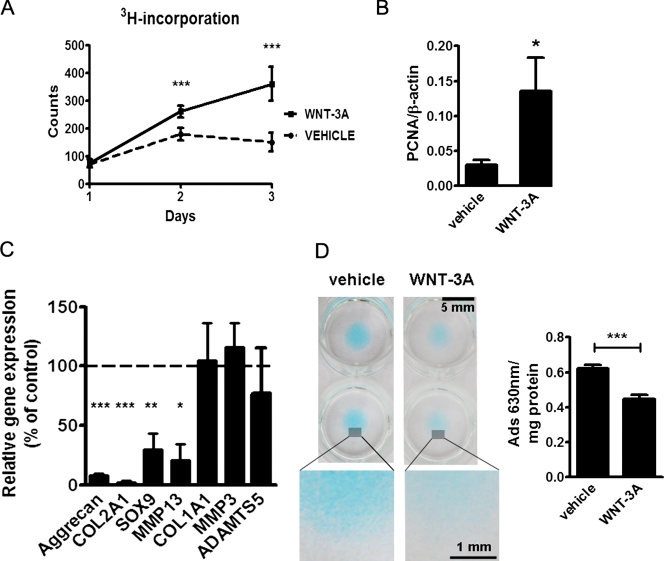
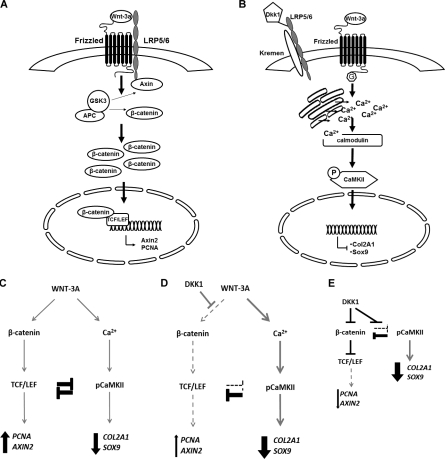
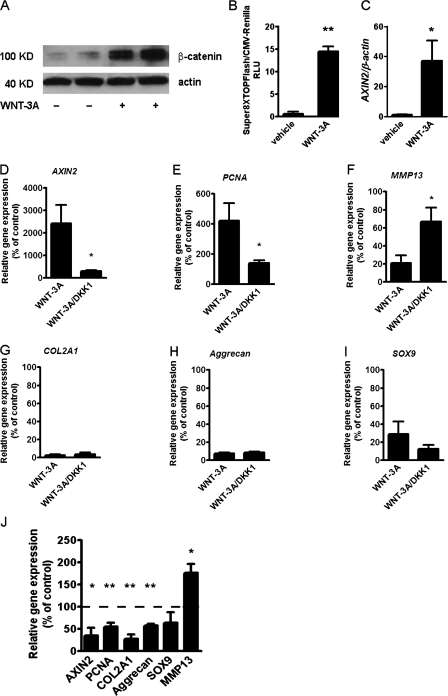
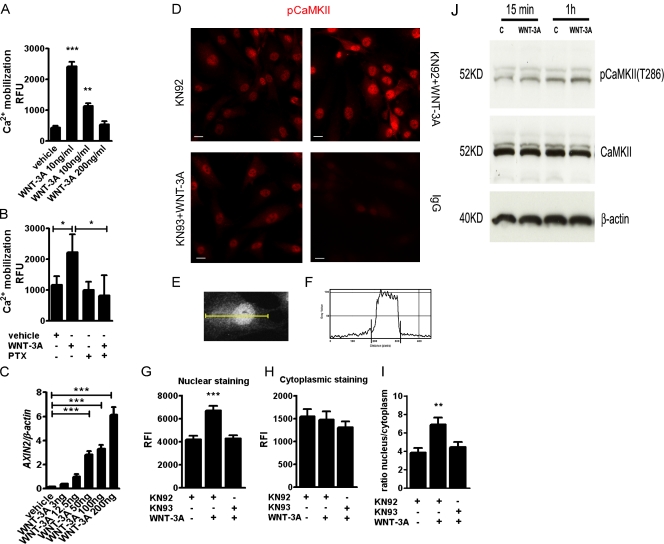
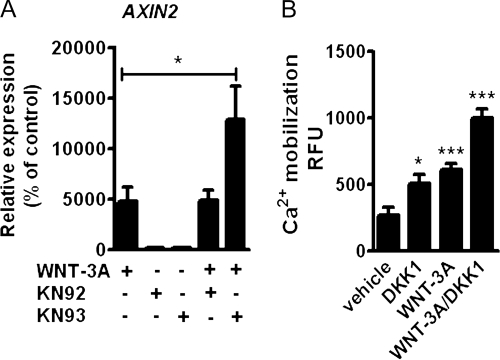
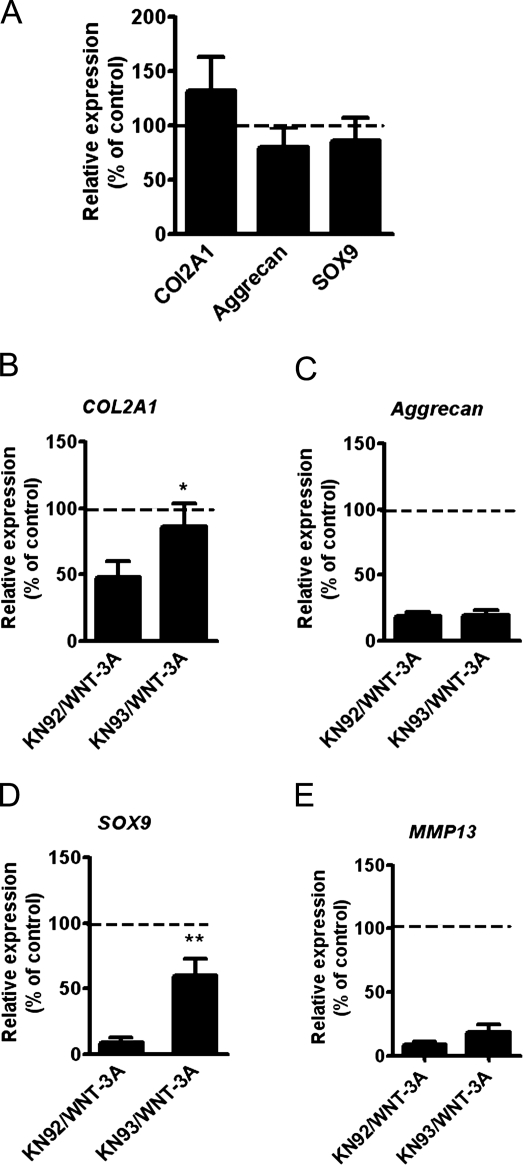
Activation and disruption of Wnt/β-catenin signaling both result in cartilage breakdown via unknown mechanisms. Here we show that both WNT-3A and the Wnt inhibitor DKK1 induced de-differentiation of human articular chondrocytes through simultaneous activation of β-catenin-dependent and independent responses. WNT-3A activates both the β-catenin-dependent canonical pathway and the Ca(2+)/CaMKII noncanonical pathways, with distinct transcriptional targets. WNT-3A promotes cell proliferation and loss of expression of the chondrocyte markers COL2A1, Aggrecan, and SOX9; however, proliferation and AXIN2 up-regulation are downstream of the canonical pathway and are rescued by DKK1, whereas the loss of differentiation markers is CaMKII dependent. Finally, we showed that in chondrocytes, the Ca(2+)/CaMKII-dependent and β-catenin-dependent pathways are reciprocally inhibitory, thereby explaining why DKK1 can induce loss of differentiation through de-repression of the CaMKII pathway. We propose a novel model in which a single WNT can simultaneously activate different pathways with distinct and independent outcomes and with reciprocal regulation. This offers an opportunity for selective pharmacological targeting.
Wnt/β-catenin 信号的激活和中断都会通过未知机制导致软骨分解。在这里,我们表明 WNT-3A 和 Wnt 抑制剂 DKK1 通过同时激活β-catenin 依赖性和非依赖性反应诱导人关节软骨细胞去分化。WNT-3A 激活β-catenin 依赖性经典途径和 Ca(2+)/CaMKII 非经典途径,具有不同的转录靶点。WNT-3A 促进细胞增殖和软骨细胞标志物 COL2A1、聚集蛋白聚糖和 SOX9 的表达丢失;然而,增殖和 AXIN2 的上调是经典途径的下游,可被 DKK1 挽救,而分化标志物的丢失则依赖于 CaMKII。最后,我们表明在软骨细胞中,Ca(2+)/CaMKII 依赖性和β-catenin 依赖性途径是相互抑制的,从而解释了为什么 DKK1 可以通过去抑制 CaMKII 途径诱导分化丢失。我们提出了一个新模型,其中单个 WNT 可以同时激活具有不同和独立结果的不同途径,并进行相互调节。这为选择性的药理学靶向提供了机会。