• 文献检索
  • 文档翻译
  • 深度研究
  • 学术资讯
  • Suppr Zotero 插件Zotero 插件
  • 邀请有礼
  • 套餐&价格
  • 历史记录
应用&插件
Suppr Zotero 插件Zotero 插件浏览器插件Mac 客户端Windows 客户端微信小程序
定价
高级版会员购买积分包购买API积分包
服务
文献检索文档翻译深度研究API 文档MCP 服务
关于我们
关于 Suppr公司介绍联系我们用户协议隐私条款
关注我们

Suppr 超能文献

核心技术专利:CN118964589B侵权必究
粤ICP备2023148730 号-1Suppr @ 2026

文献检索

告别复杂PubMed语法,用中文像聊天一样搜索,搜遍4000万医学文献。AI智能推荐,让科研检索更轻松。

立即免费搜索

文件翻译

保留排版,准确专业,支持PDF/Word/PPT等文件格式,支持 12+语言互译。

免费翻译文档

深度研究

AI帮你快速写综述,25分钟生成高质量综述,智能提取关键信息,辅助科研写作。

立即免费体验

引入沃尔巴克氏体以减少蚊媒疾病传播的策略。

Strategies for introducing Wolbachia to reduce transmission of mosquito-borne diseases.

机构信息

Department of Zoology, University of Oxford, Oxford, United Kingdom.

出版信息

PLoS Negl Trop Dis. 2011 Apr 26;5(4):e1024. doi: 10.1371/journal.pntd.0001024.

DOI:10.1371/journal.pntd.0001024
PMID:21541357
原文链接:https://pmc.ncbi.nlm.nih.gov/articles/PMC3082501/
Abstract

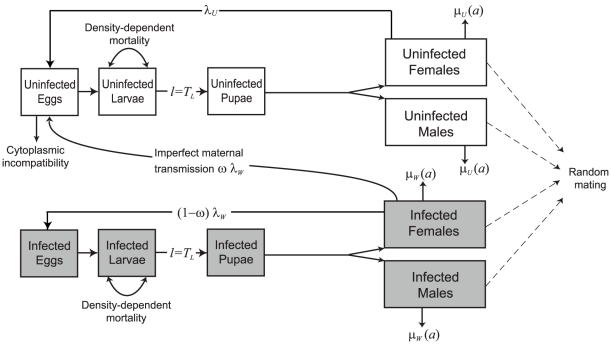
Certain strains of the endosymbiont Wolbachia have the potential to lower the vectorial capacity of mosquito populations and assist in controlling a number of mosquito-borne diseases. An important consideration when introducing Wolbachia-carrying mosquitoes into natural populations is the minimisation of any transient increase in disease risk or biting nuisance. This may be achieved by predominantly releasing male mosquitoes. To explore this, we use a sex-structured model of Wolbachia-mosquito interactions. We first show that Wolbachia spread can be initiated with very few infected females provided the infection frequency in males exceeds a threshold. We then consider realistic introduction scenarios involving the release of batches of infected mosquitoes, incorporating seasonal fluctuations in population size. For a range of assumptions about mosquito population dynamics we find that male-biased releases allow the infection to spread after the introduction of low numbers of females, many fewer than with equal sex-ratio releases. We extend the model to estimate the transmission rate of a mosquito-borne pathogen over the course of Wolbachia establishment. For a range of release strategies we demonstrate that male-biased release of Wolbachia-infected mosquitoes can cause substantial transmission reductions without transiently increasing disease risk. The results show the importance of including mosquito population dynamics in studying Wolbachia spread and that male-biased releases can be an effective and safe way of rapidly establishing the symbiont in mosquito populations.

摘要

某些内共生菌沃尔巴克氏体菌株有可能降低蚊子种群的传播能力,并有助于控制多种蚊媒疾病。在将携带沃尔巴克氏体的蚊子引入自然种群时,一个重要的考虑因素是尽量减少疾病风险或叮咬滋扰的短暂增加。这可以通过主要释放雄性蚊子来实现。为了探索这一点,我们使用了沃尔巴克氏体与蚊子相互作用的结构模型。我们首先表明,只要雄性的感染频率超过一个阈值,就可以用非常少的感染雌性来启动沃尔巴克氏体的传播。然后,我们考虑了涉及释放一批感染蚊子的现实引入场景,其中包括种群大小的季节性波动。对于关于蚊子种群动态的一系列假设,我们发现,与雌雄比例相等的释放相比,雄性偏倚的释放允许在引入少量雌性后传播感染,所需的雌性数量要少得多。我们将模型扩展到估计在沃尔巴克氏体建立过程中蚊媒病原体的传播率。对于一系列释放策略,我们证明,雄性偏倚释放感染沃尔巴克氏体的蚊子可以在不短暂增加疾病风险的情况下,显著降低传播风险。研究结果表明,在研究沃尔巴克氏体传播时,必须考虑蚊子种群动态,并且雄性偏倚释放可以成为在蚊子种群中快速建立共生体的有效和安全方法。
https://cdn.ncbi.nlm.nih.gov/pmc/blobs/ca9c/3082501/4f798dbc0bcf/pntd.0001024.g005.jpg
https://cdn.ncbi.nlm.nih.gov/pmc/blobs/ca9c/3082501/7ffac17bc925/pntd.0001024.g001.jpg
https://cdn.ncbi.nlm.nih.gov/pmc/blobs/ca9c/3082501/386a45454fdb/pntd.0001024.g002.jpg
https://cdn.ncbi.nlm.nih.gov/pmc/blobs/ca9c/3082501/b18bde81a71f/pntd.0001024.g003.jpg
https://cdn.ncbi.nlm.nih.gov/pmc/blobs/ca9c/3082501/0f72aef829a1/pntd.0001024.g004.jpg
https://cdn.ncbi.nlm.nih.gov/pmc/blobs/ca9c/3082501/4f798dbc0bcf/pntd.0001024.g005.jpg
https://cdn.ncbi.nlm.nih.gov/pmc/blobs/ca9c/3082501/7ffac17bc925/pntd.0001024.g001.jpg
https://cdn.ncbi.nlm.nih.gov/pmc/blobs/ca9c/3082501/386a45454fdb/pntd.0001024.g002.jpg
https://cdn.ncbi.nlm.nih.gov/pmc/blobs/ca9c/3082501/b18bde81a71f/pntd.0001024.g003.jpg
https://cdn.ncbi.nlm.nih.gov/pmc/blobs/ca9c/3082501/0f72aef829a1/pntd.0001024.g004.jpg
https://cdn.ncbi.nlm.nih.gov/pmc/blobs/ca9c/3082501/4f798dbc0bcf/pntd.0001024.g005.jpg

相似文献

1
Strategies for introducing Wolbachia to reduce transmission of mosquito-borne diseases.引入沃尔巴克氏体以减少蚊媒疾病传播的策略。
PLoS Negl Trop Dis. 2011 Apr 26;5(4):e1024. doi: 10.1371/journal.pntd.0001024.
2
Models to assess the effects of non-identical sex ratio augmentations of Wolbachia-carrying mosquitoes on the control of dengue disease.评估携带沃尔巴克氏体的蚊子非同源性别比例增加对登革热控制影响的模型。
Math Biosci. 2018 May;299:58-72. doi: 10.1016/j.mbs.2018.03.003. Epub 2018 Mar 9.
3
Optimal control approach for establishing wMelPop Wolbachia infection among wild Aedes aegypti populations.在野生埃及伊蚊种群中建立wMelPop沃尔巴克氏体感染的最优控制方法。
J Math Biol. 2018 Jun;76(7):1907-1950. doi: 10.1007/s00285-018-1213-2. Epub 2018 Feb 10.
4
Wolbachia and dengue virus infection in the mosquito Aedes fluviatilis (Diptera: Culicidae).河流伊蚊(双翅目:蚊科)中的沃尔巴克氏体与登革病毒感染
PLoS One. 2017 Jul 21;12(7):e0181678. doi: 10.1371/journal.pone.0181678. eCollection 2017.
5
The potential of virulent Wolbachia to modulate disease transmission by insects.致病性沃尔巴克氏体调控昆虫疾病传播的潜力。
J Invertebr Pathol. 2003 Sep;84(1):24-9. doi: 10.1016/s0022-2011(03)00082-x.
6
wFlu: characterization and evaluation of a native Wolbachia from the mosquito Aedes fluviatilis as a potential vector control agent.wFlu:对本地沃尔巴克氏体(Aedes fluviatilis 蚊种)的特性描述和评估,作为一种有潜力的病媒控制剂。
PLoS One. 2013;8(3):e59619. doi: 10.1371/journal.pone.0059619. Epub 2013 Mar 26.
7
Mosquito Control Based on Pesticides and Endosymbiotic Bacterium Wolbachia.基于农药和共生细菌沃尔巴克氏体的蚊虫控制。
Bull Math Biol. 2021 Apr 13;83(5):58. doi: 10.1007/s11538-021-00881-9.
8
Dynamics of a two-sex model for the population ecology of dengue mosquitoes in the presence of Wolbachia.存在沃尔巴克氏体时登革热蚊子种群生态学的两性别模型动力学。
Math Biosci. 2020 Oct;328:108426. doi: 10.1016/j.mbs.2020.108426. Epub 2020 Jul 23.
9
Wolbachia infection in wild mosquitoes (Diptera: Culicidae): implications for transmission modes and host-endosymbiont associations in Singapore.野生蚊子(双翅目:蚊科)中的沃尔巴克氏体感染:对新加坡传播模式和宿主-内共生体关系的影响。
Parasit Vectors. 2020 Dec 9;13(1):612. doi: 10.1186/s13071-020-04466-8.
10
Predicting Wolbachia invasion dynamics in Aedes aegypti populations using models of density-dependent demographic traits.利用密度依赖人口统计学特征模型预测埃及伊蚊种群中沃尔巴克氏体的入侵动态。
BMC Biol. 2016 Nov 8;14(1):96. doi: 10.1186/s12915-016-0319-5.

引用本文的文献

1
Comparative Endosymbiont Community Structures of Nonviruliferous and Rice Stripe Virus-Viruliferous (Hemiptera: Delphacidae) in Korea.韩国非带毒及带水稻条纹病毒(半翅目:飞虱科)内共生菌群落结构的比较
Viruses. 2025 Aug 1;17(8):1074. doi: 10.3390/v17081074.
2
Using models and maps to inform Target Product Profiles and Preferred Product Characteristics: the example of replacement.利用模型和图谱来为目标产品概况和首选产品特性提供信息:以替代疗法为例。
Gates Open Res. 2024 Oct 31;7:68. doi: 10.12688/gatesopenres.14300.3. eCollection 2023.
3
Genomic Underpinnings of Cytoplasmic Incompatibility: CIF Gene-Neighborhood Diversification Through Extensive Lateral Transfers and Recombination in Wolbachia.

本文引用的文献

1
EVOLUTION OF INCOMPATIBILITY-INDUCING MICROBES AND THEIR HOSTS.诱导不相容性的微生物及其宿主的进化
Evolution. 1994 Oct;48(5):1500-1513. doi: 10.1111/j.1558-5646.1994.tb02192.x.
2
Population dynamic models of the spread of Wolbachia.沃尔巴克氏体传播的种群动态模型。
Am Nat. 2011 Mar;177(3):323-33. doi: 10.1086/658121.
3
Wolbachia stimulates immune gene expression and inhibits plasmodium development in Anopheles gambiae.沃尔巴克氏体能刺激冈比亚按蚊的免疫基因表达并抑制疟原虫发育。
细胞质不亲和性的基因组基础:沃尔巴克氏体中通过广泛的水平转移和重组导致 CIF 基因邻近区域多样化。
Genome Biol Evol. 2024 Aug 5;16(8). doi: 10.1093/gbe/evae171.
4
Wolbachia confers protection against the entomopathogenic fungus Metarhizium pingshaense in African Aedes aegypti.沃尔巴克氏体赋予非洲埃及伊蚊对昆虫病原真菌平沙淡紫拟青霉的抗性。
Environ Microbiol Rep. 2024 Aug;16(4):e13316. doi: 10.1111/1758-2229.13316.
5
Gene drives: an alternative approach to malaria control?基因驱动:控制疟疾的另一种方法?
Gene Ther. 2025 Jan;32(1):25-37. doi: 10.1038/s41434-024-00468-8. Epub 2024 Jul 22.
6
Variation of endosymbiont and (CTV) titers in the Huanglongbing insect vector, on CTV-infected plants.黄龙病昆虫传播媒介体内内共生菌及柑橘速衰病毒(CTV)滴度在感染CTV的植株上的变化情况 。
Front Microbiol. 2023 Sep 22;14:1236731. doi: 10.3389/fmicb.2023.1236731. eCollection 2023.
7
First Detection and Genetic Identification of Endosymbiont in Field-Caught (Diptera: Culicidae) Mosquitoes Collected from Southern Taiwan.首次在台湾南部采集的野外捕获(双翅目:蚊科)蚊子中检测到内共生菌并进行基因鉴定。
Microorganisms. 2023 Jul 27;11(8):1911. doi: 10.3390/microorganisms11081911.
8
Tolerance-conferring defensive symbionts and the evolution of parasite virulence.赋予耐受性的防御性共生体与寄生虫毒力的进化
Evol Lett. 2023 May 5;7(4):262-272. doi: 10.1093/evlett/qrad015. eCollection 2023 Aug.
9
The Dynamic Distribution of and in AsiaII1 .亚洲II1中 和 的动态分布
Insects. 2023 Apr 21;14(4):401. doi: 10.3390/insects14040401.
10
The phylogeny and distribution of in two pathogen vector insects, Asian citrus psyllid and Longan psyllid.在两种病原体传播昆虫(亚洲柑橘木虱和龙眼木虱)中 的系统发育和分布。
Front Cell Infect Microbiol. 2023 Mar 6;13:1121186. doi: 10.3389/fcimb.2023.1121186. eCollection 2023.
PLoS Pathog. 2010 Oct 7;6(10):e1001143. doi: 10.1371/journal.ppat.1001143.
4
Forcing versus feedback: epidemic malaria and monsoon rains in northwest India.强制与反馈:印度西北部的流行疟疾与季风降雨。
PLoS Comput Biol. 2010 Sep 2;6(9):e1000898. doi: 10.1371/journal.pcbi.1000898.
5
Aestivation of the African malaria mosquito, Anopheles gambiae in the Sahel.撒哈拉地区非洲疟蚊(冈比亚按蚊)的夏眠
Am J Trop Med Hyg. 2010 Sep;83(3):601-6. doi: 10.4269/ajtmh.2010.09-0779.
6
The endosymbiotic bacterium Wolbachia induces resistance to dengue virus in Aedes aegypti.共生细菌沃尔巴克氏体可诱导埃及伊蚊抵抗登革病毒。
PLoS Pathog. 2010 Apr 1;6(4):e1000833. doi: 10.1371/journal.ppat.1000833.
7
A Wolbachia symbiont in Aedes aegypti limits infection with dengue, Chikungunya, and Plasmodium.埃及伊蚊中的共生菌沃尔巴克氏体限制登革热、基孔肯雅热和疟原虫感染。
Cell. 2009 Dec 24;139(7):1268-78. doi: 10.1016/j.cell.2009.11.042.
8
Insecticide resistance in Anopheles gambiae: data from the first year of a multi-country study highlight the extent of the problem.冈比亚按蚊的杀虫剂抗性:多国研究第一年的数据凸显了问题的严重程度。
Malar J. 2009 Dec 17;8:299. doi: 10.1186/1475-2875-8-299.
9
Characterizing the Aedes aegypti population in a Vietnamese village in preparation for a Wolbachia-based mosquito control strategy to eliminate dengue.描述越南某村庄伊蚊种群特征,为基于沃尔巴克氏体的蚊媒控制策略消除登革热做准备。
PLoS Negl Trop Dis. 2009 Nov 24;3(11):e552. doi: 10.1371/journal.pntd.0000552.
10
Variation in antiviral protection mediated by different Wolbachia strains in Drosophila simulans.不同沃尔巴克氏体菌株介导的果蝇 simulans 抗病毒保护的变异。
PLoS Pathog. 2009 Nov;5(11):e1000656. doi: 10.1371/journal.ppat.1000656. Epub 2009 Nov 13.