Kumar Vikash
Department of Biosciences and Bioengineering, Indian Institute of Technology Bombay, Powai, Mumbai 400076, India.
Bioinformation. 2011 Mar 26;6(2):61-3. doi: 10.6026/97320630006061.
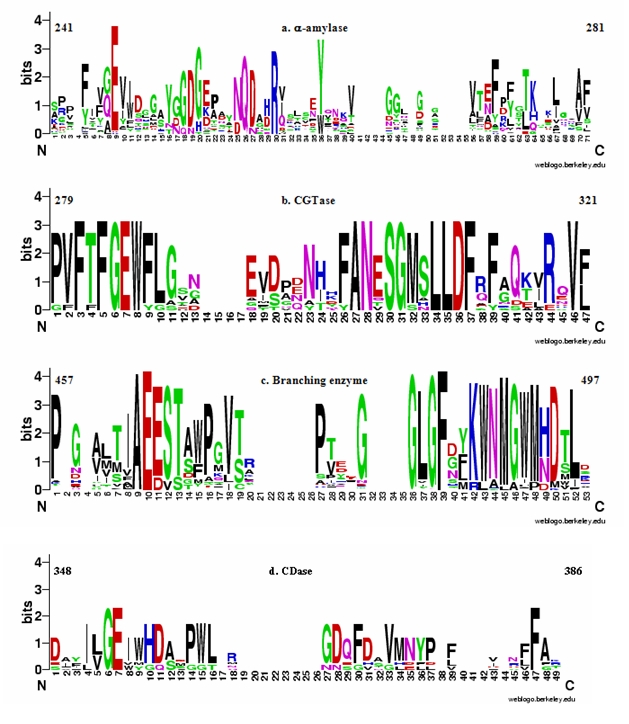
A bioinformatics analysis of sequences of enzymes of the glycoside hydrolase (GH) 13 family members such as α-amylase, cyclodextrin glycosyltransferase (CGTase), branching enzyme and cyclomaltodextrinase has been carried out in order to find out the sequence motifs that govern the reactions specificities of these enzymes by using hidden Markov model (HMM) profile. This analysis suggests the existence of such sequence motifs and residues of these motifs constituting the -1 to +3 catalytic subsites of the enzyme. Hence, by introducing mutations in the residues of these four subsites, one can change the reaction specificities of the enzymes. In general it has been observed that α -amylase sequence motif have low sequence conservation than rest of the motifs of the GH13 family members.
为了通过使用隐马尔可夫模型(HMM)概况找出控制糖苷水解酶(GH)13家族成员(如α-淀粉酶、环糊精糖基转移酶(CGTase)、分支酶和环麦芽糊精酶)的酶序列的反应特异性的序列基序,已经对这些酶的序列进行了生物信息学分析。该分析表明存在这样的序列基序以及构成酶的-1至+3催化亚位点的这些基序的残基。因此,通过在这四个亚位点的残基中引入突变,可以改变酶的反应特异性。一般观察到,与GH13家族其他成员的基序相比,α-淀粉酶序列基序的序列保守性较低。