Department of Internal Medicine, Medical University of Vienna, Währinger Gürtel 18-20, 1090 Vienna, Austria.
Infection. 2011 Aug;39(4):341-52. doi: 10.1007/s15010-011-0121-9. Epub 2011 May 5.
To describe the clinical features, risk factors for severe disease and effectiveness of oseltamivir in patients with 2009 pandemic influenza A (H1N1) virus infection.
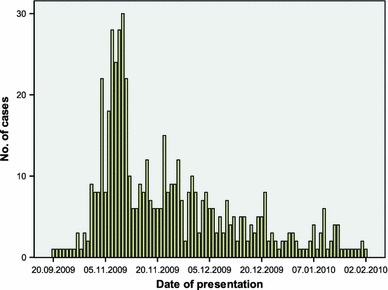
In a prospective, cross-sectional, multicentre study, data on 540 patients with confirmed 2009 H1N1 infection from seven Austrian hospitals were collected using a standardised online case-history form.
The median age of the patients was 19.3 years (range 26 days-90.8 years); point-of-care testing yielded false-negative results in 60.2% of the 176 cases tested. The most common symptoms were fever, cough, fatigue and headache. Overall, 343 patients (63.5%) were hospitalised, 49 (9.1%) were admitted to an intensive care unit (ICU) and 14 (4.1%) died. Case fatality rates were highest (9.1%) in those aged 65 years or older. Factors significantly associated with a higher risk for ICU admission included age, neurological disease, adipositas, and both interstitial pathology and lobular pathology on chest X-ray. No association with pregnancy, malignancy or immunosuppressive therapy was detected. Antiviral treatment significantly reduced the duration of fever by 0.66 days and lowered the risk of ICU admission, but had no significant benefit on survival.
During the 2009 H1N1 influenza pandemic, elderly or obese patients and those with neurological disease had an increased risk for severe H1N1 infection in Austria. Pregnancy was not associated with a higher risk for severe disease in the later phase of the 2009 H1N1 pandemic. Antiviral treatment provided a minimal effect on the symptoms of influenza but reduced the risk of admission to an ICU.
描述 2009 年甲型 H1N1 流感病毒感染患者的临床特征、重症疾病的危险因素和奥司他韦的疗效。
在一项前瞻性、横断面、多中心研究中,使用标准化的在线病历表,从奥地利的七家医院收集了 540 例确诊为 2009 年 H1N1 感染患者的数据。
患者的中位年龄为 19.3 岁(范围为 26 天至 90.8 岁);在 176 例接受检测的病例中,即时检测结果有 60.2%为假阴性。最常见的症状是发热、咳嗽、疲劳和头痛。总的来说,343 例(63.5%)患者住院,49 例(9.1%)患者入住重症监护病房(ICU),14 例(4.1%)患者死亡。年龄在 65 岁或以上的患者病死率最高(9.1%)。与 ICU 入院风险较高显著相关的因素包括年龄、神经系统疾病、肥胖症,以及胸部 X 光片上的间质性和小叶性病理。未发现与妊娠、恶性肿瘤或免疫抑制治疗有关。抗病毒治疗可使发热持续时间平均缩短 0.66 天,并降低 ICU 入院风险,但对生存无显著获益。
在 2009 年 H1N1 流感大流行期间,奥地利的老年或肥胖患者以及患有神经系统疾病的患者发生严重 H1N1 感染的风险增加。在 2009 年 H1N1 大流行的后期,妊娠与严重疾病的风险增加无关。抗病毒治疗对流感症状有轻微影响,但降低了入住 ICU 的风险。