Department of Psychiatry and Psychotherapy, Friedrich-Alexander University of Erlangen-Nuremberg, Erlangen, Germany.
PLoS One. 2011 Apr 25;6(4):e19332. doi: 10.1371/journal.pone.0019332.
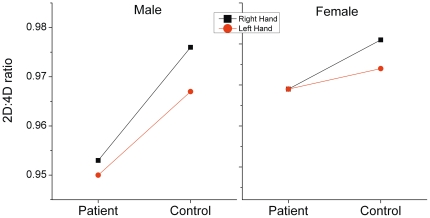
The ratio of the lengths of the second and fourth finger (2D∶4D) has been described as reflecting the degree of prenatal androgen exposure in humans. 2D∶4D is smaller for males than females and is associated with traits such as left-handedness, physical aggression, attention-deficit-hyperactivity disorder and a genetic polymorphism of the androgen receptor. All of these traits are known to be correlated to the vulnerability for alcohol dependency. We therefore hypothesized low 2D∶4D in patients with alcohol dependency. In the present study on 131 patients suffering from alcohol dependency and 185 healthy volunteers, we found that alcohol dependent patients had smaller 2D∶4D ratios compared to controls with preserved sexual dimorphism but with reduced right-left differences. The detection of alcohol dependency based on 2D∶4D ratios was most accurate using the right hand of males (ROC-analysis: AUC 0.725, sensitivity 0.667, specificity 0.723). These findings provide novel insights into the role of prenatal androgen exposure in the development of alcohol dependency and for the use of 2D∶4D as a possible trait marker in identifying patients with alcohol dependency.
第二和第四指的长度比(2D∶4D)被描述为反映人类产前雄激素暴露的程度。男性的 2D∶4D 比女性小,与左撇子、身体攻击性、注意力缺陷多动障碍和雄激素受体的遗传多态性等特征有关。所有这些特征都与酒精依赖的易感性有关。因此,我们假设酒精依赖患者的 2D∶4D 较低。在本研究中,我们对 131 名酒精依赖患者和 185 名健康志愿者进行了研究,发现与对照组相比,酒精依赖患者的 2D∶4D 比值较小,性二态性保持不变,但左右差异减小。使用男性右手,基于 2D∶4D 比值检测酒精依赖的准确性最高(ROC 分析:AUC 为 0.725,灵敏度为 0.667,特异性为 0.723)。这些发现为产前雄激素暴露在酒精依赖发展中的作用以及 2D∶4D 作为识别酒精依赖患者的可能特征标志物提供了新的见解。