School of Agriculture and Food Science, The University of Queensland, St Lucia, Queensland, Australia.
PLoS One. 2011 Apr 28;6(4):e19045. doi: 10.1371/journal.pone.0019045.
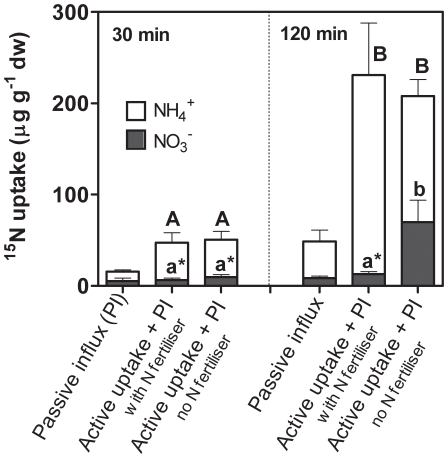
Modern agriculture is based on the notion that nitrate is the main source of nitrogen (N) for crops, but nitrate is also the most mobile form of N and easily lost from soil. Efficient acquisition of nitrate by crops is therefore a prerequisite for avoiding off-site N pollution. Sugarcane is considered the most suitable tropical crop for biofuel production, but surprisingly high N fertilizer applications in main producer countries raise doubt about the sustainability of production and are at odds with a carbon-based crop. Examining reasons for the inefficient use of N fertilizer, we hypothesized that sugarcane resembles other giant tropical grasses which inhibit the production of nitrate in soil and differ from related grain crops with a confirmed ability to use nitrate. The results of our study support the hypothesis that N-replete sugarcane and ancestral species in the Andropogoneae supertribe strongly prefer ammonium over nitrate. Sugarcane differs from grain crops, sorghum and maize, which acquired both N sources equally well, while giant grass, Erianthus, displayed an intermediate ability to use nitrate. We conclude that discrimination against nitrate and a low capacity to store nitrate in shoots prevents commercial sugarcane varieties from taking advantage of the high nitrate concentrations in fertilized soils in the first three months of the growing season, leaving nitrate vulnerable to loss. Our study addresses a major caveat of sugarcane production and affords a strong basis for improvement through breeding cultivars with enhanced capacity to use nitrate as well as through agronomic measures that reduce nitrification in soil.
现代农业基于硝酸盐是作物氮(N)的主要来源这一概念,但硝酸盐也是最具流动性的 N 形式,很容易从土壤中流失。因此,作物高效获取硝酸盐是避免非点源 N 污染的前提。甘蔗被认为是最适合生产生物燃料的热带作物,但主要生产国高浓度的氮肥应用令人怀疑其生产的可持续性,并且与以碳为基础的作物背道而驰。在研究氮肥利用效率低下的原因时,我们假设甘蔗类似于其他巨型热带草类,它们抑制了土壤中硝酸盐的产生,与已确认有能力利用硝酸盐的相关谷物作物不同。我们研究的结果支持了以下假设:氮充足的甘蔗和 Andropogoneae 超科的祖先物种强烈偏爱铵而不是硝酸盐。甘蔗与谷物作物高粱和玉米不同,它们同样能很好地利用这两种氮源,而巨型草类大黍则表现出中等的硝酸盐利用能力。我们得出的结论是,对硝酸盐的歧视和在 shoots 中储存硝酸盐的能力低,阻止了商业甘蔗品种在生长季节的前三个月充分利用施肥土壤中高浓度的硝酸盐,使硝酸盐容易流失。我们的研究解决了甘蔗生产的一个主要难题,并为通过培育具有增强利用硝酸盐能力的品种以及通过减少土壤硝化的农业措施来提高甘蔗生产提供了坚实的基础。