Department of Psychology, Stanford University, USA.
J Abnorm Psychol. 2012 May;121(2):297-308. doi: 10.1037/a0023533. Epub 2011 May 9.
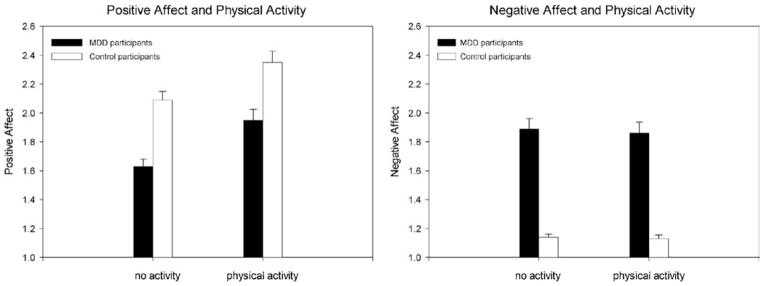
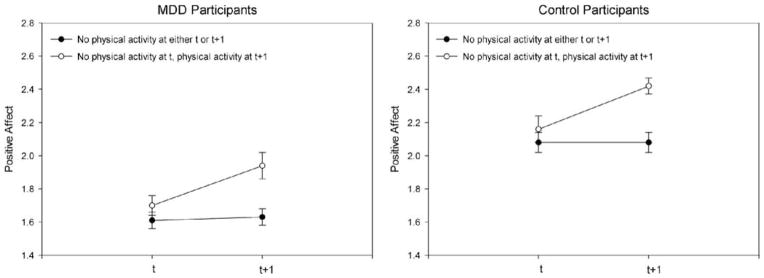
Although prescribed exercise has been found to improve affect and reduce levels of depression, we do not know how self-initiated everyday physical activity influences levels of positive affect (PA) and negative affect (NA) in depressed persons. Fifty-three individuals diagnosed with Major Depressive Disorder (MDD) and 53 never-depressed controls participated in a seven-day experience sampling study. Participants were prompted randomly eight times per day and answered questions about their physical activity and affective state. Over the week, the two groups of participants did not differ in average level of physical activity. As expected, participants with MDD reported lower average PA and higher average NA than did never-depressed controls. Both participants with MDD and controls reported higher levels of PA at prompts after physical activity than at prompts after inactive periods; moreover, for both groups of participants, PA increased from a prompt after an inactive period to a subsequent prompt at which activity was reported. Depressed participants in particular showed a dose-response effect of physical activity on affect: longer duration and/or higher intensity of physical activity increased their PA significantly more than did short duration and/or lower intensity physical activity. Physical activity did not influence NA in either group. In contrast to previous treatment studies that examined the effects of prescribed structured exercise, this investigation showed that self-initiated physical activity influences PA. These findings also underscore the importance of distinguishing between PA and NA to gain a more comprehensive understanding of the effects of physical activity on affect in MDD.
虽然规定的运动已被发现可以改善情绪并降低抑郁水平,但我们不知道自发的日常体育活动如何影响抑郁患者的积极情绪 (PA) 和消极情绪 (NA) 水平。53 名被诊断患有重度抑郁症 (MDD) 的患者和 53 名从未抑郁过的对照组参与者参加了为期七天的体验抽样研究。参与者每天随机收到 8 次提示,并回答有关其体育活动和情绪状态的问题。在一周内,两组参与者的平均体力活动水平没有差异。正如预期的那样,与从未抑郁过的对照组相比,患有 MDD 的参与者报告的平均 PA 较低,NA 较高。MDD 患者和对照组参与者在体力活动后的提示中报告的 PA 水平均高于无活动期后的提示;此外,对于两组参与者,PA 从无活动期后的提示增加到随后报告活动的提示。特别是抑郁患者表现出体力活动对情绪的剂量反应效应:体力活动的持续时间更长和/或强度更高,比持续时间短和/或强度低的体力活动更能显著提高 PA。体力活动对两组参与者的 NA 均无影响。与之前研究规定的结构化运动对治疗效果的研究不同,这项研究表明,自发的体育活动会影响 PA。这些发现还强调了区分 PA 和 NA 的重要性,以更全面地了解体力活动对 MDD 中情绪的影响。