Department of Environmental Health, University of Alabama at Birmingham, Birmingham, Alabama, 35294 USA.
Environ Health Perspect. 2011 Aug;119(8):1062-9. doi: 10.1289/ehp.1103507. Epub 2011 May 12.
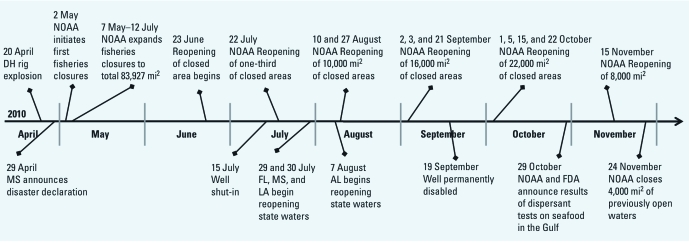
The Deepwater Horizon (DH) blowout resulted in fisheries closings across the Gulf of Mexico. Federal agencies, in collaboration with impacted Gulf states, developed a protocol to determine when it is safe to reopen fisheries based on sensory and chemical analyses of seafood. All federal waters have been reopened, yet concerns have been raised regarding the robustness of the protocol to identify all potential harmful exposures and protect the most sensitive populations.
We aimed to assess this protocol based on comparisons with previous oil spills, published testing results, and current knowledge regarding chemicals released during the DH oil spill.
We performed a comprehensive review of relevant scientific journal articles and government documents concerning seafood contamination and oil spills and consulted with academic and government experts.
Protocols to evaluate seafood safety before reopening fisheries have relied on risk assessment of health impacts from polycyclic aromatic hydrocarbon (PAH) exposures, but metal contamination may also be a concern. Assumptions used to determine levels of concern (LOCs) after oil spills have not been consistent across risk assessments performed after oil spills. Chemical testing results after the DH oil spill suggest PAH levels are at or below levels reported after previous oil spills, and well below LOCs, even when more conservative parameters are used to estimate risk.
We recommend use of a range of plausible risk parameters to set bounds around LOCs, comparisons of post-spill measurements with baseline levels, and the development and implementation of long-term monitoring strategies for metals as well as PAHs and dispersant components. In addition, the methods, results, and uncertainties associated with estimating seafood safety after oil spills should be communicated in a transparent and timely manner, and stakeholders should be actively involved in developing a long-term monitoring strategy.
深水地平线(DH)井喷事故导致墨西哥湾的渔业关闭。联邦机构与受影响的海湾州合作,制定了一项协议,根据海鲜的感官和化学分析来确定何时安全重新开放渔业。所有联邦水域已经重新开放,但人们对该协议识别所有潜在有害暴露并保护最敏感人群的能力提出了担忧。
我们旨在根据与以前的石油泄漏、已发表的测试结果以及关于在 DH 石油泄漏期间释放的化学物质的当前知识,对该协议进行评估。
我们对有关海鲜污染和石油泄漏的相关科学期刊文章和政府文件进行了全面审查,并咨询了学术和政府专家。
在重新开放渔业之前评估海鲜安全性的协议依赖于对多环芳烃 (PAH) 暴露健康影响的风险评估,但金属污染也可能是一个问题。在石油泄漏后的风险评估中,用于确定关注水平 (LOC) 的假设并非在所有风险评估中都一致。DH 石油泄漏后的化学测试结果表明,PAH 水平与以前的石油泄漏报告的水平相当或低于报告水平,即使使用更保守的参数来估计风险,也远低于 LOC。
我们建议使用一系列合理的风险参数来设置 LOC 的范围,将泄漏后的测量值与基线水平进行比较,并制定和实施用于金属以及 PAH 和分散剂成分的长期监测策略。此外,在石油泄漏后评估海鲜安全性的方法、结果和不确定性应透明且及时地进行沟通,利益相关者应积极参与制定长期监测策略。