Division of Molecular Biosciences, Department of Life Sciences, Imperial College, London SW7 2AZ, United Kingdom.
J Biol Chem. 2011 Jul 8;286(27):24336-49. doi: 10.1074/jbc.M111.244772. Epub 2011 May 11.
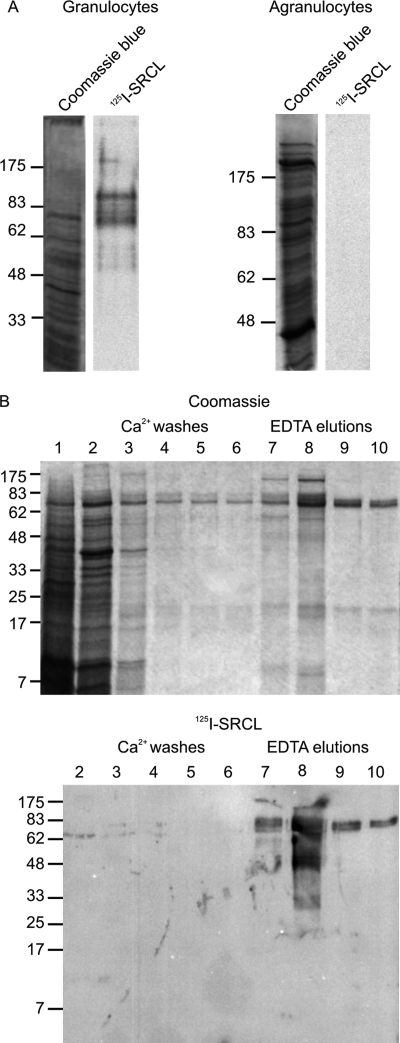
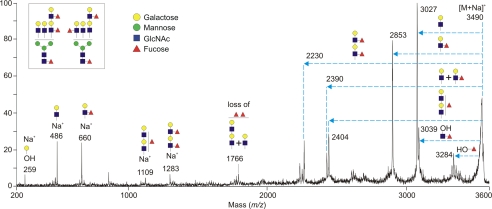
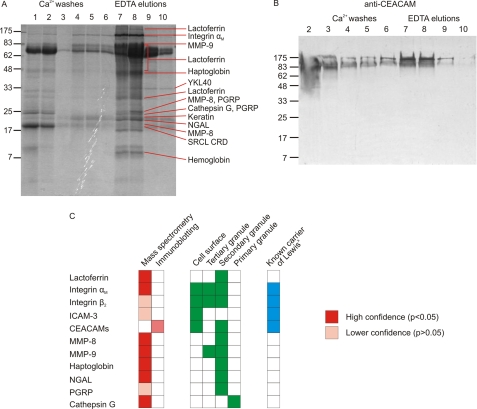
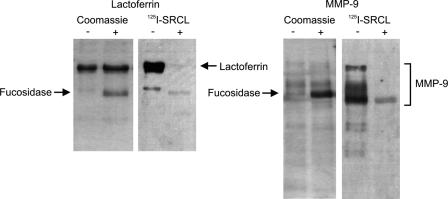
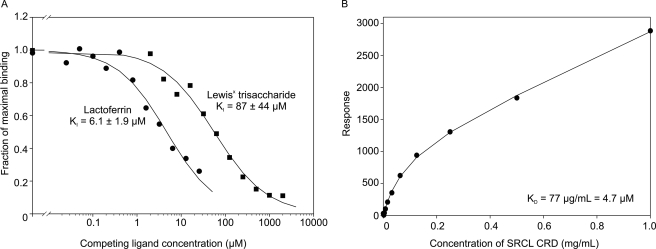
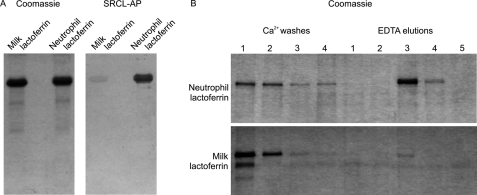
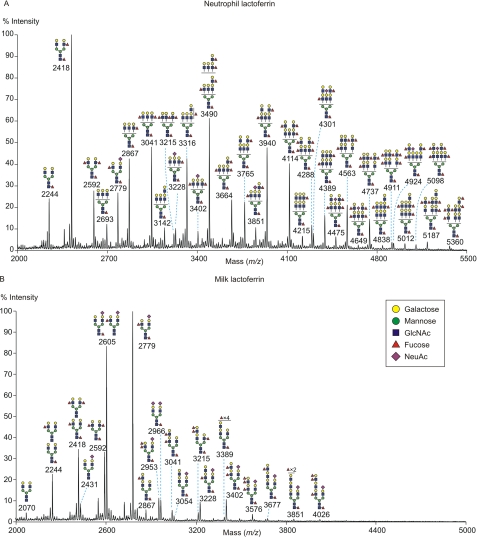
The scavenger receptor C-type lectin (SRCL) is a glycan-binding receptor that has the capacity to mediate endocytosis of glycoproteins carrying terminal Lewis(x) groups (Galβ1-4(Fucα1-3)GlcNAc). A screen for glycoprotein ligands for SRCL using affinity chromatography on immobilized SRCL followed by mass spectrometry-based proteomic analysis revealed that soluble glycoproteins from secondary granules of neutrophils, including lactoferrin and matrix metalloproteinases 8 and 9, are major ligands. Binding competition and surface plasmon resonance analysis showed affinities in the low micromolar range. Comparison of SRCL binding to neutrophil and milk lactoferrin indicates that the binding is dependent on cell-specific glycosylation in the neutrophils, as the milk form of the glycoprotein is a much poorer ligand. Binding to neutrophil glycoproteins is fucose-dependent, and mass spectrometry-based glycomic analysis of neutrophil and milk lactoferrin was used to establish a correlation between high affinity binding to SRCL and the presence of multiple clustered terminal Lewis(x) groups on a heterogeneous mixture of branched glycans, some with poly N-acetyllactosamine extensions. The ability of SRCL to mediate uptake of neutrophil lactoferrin was confirmed using fibroblasts transfected with SRCL. The common presence of Lewis(x) groups in granule protein glycans can thus target granule proteins for clearance by SRCL. PCR and immunohistochemical analysis confirm that SRCL is widely expressed on endothelial cells and thus represents a distributed system that could scavenge released neutrophil glycoproteins both locally at sites of inflammation or systemically when they are released in the circulation.
清道夫受体 C 型凝集素(SRCL)是一种糖结合受体,能够介导携带末端 Lewis(x) 基团(Galβ1-4(Fucα1-3)GlcNAc)的糖蛋白的内吞作用。使用固定化 SRCL 进行亲和层析,然后进行基于质谱的蛋白质组学分析,筛选 SRCL 的糖蛋白配体,结果表明中性粒细胞次级颗粒中的可溶性糖蛋白,包括乳铁蛋白和基质金属蛋白酶 8 和 9,是主要的配体。结合竞争和表面等离子体共振分析表明亲和力在低微摩尔范围内。SRCL 与中性粒细胞和乳乳铁蛋白的结合比较表明,结合依赖于中性粒细胞中细胞特异性糖基化,因为糖蛋白的乳形式是较差的配体。与中性粒细胞糖蛋白的结合依赖于岩藻糖,并且基于质谱的中性粒细胞和乳乳铁蛋白糖组学分析用于建立与 SRCL 高亲和力结合和存在多个聚集末端 Lewis(x) 基团之间的相关性在支化聚糖的不均匀混合物上,一些具有多 N-乙酰乳糖胺延伸。使用转染了 SRCL 的成纤维细胞证实了 SRCL 介导中性粒细胞乳铁蛋白摄取的能力。因此,颗粒蛋白聚糖中常见的 Lewis(x) 基团可以将颗粒蛋白作为 SRCL 清除的靶标。PCR 和免疫组织化学分析证实,SRCL 在血管内皮细胞上广泛表达,因此代表了一个分布式系统,可以在炎症部位局部或在循环中释放时系统性地清除释放的中性粒细胞糖蛋白。