Pulmonary Diseases Department, Baskent University School of Medicine, Ankara, Turkey.
Ann Thorac Med. 2011 Apr;6(2):85-90. doi: 10.4103/1817-1737.78427.
Training for advanced bronchoscopic procedures is acquired during the interventional pulmonology (IP) Fellowship. Unfortunately a number of such programs are small, limiting dissemination of formal training.
We studied success of conventional transbronchial needle aspiration (C-TBNA) in the hands of physicians without formal IP training.
A technique of C-TBNA was learned solely from the literature, videos and practicing on inanimate models at "Hands-On" courses. Conventional TBNA with 21 and/or 19 gauge Smooth Shot Needles (Olympus(®), Japan) was performed on consecutive patients with undiagnosed mediastinal lymphadenopathy.
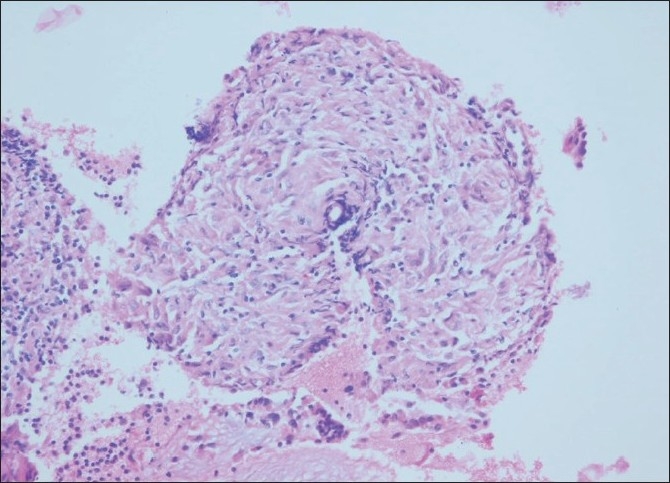
Thirty-four patients (male 23), mean age 54.9 ± 11.8 years underwent C-TBNA. Twenty-two patients had nodes larger than 20 mms. Suspected diagnoses were malignancy in 20 and nonmalignant conditions in 14. Final diagnoses were malignancy 17, sarcoidosis 4, reactive lymph nodes 12, and tuberculosis 1. Final diagnosis was established by C-TBNA in 14 (11 malignancy, 3 sarcoidosis; yield 41.1%), mediastinoscopy in 14, transthoracic needle aspiration in 3, peripheral lymph node biopsies in 2 and by endobronchial biopsy in 1. Nodal size had an impact on outcome (P = 0.000) while location did not (P = 0.33). C-TBNA was positive in 11/20 when malignancy was suspected (yield 55%), while 3/14 when benign diagnosis was suspected (yield 21.4%) (P = 0.05). Sensitivity, specificity, PPV, NPV, and diagnostic accuracy were 66.6%, 100%, 100%, 65%, and 79.4%, respectively. There were no complications or scope damage.
Conventional-TBNA can be learned by the books and by practicing on inanimate models without formal training and results similar to those published in the literature could be achieved.
高级支气管镜检查程序的培训是在介入肺科(IP)研究员期间获得的。不幸的是,许多这样的项目规模较小,限制了正式培训的传播。
我们研究了没有接受过正式 IP 培训的医生进行传统经支气管针吸活检(C-TBNA)的成功率。
仅通过文献、视频和在“实践”课程中对无生命模型进行练习来学习 C-TBNA 技术。使用 21 和/或 19 号光滑射流针(奥林巴斯(®),日本)对连续患有不明原因纵隔淋巴结病的患者进行常规 TBNA。
34 名患者(男性 23 名),平均年龄 54.9 ± 11.8 岁,接受了 C-TBNA。22 名患者的淋巴结大于 20 毫米。可疑诊断为恶性肿瘤 20 例,非恶性疾病 14 例。最终诊断为恶性肿瘤 17 例,结节病 4 例,反应性淋巴结 12 例,结核 1 例。C-TBNA 确诊 14 例(恶性肿瘤 11 例,结节病 3 例;检出率 41.1%),纵隔镜检查 14 例,经胸针吸活检 3 例,外周淋巴结活检 2 例,支气管内活检 1 例。淋巴结大小对结果有影响(P = 0.000),而位置没有影响(P = 0.33)。怀疑恶性肿瘤时,C-TBNA 阳性 20 例中的 11 例(检出率 55%),怀疑良性诊断时阳性 14 例中的 3 例(检出率 21.4%)(P = 0.05)。敏感性、特异性、PPV、NPV 和诊断准确性分别为 66.6%、100%、100%、65%和 79.4%。无并发症或器械损坏。
无需正式培训,仅通过书籍和练习无生命模型即可学习常规-TBNA,并且可以获得与文献报道相似的结果。