Avian Infectious Disease Programme, Institute for Animal Health, Compton, Berkshire, United Kingdom.
PLoS Pathog. 2011 May;7(5):e1001337. doi: 10.1371/journal.ppat.1001337. Epub 2011 May 5.
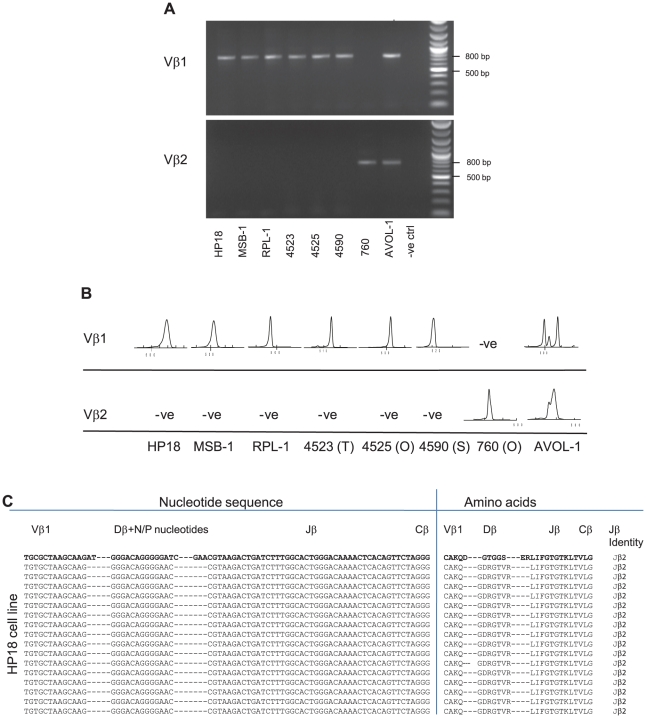
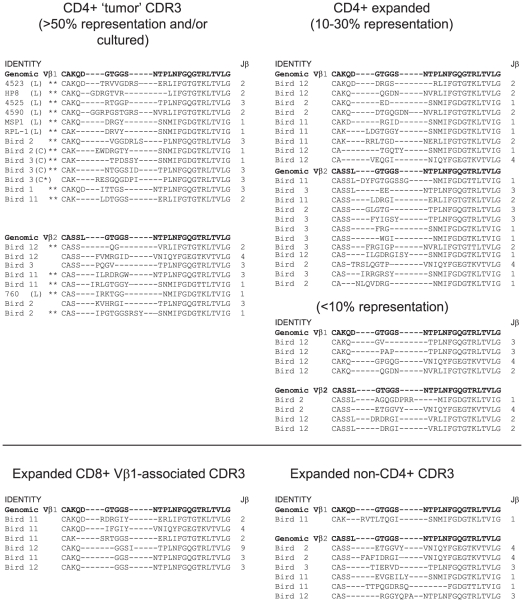
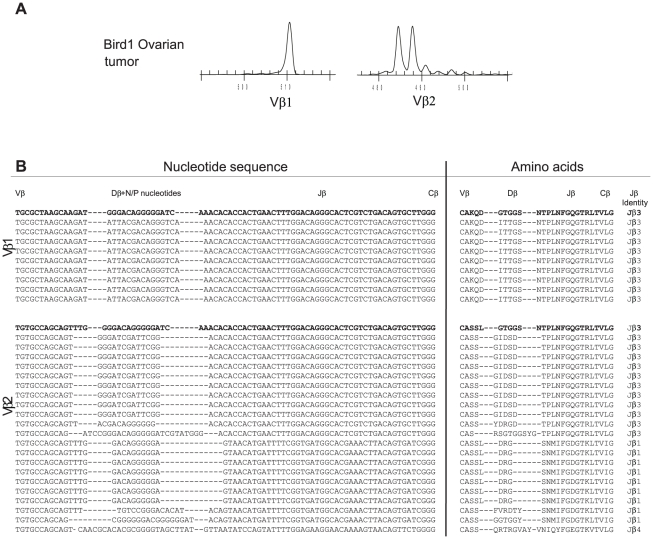
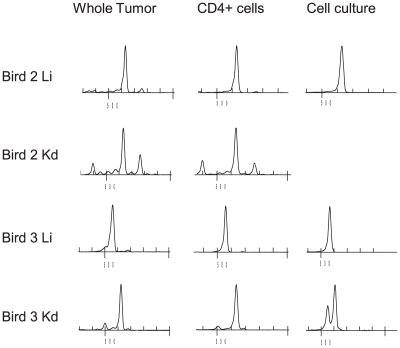
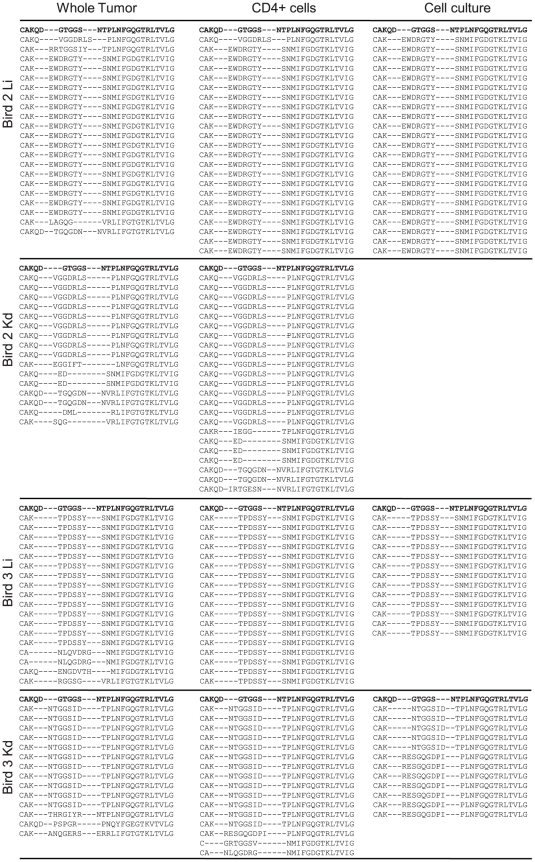
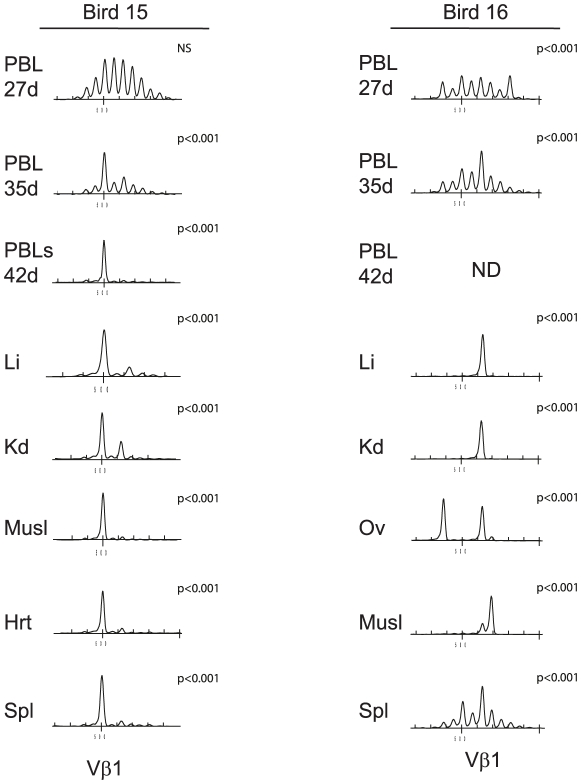
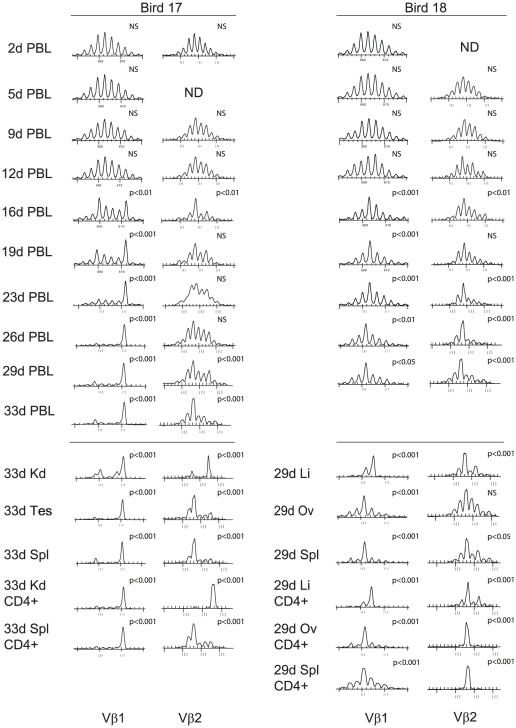
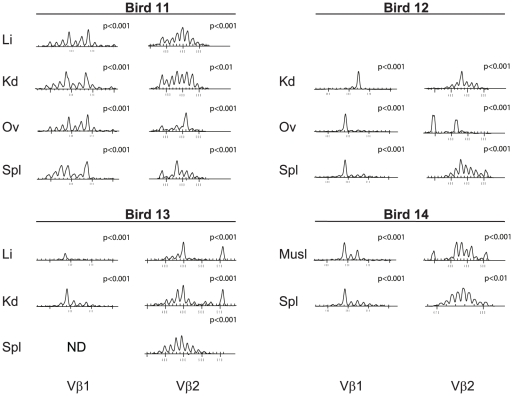
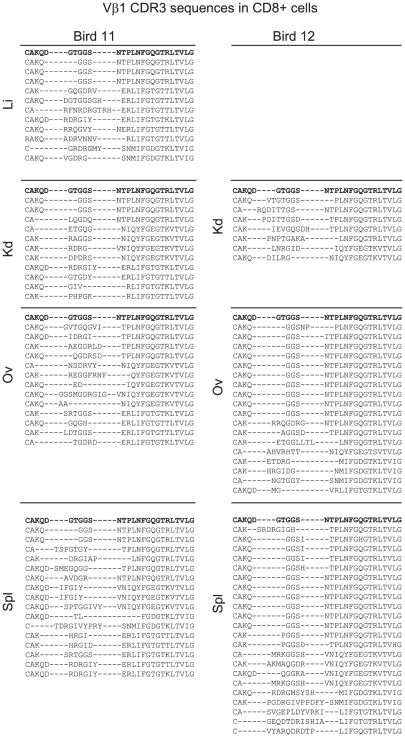
Lymphoid oncogenesis is a life threatening complication associated with a number of persistent viral infections (e.g. EBV and HTLV-1 in humans). With many of these infections it is difficult to study their natural history and the dynamics of tumor formation. Marek's Disease Virus (MDV) is a prevalent α-herpesvirus of poultry, inducing CD4+ TCRαβ+ T cell tumors in susceptible hosts. The high penetrance and temporal predictability of tumor induction raises issues related to the clonal structure of these lymphomas. Similarly, the clonality of responding CD8 T cells that infiltrate the tumor sites is unknown. Using TCRβ repertoire analysis tools, we demonstrated that MDV driven CD4+ T cell tumors were dominated by one to three large clones within an oligoclonal framework of smaller clones of CD4+ T cells. Individual birds had multiple tumor sites, some the result of metastasis (i.e. shared dominant clones) and others derived from distinct clones of transformed cells. The smaller oligoclonal CD4+ cells may represent an anti-tumor response, although on one occasion a low frequency clone was transformed and expanded after culture. Metastatic tumor clones were detected in the blood early during infection and dominated the circulating T cell repertoire, leading to MDV associated immune suppression. We also demonstrated that the tumor-infiltrating CD8+ T cell response was dominated by large oligoclonal expansions containing both "public" and "private" CDR3 sequences. The frequency of CD8+ T cell CDR3 sequences suggests initial stimulation during the early phases of infection. Collectively, our results indicate that MDV driven tumors are dominated by a highly restricted number of CD4+ clones. Moreover, the responding CD8+ T cell infiltrate is oligoclonal indicating recognition of a limited number of MDV antigens. These studies improve our understanding of the biology of MDV, an important poultry pathogen and a natural infection model of virus-induced tumor formation.
淋巴肿瘤发生是一种危及生命的并发症,与多种持续性病毒感染有关(例如人类中的 EBV 和 HTLV-1)。对于许多这些感染,很难研究其自然史和肿瘤形成的动态。马立克氏病病毒(MDV)是一种普遍存在的α疱疹病毒,可在易感宿主中诱导 CD4+TCRαβ+T 细胞肿瘤。肿瘤诱导的高穿透率和时间可预测性引发了与这些淋巴瘤克隆结构相关的问题。同样,浸润肿瘤部位的反应性 CD8+T 细胞的克隆性也未知。使用 TCRβ 库分析工具,我们证明 MDV 驱动的 CD4+T 细胞肿瘤由一个至三个大克隆主导,这些克隆在较小的 CD4+T 细胞克隆的寡克隆框架内。个别鸟类有多个肿瘤部位,有些是转移的结果(即共享主导克隆),而另一些则来自转化细胞的不同克隆。较小的寡克隆 CD4+细胞可能代表抗肿瘤反应,尽管有一次低频克隆在培养后被转化和扩增。在感染早期就可以在血液中检测到转移性肿瘤克隆,并主导循环 T 细胞库,导致与 MDV 相关的免疫抑制。我们还证明,肿瘤浸润的 CD8+T 细胞反应由包含“公共”和“私有”CDR3 序列的大寡克隆扩增主导。CD8+T 细胞 CDR3 序列的频率表明在感染的早期阶段进行了初始刺激。总的来说,我们的研究结果表明,MDV 驱动的肿瘤主要由高度受限数量的 CD4+克隆主导。此外,反应性 CD8+T 细胞浸润呈寡克隆性,表明对有限数量的 MDV 抗原的识别。这些研究提高了我们对 MDV 的生物学的理解,MDV 是一种重要的家禽病原体和病毒诱导肿瘤形成的天然感染模型。