Department of Psychology, University of Wisconsin-Madison, Madison, Wisconsin, United States of America.
PLoS One. 2011 May 4;6(5):e18712. doi: 10.1371/journal.pone.0018712.
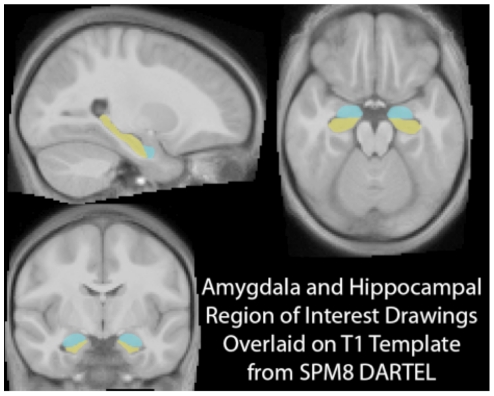
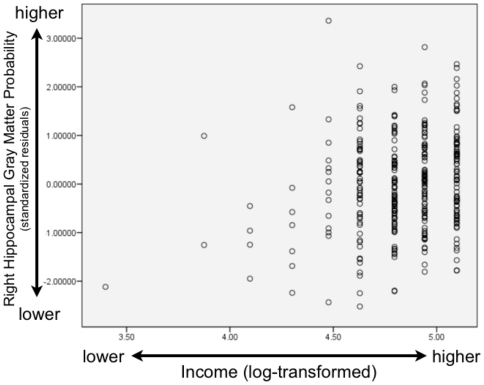
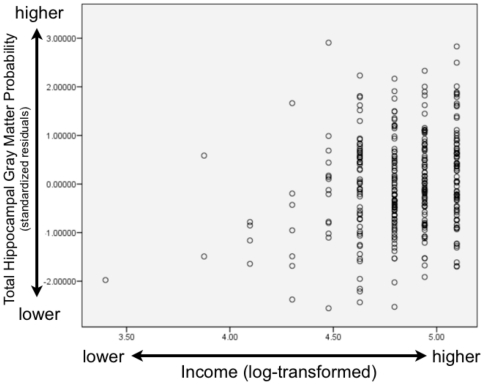
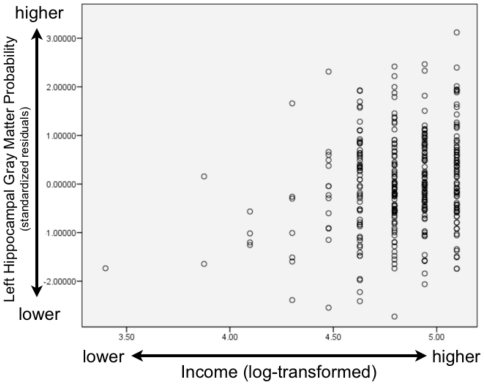
Facets of the post-natal environment including the type and complexity of environmental stimuli, the quality of parenting behaviors, and the amount and type of stress experienced by a child affects brain and behavioral functioning. Poverty is a type of pervasive experience that is likely to influence biobehavioral processes because children developing in such environments often encounter high levels of stress and reduced environmental stimulation. This study explores the association between socioeconomic status and the hippocampus, a brain region involved in learning and memory that is known to be affected by stress. We employ a voxel-based morphometry analytic framework with region of interest drawing for structural brain images acquired from participants across the socioeconomic spectrum (n = 317). Children from lower income backgrounds had lower hippocampal gray matter density, a measure of volume. This finding is discussed in terms of disparities in education and health that are observed across the socioeconomic spectrum.
产后环境的各个方面,包括环境刺激的类型和复杂性、育儿行为的质量,以及儿童经历的压力的数量和类型,都会影响大脑和行为功能。贫困是一种普遍存在的经历,很可能会影响生物行为过程,因为在这种环境中成长的儿童经常面临高水平的压力和减少的环境刺激。本研究探讨了社会经济地位与海马体之间的关联,海马体是参与学习和记忆的大脑区域,已知其受到压力的影响。我们采用基于体素的形态计量学分析框架,并对来自社会经济谱(n = 317)参与者的结构脑图像进行感兴趣区域绘制。来自低收入背景的儿童的海马灰质密度较低,这是体积的一种衡量标准。这一发现是根据社会经济谱中观察到的教育和健康方面的差异来讨论的。