Botany Department, National Museum of Natural Science, Taichung, Taiwan.
Ann Bot. 2011 Jul;108(1):113-21. doi: 10.1093/aob/mcr114. Epub 2011 May 15.
Lady's slipper orchids (Paphiopedilum) are of high value in floriculture, and interspecific hybridization has long been used for breeding improved cultivars; however, information regarding the genome affinities of species and chromosome pairing behaviour of the hybrids remains almost unknown. The present work analyses the meiotic behaviour of interspecific hybrids by genomic in situ hybridization and cytologically evaluates the genomic relationships among parental species.
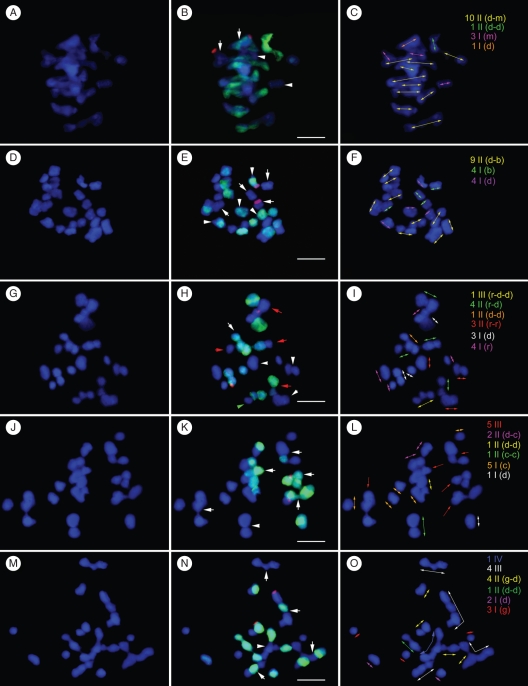
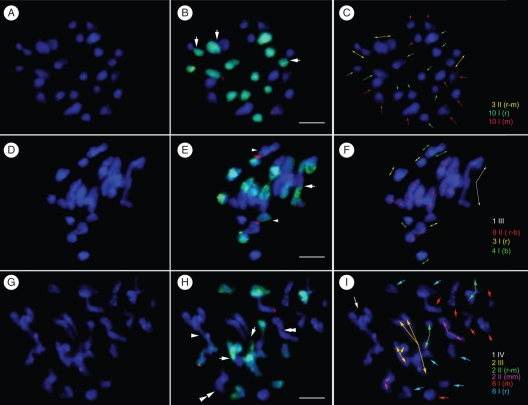
Eight interspecific F(1) hybrids of Paphiopedilum species in various subgenera or sections were investigated in this study. The chromosome behaviour in meiosis of these interspecific hybrids was analysed and subjected to genomic in situ hybridization and fluorescent in situ hybridization.
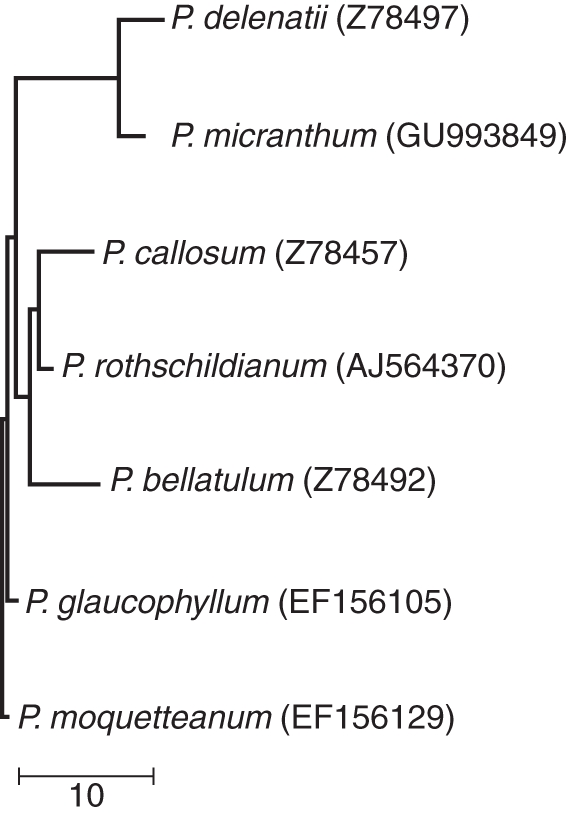
Genomic in situ hybridization was demonstrated as an efficient method to differentiate between Paphiopedilum genomes and to visualize the chromosome pairing affinities in interspecific F(1) hybrids, clarifying the phylogenetic distances among these species. Comparatively regular chromosome pairing observed in the hybrids of P. delenatii × P. bellatulum, P. delenatii × P. rothschildianum and P. rothschildianum × P. bellatulum suggested high genomic affinities and close relationships between parents of each hybrid. In contrast, irregular chromosome associations, such as univalents, trivalents and quadrivalents occurred frequently in the hybrids derived from distant parents with divergent karyotypes, such as P. delenatii × P. callosum, P. delenatii × P. glaucophyllum, P. rothschildianum × P. micranthum and P. rothschildianum × P. moquetteanum. The existence of multivalents and autosyndesis demonstrated by genomic in situ hybridization in this study indicates that some micro-rearrangements and other structural alterations may also play a part in differentiating Paphiopedilum species at chromosomal level, demonstrated as different chromosome pairing affinities in interspecific hybrids.
The results indicate that genome homology and the interaction of genetic factors, but not chromosome number nor karyotype similarity, determine the chromosome pairing behaviour in Paphiopedilum hybrids.
杓兰属(Paphiopedilum)的兜兰因其在花卉园艺中的高价值而备受关注,种间杂交长期以来一直被用于培育改良品种;然而,关于物种的基因组亲缘关系和杂种的染色体配对行为的信息几乎未知。本研究通过基因组原位杂交分析种间杂种的减数分裂行为,并从细胞学上评估亲本种间的基因组关系。
本研究调查了 8 个不同亚属或节的 Paphiopedilum 种间 F1 杂种。分析了这些种间杂种减数分裂过程中的染色体行为,并进行了基因组原位杂交和荧光原位杂交。
基因组原位杂交被证明是一种有效的方法,可以区分 Paphiopedilum 基因组,并可视化种间 F1 杂种中的染色体配对亲和力,阐明这些物种之间的系统发育距离。在 P. delenatii × P. bellatulum、P. delenatii × P. rothschildianum 和 P. rothschildianum × P. bellatulum 的杂种中观察到相对规则的染色体配对,表明亲本之间具有较高的基因组亲和力和密切关系。相比之下,在来自具有不同核型的远缘亲本的杂种中,如 P. delenatii × P. callosum、P. delenatii × P. glaucophyllum、P. rothschildianum × P. micranthum 和 P. rothschildianum × P. moquetteanum,经常出现不规则的染色体结合,如单价体、三价体和四价体。本研究通过基因组原位杂交证明的多价体和自体联会的存在表明,一些微重排和其他结构改变也可能在染色体水平上区分杓兰属物种,表现为种间杂种中不同的染色体配对亲和力。
结果表明,基因组同源性和遗传因素的相互作用,而不是染色体数目或核型相似性,决定了 Paphiopedilum 杂种的染色体配对行为。