Hellenic Centre for Disease Control and Prevention, Athens, Greece.
PLoS One. 2011 May 11;6(5):e19432. doi: 10.1371/journal.pone.0019432.
Pandemic A (H1N1) 2009 mortality rates varied widely from one country to another. Our aim was to identify potential socioeconomic determinants of pandemic mortality and explain between-country variation.
Based on data from a total of 30 European countries, we applied random-effects Poisson regression models to study the relationship between pandemic mortality rates (May 2009 to May 2010) and a set of representative environmental, health care-associated, economic and demographic country-level parameters. The study was completed by June 2010.
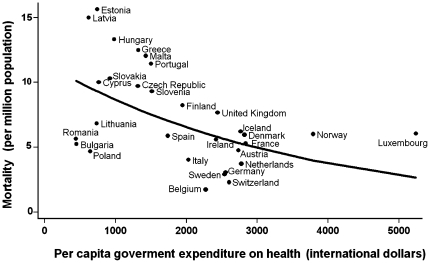
Most regression approaches indicated a consistent, statistically significant inverse association between pandemic influenza-related mortality and per capita government expenditure on health. The findings were similar in univariable [coefficient: -0.00028, 95% Confidence Interval (CI): -0.00046, -0.00010, p = 0.002] and multivariable analyses (including all covariates, coefficient: -0.00107, 95% CI: -0.00196, -0.00018, p = 0.018). The estimate was barely insignificant when the multivariable model included only significant covariates from the univariate step (coefficient: -0.00046, 95% CI: -0.00095, 0.00003, p = 0.063).
Our findings imply a significant inverse association between public spending on health and pandemic influenza mortality. In an attempt to interpret the estimated coefficient (-0.00028) for the per capita government expenditure on health, we observed that a rise of 100 international dollars was associated with a reduction in the pandemic influenza mortality rate by approximately 2.8%. However, further work needs to be done to unravel the mechanisms by which reduced government spending on health may have affected the 2009 pandemic influenza mortality.
甲型 H1N1 流感大流行的死亡率在不同国家之间存在很大差异。我们的目的是确定大流行死亡率的潜在社会经济决定因素,并解释国家间的差异。
基于来自 30 个欧洲国家的综合数据,我们应用随机效应泊松回归模型来研究大流行死亡率(2009 年 5 月至 2010 年 5 月)与一系列代表性的环境、医疗保健相关、经济和人口国家层面参数之间的关系。研究于 2010 年 6 月完成。
大多数回归方法表明,大流行性流感相关死亡率与人均政府卫生支出之间存在一致的、具有统计学意义的反比关系。在单变量分析中(系数:-0.00028,95%置信区间(CI):-0.00046,-0.00010,p=0.002)和多变量分析(包括所有协变量,系数:-0.00107,95% CI:-0.00196,-0.00018,p=0.018)中,发现结果相似。当多变量模型仅包含单变量步骤中具有统计学意义的协变量时,估计值几乎不显著(系数:-0.00046,95% CI:-0.00095,0.00003,p=0.063)。
我们的研究结果表明,公共卫生支出与大流行性流感死亡率之间存在显著的反比关系。为了解释人均政府卫生支出的估计系数(-0.00028),我们观察到,政府卫生支出每增加 100 国际美元,大流行性流感死亡率就会降低约 2.8%。然而,需要进一步的工作来揭示政府卫生支出减少可能影响 2009 年大流行性流感死亡率的机制。