Department of Public Health, Arba Minch University, Arba Minch, Ethiopia.
BMC Public Health. 2011 May 19;11:342. doi: 10.1186/1471-2458-11-342.
Women in developing countries are either under collective decision making with their partners or completely rely on the male partner's decision on issues that affect their reproductive live. Identifying the major barriers of married women's decision making power on contraceptive use has significant relevance for planning contextually appropriate family planning interventions. The objective of this study was to determine current modern contraceptive practices and decision making power among married women in Tercha Town and surrounding rural areas of Dawro zone, Southern Ethiopia.
Community based comparative cross-sectional design with both quantitative and Qualitative study has been employed in March and April 2010. The respondents were 699 married women of child bearing age from urban and rural parts of Dawro zone. After conducting census, we took the sample using simple random sampling technique.
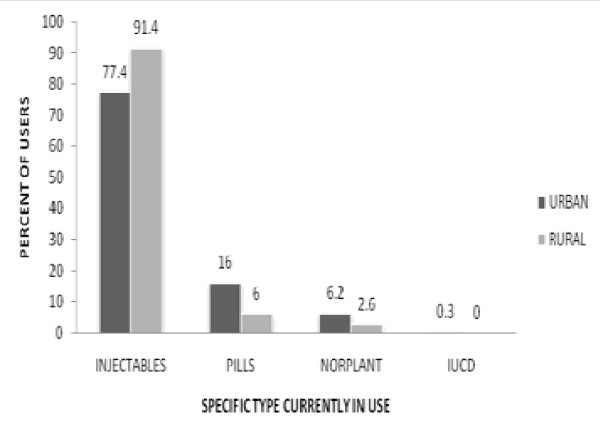
Current modern contraceptive use among married women in the urban was 293 (87.5%) and 243 (72.8%) in rural. Married women who reside in urban area were more likely to decide on the use of modern contraceptive method than rural women. Having better knowledge about modern contraceptive methods, gender equitable attitude, better involvement in decisions related to children, socio-cultural and family relations were statistically significant factors for decision making power of women on the use of modern contraceptive methods in the urban setting. Better knowledge, fear of partner's opposition or negligence, involvement in decisions about child and economic affairs were statistically significant factors for better decision making power of women on the use of modern contraceptive methods in the rural part.
High level of current modern contraceptive practice with reduced urban-rural difference was found as compared to regional and national figures. Urban women had better power to make decisions on modern contraceptive than rural women. Modern family planning interventions in the area should be promoted by considering empowering of women on modern contraceptive use decision making.
发展中国家的女性要么在与伴侣的集体决策下,要么完全依赖男性伴侣对影响其生殖生活的问题做出决定。确定已婚妇女在避孕使用方面的决策权的主要障碍对于规划具有背景适当性的计划生育干预措施具有重要意义。本研究的目的是确定埃塞俄比亚南部达罗地区特查镇及周边农村已婚妇女目前的现代避孕措施和决策能力。
2010 年 3 月至 4 月采用了基于社区的比较性横断面设计,同时进行定量和定性研究。受访者是来自达罗地区城乡的 699 名育龄已婚妇女。在进行人口普查后,我们采用简单随机抽样技术抽取了样本。
城市中已婚妇女目前使用现代避孕方法的比例为 293(87.5%),农村为 243(72.8%)。居住在城市的已婚妇女比农村妇女更有可能决定使用现代避孕方法。关于现代避孕方法的知识更好、性别平等态度、更好地参与与子女有关的决策、社会文化和家庭关系是城市中妇女在使用现代避孕方法方面决策能力的统计学显著因素。知识更好、担心伴侣反对或忽视、参与有关子女和经济事务的决策是农村妇女在使用现代避孕方法方面更好决策能力的统计学显著因素。
与区域和国家数据相比,目前现代避孕方法的实施率较高,城乡差异较小。城市妇女在现代避孕方面的决策权强于农村妇女。该地区的现代计划生育干预措施应通过考虑增强妇女在现代避孕使用决策方面的权力来加以推广。