National Center for Biotechnology Information, National Library of Medicine, National Institutes of Health, Bethesda, MD 20894, USA.
Biol Direct. 2011 May 19;6:26. doi: 10.1186/1745-6150-6-26.
Accurate estimation of the divergence time of the extant eukaryotes is a fundamentally important but extremely difficult problem owing primarily to gross violations of the molecular clock at long evolutionary distances and the lack of appropriate calibration points close to the date of interest. These difficulties are intrinsic to the dating of ancient divergence events and are reflected in the large discrepancies between estimates obtained with different approaches. Estimates of the age of Last Eukaryotic Common Ancestor (LECA) vary approximately twofold, from ~1,100 million years ago (Mya) to ~2,300 Mya.
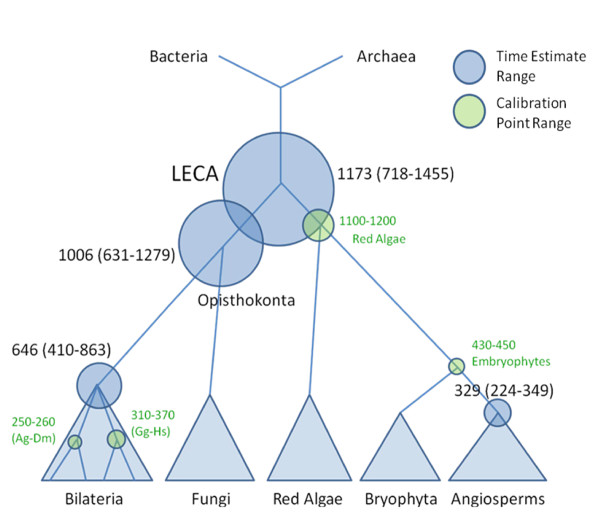
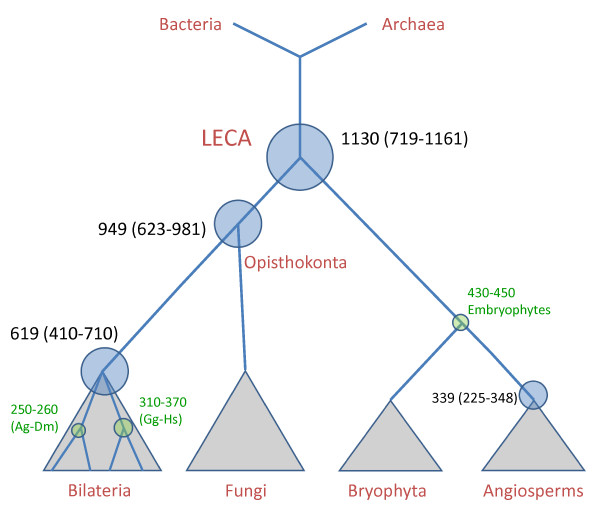
We applied the genome-wide analysis of rare genomic changes associated with conserved amino acids (RGC_CAs) and used several independent techniques to obtain date estimates for the divergence of the major lineages of eukaryotes with calibration intervals for insects, land plants and vertebrates. The results suggest an early divergence of monocot and dicot plants, approximately 340 Mya, raising the possibility of plant-insect coevolution. The divergence of bilaterian animal phyla is estimated at ~400-700 Mya, a range of dates that is consistent with cladogenesis immediately preceding the Cambrian explosion. The origin of opisthokonts (the supergroup of eukaryotes that includes metazoa and fungi) is estimated at ~700-1,000 Mya, and the age of LECA at ~1,000-1,300 Mya. We separately analyzed the red algal calibration interval which is based on single fossil. This analysis produced time estimates that were systematically older compared to the other estimates. Nevertheless, the majority of the estimates for the age of the LECA using the red algal data fell within the 1,200-1,400 Mya interval.
The inference of a "young LECA" is compatible with the latest of previously estimated dates and has substantial biological implications. If these estimates are valid, the approximately 1 to 1.4 billion years of evolution of eukaryotes that is open to comparative-genomic study probably was preceded by hundreds of millions years of evolution that might have included extinct diversity inaccessible to comparative approaches.
This article was reviewed by William Martin, Herve Philippe (nominated by I. King Jordan), and Romain Derelle.
由于在长进化距离上存在严重的分子钟违例现象,以及缺乏接近感兴趣日期的适当校准点,因此准确估计现存真核生物的分歧时间是一个非常重要但极具挑战性的问题。这些困难是古老分歧事件的固有困难,并且反映在不同方法得出的估计值之间存在较大差异。真核生物的最后共同祖先(LECA)的年龄估计值大约相差两倍,从 1.1 亿年前(Mya)到 2.3 亿年前。
我们应用了与保守氨基酸相关的全基因组稀有基因组变化分析(RGC_CAs),并使用了几种独立的技术,根据昆虫、陆地植物和脊椎动物的校准间隔,获得了真核生物主要谱系分歧的日期估计值。结果表明,单子叶植物和双子叶植物的早期分歧,大约在 3.4 亿年前,增加了植物与昆虫协同进化的可能性。两侧对称动物门的分歧估计在 4 亿到 7 亿年前之间,这一时间范围与寒武纪大爆发之前的分支发生相一致。后生动物(包括后生动物和真菌的超类群)的起源估计在 7 亿到 10 亿年前,LECA 的年龄估计在 10 亿到 13 亿年前。我们分别分析了基于单一化石的红藻校准间隔。与其他估计值相比,这种分析产生的时间估计值系统地偏老。尽管如此,使用红藻数据估计 LECA 的年龄的大多数估计值仍落在 12 亿到 14 亿年前的范围内。
“年轻的 LECA”的推断与先前估计的最新日期是一致的,并且具有重要的生物学意义。如果这些估计值有效,那么真核生物大约 1 到 1.4 亿年的进化可以进行比较基因组研究,而之前可能已经经历了数亿年的进化,其中可能包括无法通过比较方法获得的灭绝多样性。
本文由 William Martin、Herve Philippe(由 I. King Jordan 提名)和 Romain Derelle 进行了评审。