Norwegian Veterinary Institute, Oslo, Norway.
Parasit Vectors. 2011 May 19;4:84. doi: 10.1186/1756-3305-4-84.
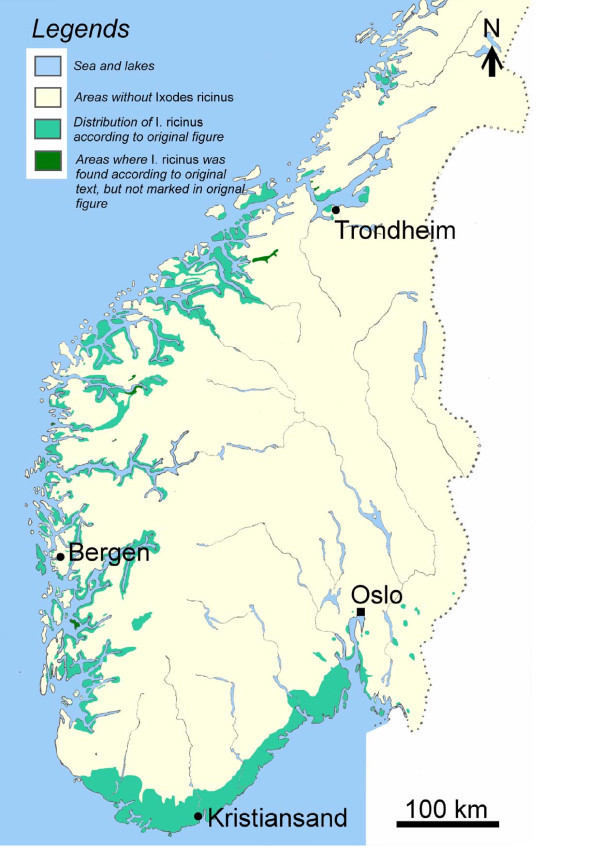
There is increasing evidence for a latitudinal and altitudinal shift in the distribution range of Ixodes ricinus. The reported incidence of tick-borne disease in humans is on the rise in many European countries and has raised political concern and attracted media attention. It is disputed which factors are responsible for these trends, though many ascribe shifts in distribution range to climate changes. Any possible climate effect would be most easily noticeable close to the tick's geographical distribution limits. In Norway- being the northern limit of this species in Europe- no documentation of changes in range has been published. The objectives of this study were to describe the distribution of I. ricinus in Norway and to evaluate if any range shifts have occurred relative to historical descriptions.
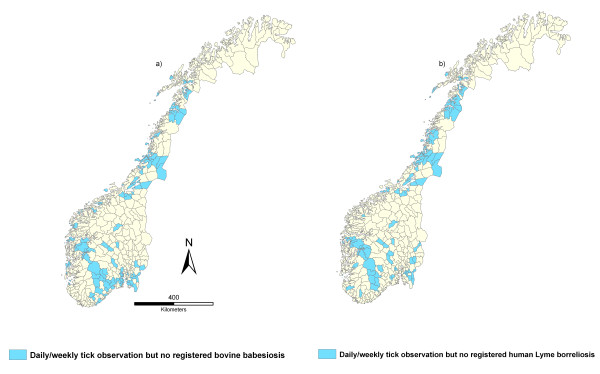
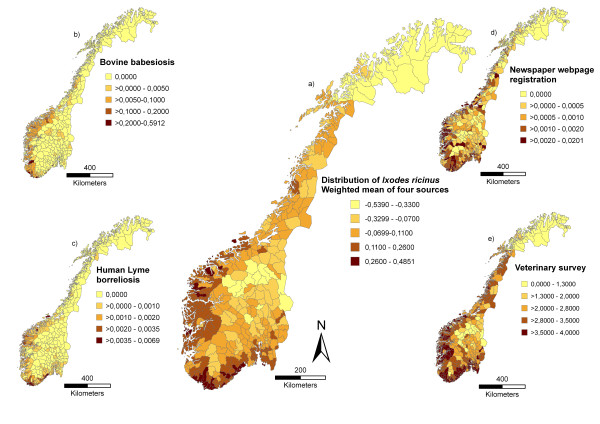
Multiple data sources - such as tick-sighting reports from veterinarians, hunters, and the general public - and surveillance of human and animal tick-borne diseases were compared to describe the present distribution of I. ricinus in Norway. Correlation between data sources and visual comparison of maps revealed spatial consistency. In order to identify the main spatial pattern of tick abundance, a principal component analysis (PCA) was used to obtain a weighted mean of four data sources. The weighted mean explained 67% of the variation of the data sources covering Norway's 430 municipalities and was used to depict the present distribution of I. ricinus. To evaluate if any geographical range shift has occurred in recent decades, the present distribution was compared to historical data from 1943 and 1983.
Tick-borne disease and/or observations of I. ricinus was reported in municipalities up to an altitude of 583 metres above sea level (MASL) and is now present in coastal municipalities north to approximately 69°N.
I. ricinus is currently found further north and at higher altitudes than described in historical records. The approach used in this study, a multi-source analysis, proved useful to assess alterations in tick distribution.
越来越多的证据表明,硬蜱(Ixodes ricinus)的分布范围在纬度和海拔上都发生了转移。在许多欧洲国家,报告的人类 tick-borne 疾病发病率正在上升,这引起了政治关注并引起了媒体的关注。尽管许多人将分布范围的转移归因于气候变化,但对于哪些因素是造成这些趋势的原因存在争议。任何可能的气候影响在接近 tick 的地理分布极限时最容易被察觉。在挪威——作为欧洲该物种的最北极限——尚未公布有关范围变化的文件。本研究的目的是描述挪威的硬蜱分布,并评估相对于历史描述是否发生了任何范围转移。
通过比较兽医、猎人以及公众的 tick 目击报告等多种数据来源以及对人类和动物 tick-borne 疾病的监测,来描述挪威目前硬蜱的分布情况。数据源之间的相关性以及地图的直观比较揭示了空间一致性。为了确定 tick 丰度的主要空间模式,使用主成分分析(PCA)来获取四个数据源的加权平均值。该加权平均值解释了覆盖挪威 430 个市的数据源的 67%变化,并用于描绘目前硬蜱的分布情况。为了评估最近几十年来是否发生了任何地理范围转移,将当前的分布与 1943 年和 1983 年的历史数据进行了比较。
在海拔 583 米以上的市报告了 tick-borne 疾病和/或观察到硬蜱,并且现在在 69°N 左右的沿海市也有发现。
目前发现硬蜱分布的位置比历史记录中描述的更北,海拔更高。本研究中使用的多源分析方法证明对评估 tick 分布的变化非常有用。