Laboratory of Integrative Immunology and Behavior, Animal Science Department, University of Illinois at Urbana-Champaign, Urbana, 7 Animal Sciences Lab 1207 W, Gregory Dr, Urbana, IL 61801, USA.
J Neuroinflammation. 2011 May 19;8:54. doi: 10.1186/1742-2094-8-54.
Interleukin (IL)-6 is produced in the brain during peripheral infection and plays an important but poorly understood role in sickness behavior. Therefore, this study investigated the capacity of soluble gp130 (sgp130), a natural inhibitor of the IL-6 trans-signaling pathway to regulate IL-6 production in microglia and neurons in vitro and its effects on lipopolysaccharide (LPS)-induced sickness behavior in vivo.
A murine microglia (BV.2) and neuronal cell line (Neuro.2A) were used to study the effects of stimulating and inhibiting the IL-6 signaling pathway in vitro. In vivo, adult (3-6 mo) BALB/c mice received an intracerebroventricular (ICV) injection of sgp130 followed by an intraperitoneal (i.p.) injection of LPS, and sickness behavior and markers of neuroinflammation were measured.
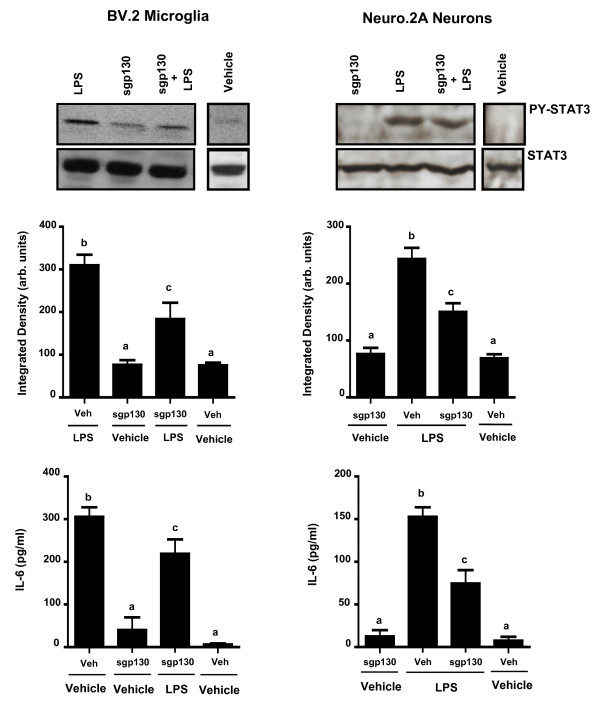
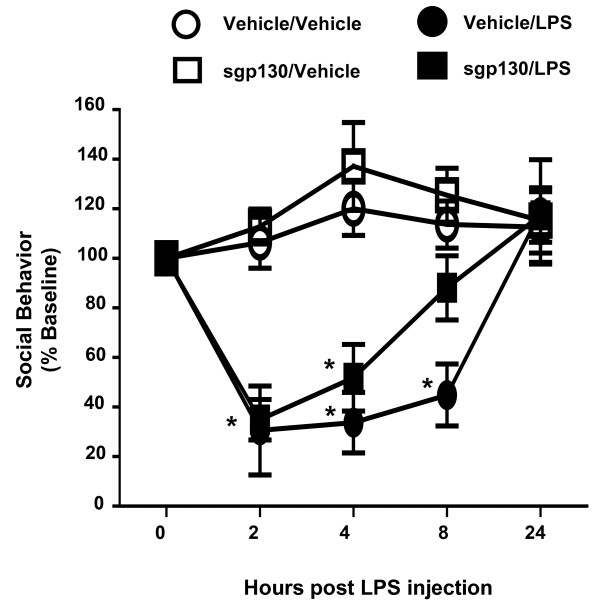
Soluble gp130 attenuated IL-6- and LPS-stimulated IL-6 receptor (IL-6R) activation along with IL-6 protein release in both microglial (BV.2) and neuronal (Neuro.2A) cell types in vitro. Moreover, in vivo experiments showed that sgp130 facilitated recovery from LPS-induced sickness, and this sgp130-associated recovery was paralleled by reduced IL-6 receptor signaling, mRNA, and protein levels of IL-6 in the hippocampus.
Taken together, the results show that sgp130 may exert an anti-inflammatory effect on microglia and neurons by inhibiting IL-6 binding. These data indicate that sgp130 inhibits the LPS-induced IL-6 trans-signal and show IL-6 and its receptor are involved in maintaining sickness behavior.
白细胞介素 (IL)-6 在周围感染时在大脑中产生,并在疾病行为中发挥重要但尚未充分理解的作用。因此,本研究调查了可溶性 gp130 (sgp130) 的能力,sgp130 是 IL-6 转信号通路的天然抑制剂,可调节体外小胶质细胞和神经元中的 IL-6 产生及其对体内脂多糖 (LPS) 诱导的疾病行为的影响。
使用鼠小胶质细胞 (BV.2) 和神经元细胞系 (Neuro.2A) 研究体外刺激和抑制 IL-6 信号通路的影响。在体内,成年 (3-6 个月) BALB/c 小鼠接受脑室内 (ICV) 注射 sgp130 后腹腔内 (i.p.) 注射 LPS,并测量疾病行为和神经炎症标志物。
可溶性 gp130 减弱了体外小胶质细胞 (BV.2) 和神经元 (Neuro.2A) 细胞类型中 IL-6 和 LPS 刺激的 IL-6 受体 (IL-6R) 激活以及 IL-6 蛋白释放。此外,体内实验表明 sgp130 促进了 LPS 诱导的疾病的恢复,sgp130 相关的恢复与海马体中 IL-6 受体信号、IL-6 mRNA 和蛋白水平降低有关。
总之,这些结果表明 sgp130 可能通过抑制 IL-6 结合对小胶质细胞和神经元发挥抗炎作用。这些数据表明 sgp130 抑制 LPS 诱导的 IL-6 转信号,并表明 IL-6 及其受体参与维持疾病行为。