Yang Hwa-Yeon, Sun Woo-Young, Lee Taek-Gu, Lee Sang-Jeon
Department of Surgery, Chungbuk National University College of Medicine, Cheongju, Korea.
J Korean Soc Coloproctol. 2011 Apr;27(2):94-8. doi: 10.3393/jksc.2011.27.2.94. Epub 2011 Apr 30.
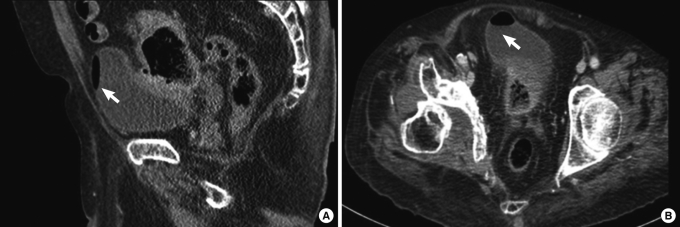
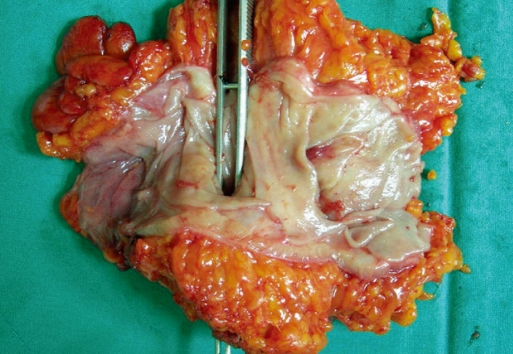
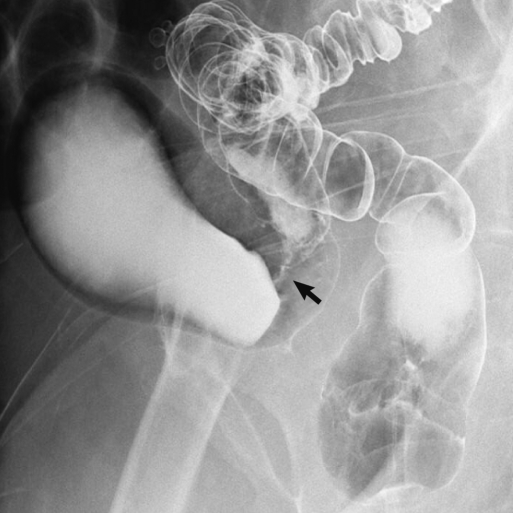
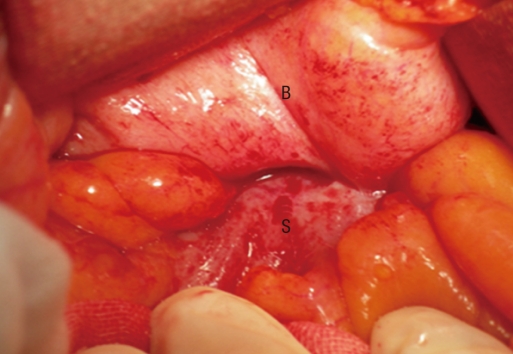
Colonic diverticulosis has continuously increased, noticeably left-sided diseases, in Korea. A colovesical fistula is an uncommon complication of diverticulitis, and its most common cause is diverticular disease. Confirmation of its presence generally depends on clinical findings, such as pneumaturia and fecaluria. The primary aim of a diagnostic workup is not to observe the fistular tract itself but to find the etiology of the disease so that an appropriate therapy can be initiated. We present here the case of a 79-year-old man complaining of pneumaturia and fecaluria. On abdomen and pelvis CT, the patient was diagnosed as having a colovesical fistula due to sigmoid diverticulitis. After division of the adhesion between the sigmoid colon and the bladder, the defect of the bladder wall was repaired by simple closure. The colonic defect was treated with a segmental resection, including the rectosigmoid junction. The patient is doing well at 6 months after the operation and shows no evidence of recurrence of the fistula.
在韩国,结肠憩室病持续增加,尤其是左侧疾病。结肠膀胱瘘是憩室炎的一种罕见并发症,其最常见的病因是憩室病。其存在的确认通常取决于临床表现,如气尿和粪尿。诊断检查的主要目的不是观察瘘管本身,而是找出疾病的病因,以便启动适当的治疗。我们在此介绍一名79岁男性,他主诉气尿和粪尿。在腹部和骨盆CT检查中,该患者被诊断为因乙状结肠憩室炎导致结肠膀胱瘘。在分离乙状结肠和膀胱之间的粘连后,膀胱壁缺损通过简单缝合进行修复。结肠缺损采用包括直肠乙状结肠交界处的节段性切除术进行治疗。患者术后6个月情况良好,未显示瘘管复发迹象。