Hepatogastroenteroly Unit, 2nd Department of Internal Medicine - Propaedeutic, Attikon University General Hospital, Athens Medical School, Athens, Greece.
J Neurogastroenterol Motil. 2011 Apr;17(2):158-63. doi: 10.5056/jnm.2011.17.2.158. Epub 2011 Apr 27.
BACKGROUND/AIMS: In patients with gastroesophageal reflux disease, persistent symptoms on proton pump inhibitor (PPI) therapy may be due to residual acid or non-acid reflux. Combined impedance-pH has been suggested to be superior to pH alone in the management of refractory patients to PPI. The utility of implementation of this technique in every day clinical practice is still unknown. The aim of this study was to investigate the outcomes of patients studied with combined impedance-pH and to evaluate the yield of additional impedance monitoring over pH alone in patients with persistent gastroesophageal reflux disease symptoms.
Seventy-one patients (31 men; mean age, 49.1 ± 15.5 years) on PPI therapy underwent combined impedance-pH for persistent typical (76%) or atypical (49%) symptoms.
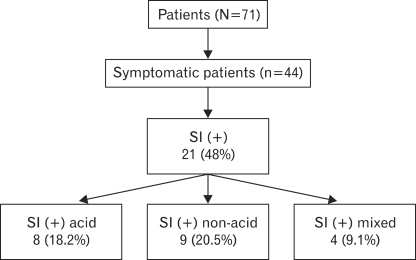
During impedance-pH study, 44 (62%) patients reported symptoms. A positive symptom index (SI) was found in 21 (48%) patients: 8 (18.2%) had a positive SI for acid reflux, 9 (20.5%) for non-acid reflux and 4 (9.1%) for mixed reflux. Addition of impedance allowed association between reflux and symptoms in 20.5% of patients who would have been missed by pH study alone. Heartburn was the most prevalent symptom associated with acid reflux, whereas regurgitation and ear, nose and throat symptoms were associated with non-acid reflux.
The use of combined impedance-pH monitoring substantially increased the diagnostic yield compared to pH alone. With SI analysis, 20.5% of patients received a diagnosis that could not have been achieved with pH testing alone.
背景/目的:在胃食管反流病患者中,质子泵抑制剂 (PPI) 治疗后持续存在症状可能是由于残留胃酸或非酸性反流。联合阻抗-pH 被认为优于 pH 监测单独用于治疗难治性 PPI 患者。但这种技术在日常临床实践中的应用效果尚不清楚。本研究旨在调查接受联合阻抗-pH 监测的患者的结果,并评估在持续性胃食管反流病症状患者中,联合阻抗监测相对于 pH 监测的附加价值。
71 例(31 名男性;平均年龄 49.1 ± 15.5 岁)正在接受 PPI 治疗的患者因持续性典型(76%)或非典型(49%)症状而接受联合阻抗-pH 监测。
在阻抗-pH 研究期间,44 例(62%)患者报告有症状。21 例(48%)患者的症状指数(SI)阳性:8 例(18.2%)存在酸反流阳性 SI,9 例(20.5%)存在非酸反流阳性 SI,4 例(9.1%)存在混合反流阳性 SI。与 pH 监测单独相比,阻抗监测增加了 20.5%的反流与症状相关的关联。烧心是与酸反流最相关的症状,而反流和耳鼻喉症状与非酸反流相关。
与 pH 监测单独相比,联合阻抗-pH 监测显著提高了诊断率。通过 SI 分析,20.5%的患者得到了 pH 检测无法得出的诊断。