Mariano Filippo, Bergamo Daniela, Gangemi Ezio Nicola, Hollo' Zsuzsanna, Stella Maurizio, Triolo Giorgio
Department of Medicine Area, Nephrology and Dialysis Unit, CTO Hospital, Via G. Zuretti 29, Turin, Italy.
Int J Nephrol. 2011;2011:748320. doi: 10.4061/2011/748320. Epub 2011 Mar 16.
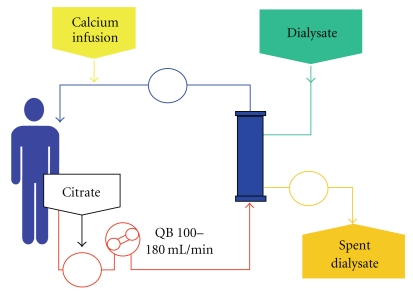
Citrate anticoagulation has risen in interest so it is now a real alternative to heparin in the ICUs practice. Citrate provides a regional anticoagulation virtually restricted to extracorporeal circuit, where it acts by chelating ionized calcium. This issue is particularly true in patients ongoing CRRT, when the "continuous" systemic anticoagulation treatment is per se a relevant risk of bleeding. When compared with heparin most of studies with citrate reported a longer circuit survival, a lower rate of bleeding complications, and transfused packed red cell requirements. As anticoagulant for CRRT, the infusion of citrate is prolonged and it could potentially have some adverse effects. When citrate is metabolized to bicarbonate, metabolic alkalosis may occur, or for impaired metabolism citrate accumulation leads to acidosis. However, large studies with dedicated machines have indeed demonstrated that citrate anticoagulation is well tolerated, safe, and an easy to handle even in septic shock critically ill patients.
枸橼酸盐抗凝法已越来越受关注,因此在重症监护病房(ICU)的实践中,它如今已成为肝素的一种切实可行的替代方法。枸橼酸盐可提供一种几乎仅限于体外循环的局部抗凝作用,它通过螯合离子钙来发挥作用。在接受连续性肾脏替代治疗(CRRT)的患者中尤其如此,此时“持续的”全身抗凝治疗本身就存在出血的相关风险。与肝素相比,大多数关于枸橼酸盐的研究报告称,其体外循环存活时间更长、出血并发症发生率更低且红细胞输注需求更少。作为CRRT的抗凝剂,枸橼酸盐的输注时间较长,可能会产生一些不良反应。当枸橼酸盐代谢为碳酸氢盐时,可能会发生代谢性碱中毒,或者由于代谢受损,枸橼酸盐蓄积会导致酸中毒。然而,使用专用设备进行的大型研究确实表明,即使在感染性休克的重症患者中,枸橼酸盐抗凝也具有良好的耐受性、安全性且易于操作。