Kawamoto Kensaku, Del Fiol Guilherme, Orton Charles, Lobach David F
Division of Clinical Informatics, Department of Community and Family Medicine, Box 2914, Duke University Medical Center, Durham, NC 27710, USA.
Open Med Inform J. 2010;4:245-54. doi: 10.2174/1874431101004010245. Epub 2010 Dec 14.
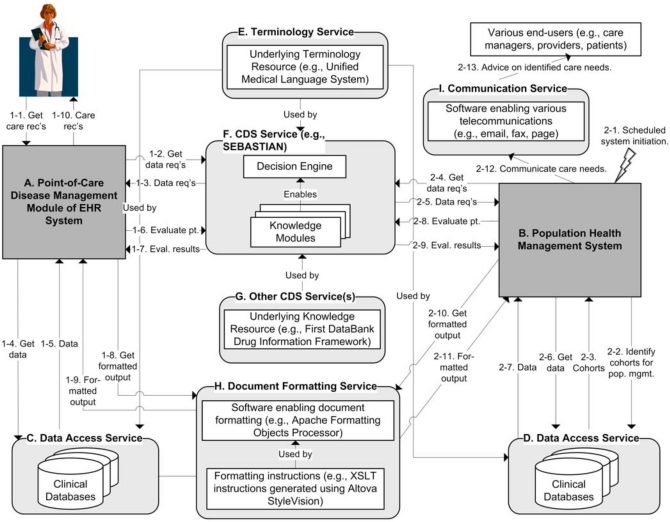
System-agnostic clinical decision support (CDS) services provide patient evaluation capabilities that are independent of specific CDS systems and system implementation contexts. While such system-agnostic CDS services hold great potential for facilitating the widespread implementation of CDS systems, little has been described regarding the benefits and challenges of their use. In this manuscript, the authors address this need by describing potential benefits and challenges of using a system-agnostic CDS service. This analysis is based on the authors' formal assessments of, and practical experiences with, various approaches to developing, implementing, and maintaining CDS capabilities. In particular, the analysis draws on the authors' experience developing and leveraging a system-agnostic CDS Web service known as SEBASTIAN. A primary potential benefit of using a system-agnostic CDS service is the relative ease and flexibility with which the service can be leveraged to implement CDS capabilities across applications and care settings. Other important potential benefits include facilitation of centralized knowledge management and knowledge sharing; the potential to support multiple underlying knowledge representations and knowledge resources through a common service interface; improved simplicity and componentization; easier testing and validation; and the enabling of distributed CDS system development. Conversely, important potential challenges include the increased effort required to develop knowledge resources capable of being used in many contexts and the critical need to standardize the service interface. Despite these challenges, our experiences to date indicate that the benefits of using a system-agnostic CDS service generally outweigh the challenges of using this approach to implementing and maintaining CDS systems.
与系统无关的临床决策支持(CDS)服务提供了独立于特定CDS系统及系统实施环境的患者评估能力。尽管此类与系统无关的CDS服务在促进CDS系统的广泛实施方面具有巨大潜力,但关于其使用的益处和挑战却鲜有描述。在本手稿中,作者通过描述使用与系统无关的CDS服务的潜在益处和挑战来满足这一需求。该分析基于作者对开发、实施和维护CDS能力的各种方法的正式评估及实践经验。特别是,该分析借鉴了作者开发和利用一种名为SEBASTIAN的与系统无关的CDS网络服务的经验。使用与系统无关的CDS服务的一个主要潜在益处是,利用该服务在各种应用程序和护理环境中实施CDS能力相对容易且灵活。其他重要的潜在益处包括促进集中式知识管理和知识共享;通过通用服务接口支持多种基础知识表示和知识资源的潜力;提高简单性和组件化程度;更易于测试和验证;以及支持分布式CDS系统开发。相反,重要的潜在挑战包括开发能够在多种环境中使用的知识资源所需的工作量增加,以及标准化服务接口的迫切需求。尽管存在这些挑战,但我们目前的经验表明,使用与系统无关的CDS服务的益处通常超过使用这种方法实施和维护CDS系统所面临的挑战。