Orthopaedic Service, Department of Surgery, Memorial Sloan-Kettering Cancer Center, New York, New York, United States of America.
PLoS One. 2011;6(5):e19956. doi: 10.1371/journal.pone.0019956. Epub 2011 May 13.
Accurate estimations of life expectancy are important in the management of patients with metastatic cancer affecting the extremities, and help set patient, family, and physician expectations. Clinically, the decision whether to operate on patients with skeletal metastases, as well as the choice of surgical procedure, are predicated on an individual patient's estimated survival. Currently, there are no reliable methods for estimating survival in this patient population. Bayesian classification, which includes bayesian belief network (BBN) modeling, is a statistical method that explores conditional, probabilistic relationships between variables to estimate the likelihood of an outcome using observed data. Thus, BBN models are being used with increasing frequency in a variety of diagnoses to codify complex clinical data into prognostic models. The purpose of this study was to determine the feasibility of developing bayesian classifiers to estimate survival in patients undergoing surgery for metastases of the axial and appendicular skeleton.
We searched an institution-owned patient management database for all patients who underwent surgery for skeletal metastases between 1999 and 2003. We then developed and trained a machine-learned BBN model to estimate survival in months using candidate features based on historical data. Ten-fold cross-validation and receiver operating characteristic (ROC) curve analysis were performed to evaluate the BNN model's accuracy and robustness.
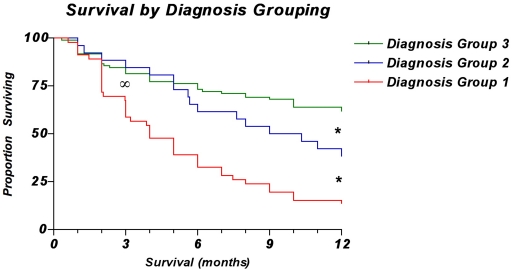
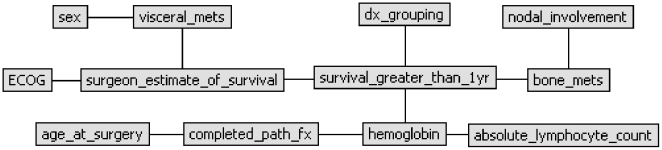
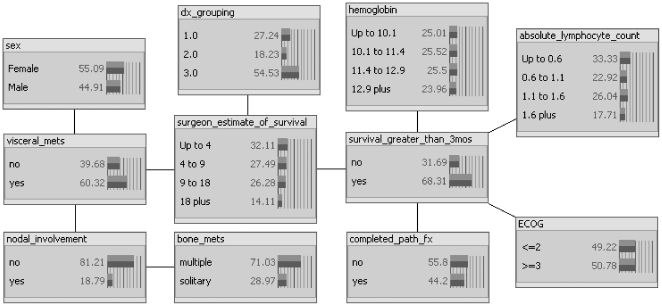
A total of 189 consecutive patients were included. First-degree predictors of survival differed between the 3-month and 12-month models. Following cross validation, the area under the ROC curve was 0.85 (95% CI: 0.80-0.93) for 3-month probability of survival and 0.83 (95% CI: 0.77-0.90) for 12-month probability of survival.
A robust, accurate, probabilistic naïve BBN model was successfully developed using observed clinical data to estimate individualized survival in patients with operable skeletal metastases. This method warrants further development and must be externally validated in other patient populations.
准确估计预期寿命对于管理影响四肢的转移性癌症患者非常重要,有助于设定患者、家庭和医生的期望。临床上,是否对患有骨骼转移的患者进行手术以及手术方式的选择,取决于患者个体的预期生存。目前,对于这一患者群体,尚无可靠的方法来估计生存。贝叶斯分类,包括贝叶斯置信网络(BBN)建模,是一种统计方法,用于探索变量之间有条件的、概率性关系,以便使用观察数据估计结果的可能性。因此,BBN 模型越来越多地用于各种诊断中,将复杂的临床数据编码为预后模型。本研究旨在确定开发贝叶斯分类器以估计接受轴性和附肢骨骼转移手术患者生存的可行性。
我们在机构拥有的患者管理数据库中搜索了 1999 年至 2003 年间接受骨骼转移手术的所有患者。然后,我们开发并训练了一个基于历史数据的机器学习 BBN 模型,使用候选特征来估计患者的生存时间(以月为单位)。采用十折交叉验证和接收者操作特征(ROC)曲线分析来评估 BNN 模型的准确性和稳健性。
共纳入 189 例连续患者。3 个月和 12 个月生存模型的生存预测的一级预测因素不同。经过交叉验证,ROC 曲线下面积分别为 3 个月生存概率的 0.85(95%CI:0.80-0.93)和 12 个月生存概率的 0.83(95%CI:0.77-0.90)。
成功地使用观察到的临床数据开发了一个强大、准确、概率性的贝叶斯朴素 BBN 模型,以估计可手术骨骼转移患者的个体化生存。该方法值得进一步开发,并需要在其他患者群体中进行外部验证。