Center for Gene Regulation in Health and Disease, Department of Biological Sciences, Cleveland State University, Cleveland, Ohio 44115, United States.
ACS Nano. 2011 May 24;5(5):3405-18. doi: 10.1021/nn200989r.
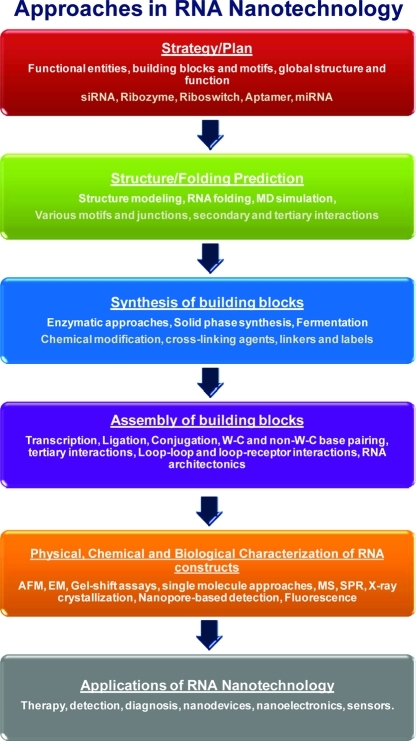
This Nano Focus article highlights recent advances in RNA nanotechnology as presented at the First International Conference of RNA Nanotechnology and Therapeutics, which took place in Cleveland, OH, USA (October 23-25, 2010) ( http://www.eng.uc.edu/nanomedicine/RNA2010/ ), chaired by Peixuan Guo and co-chaired by David Rueda and Scott Tenenbaum. The conference was the first of its kind to bring together more than 30 invited speakers in the frontier of RNA nanotechnology from France, Sweden, South Korea, China, and throughout the United States to discuss RNA nanotechnology and its applications. It provided a platform for researchers from academia, government, and the pharmaceutical industry to share existing knowledge, vision, technology, and challenges in the field and promoted collaborations among researchers interested in advancing this emerging scientific discipline. The meeting covered a range of topics, including biophysical and single-molecule approaches for characterization of RNA nanostructures; structure studies on RNA nanoparticles by chemical or biochemical approaches, computation, prediction, and modeling of RNA nanoparticle structures; methods for the assembly of RNA nanoparticles; chemistry for RNA synthesis, conjugation, and labeling; and application of RNA nanoparticles in therapeutics. A special invited talk on the well-established principles of DNA nanotechnology was arranged to provide models for RNA nanotechnology. An Administrator from National Institutes of Health (NIH) National Cancer Institute (NCI) Alliance for Nanotechnology in Cancer discussed the current nanocancer research directions and future funding opportunities at NCI. As indicated by the feedback received from the invited speakers and the meeting participants, this meeting was extremely successful, exciting, and informative, covering many groundbreaking findings, pioneering ideas, and novel discoveries.
本文重点介绍了 RNA 纳米技术方面的最新进展,这些进展是在克利夫兰举行的第一届国际 RNA 纳米技术和治疗会议上提出的(2010 年 10 月 23 日至 25 日)(http://www.eng.uc.edu/nanomedicine/RNA2010/),由 Peixuan Guo 担任主席,David Rueda 和 Scott Tenenbaum 共同担任联合主席。本次会议是首次汇聚来自法国、瑞典、韩国、中国和美国各地的 30 多位 RNA 纳米技术前沿领域的特邀演讲者,共同探讨 RNA 纳米技术及其应用。它为学术界、政府和制药行业的研究人员提供了一个平台,分享该领域现有的知识、愿景、技术和挑战,并促进了对推进这一新兴科学学科感兴趣的研究人员之间的合作。会议涵盖了一系列主题,包括用于表征 RNA 纳米结构的生物物理和单分子方法;通过化学或生化方法、计算、预测和建模研究 RNA 纳米颗粒结构;RNA 纳米颗粒组装方法;RNA 合成、缀合和标记化学;以及 RNA 纳米颗粒在治疗中的应用。特别安排了关于 DNA 纳米技术成熟原理的特邀演讲,为 RNA 纳米技术提供了模型。美国国立卫生研究院(NIH)国家癌症研究所(NCI)纳米技术联盟的一名管理人员讨论了 NCI 目前的纳米癌症研究方向和未来的资助机会。正如特邀演讲者和与会者的反馈所表明的那样,本次会议非常成功、令人兴奋且信息量丰富,涵盖了许多开创性的发现、开创性的想法和新颖的发现。