Michou Laëtitia, Brown Jacques P
Department of Medicine, CHUQ (CHUL), Research Centre and Division of Rheumatology, Laval University, Quebec City, QC, Canada.
Drug Des Devel Ther. 2011;5:225-39. doi: 10.2147/DDDT.S11306. Epub 2011 Apr 26.
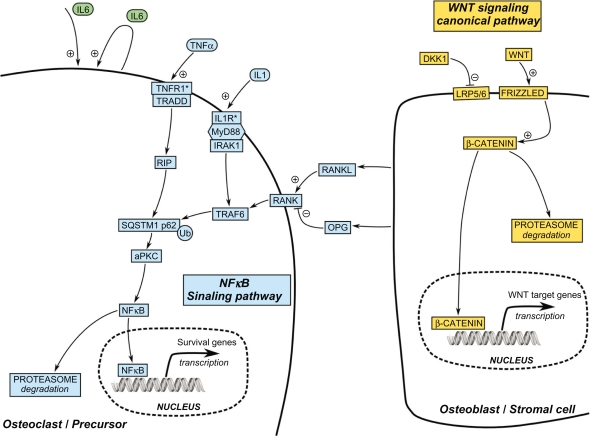
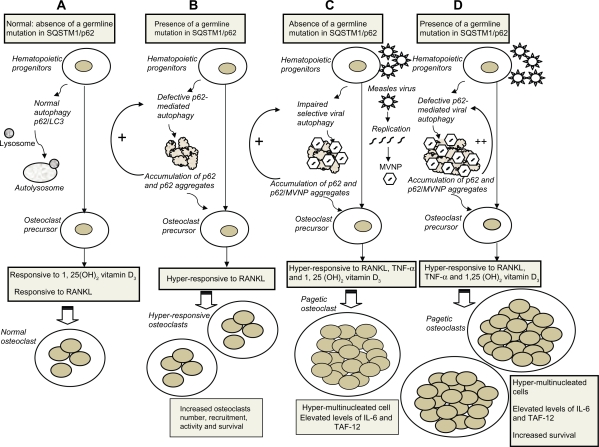
Paget's disease of bone (PDB) is a progressive monostotic or polyostotic metabolic bone disease characterized by focal abnormal bone remodeling, with increased bone resorption and excessive, disorganized, new bone formation. PDB rarely occurs before middle age, and it is the second most frequent metabolic bone disorder after osteoporosis, affecting up to 3% of adults over 55 years of age. One of the most striking and intriguing clinical features is the focal nature of the disorder, in that once the disease is established within a bone, there is only local spread within that bone and no systemic dissemination. Despite many years of intense research, the etiology of PDB has still to be conclusively determined. Based on a detailed review of genetic and viral factors incriminated in PDB, we propose a unifying hypothesis from which we can suggest emerging strategies and therapies. PDB results in weakened bone strength and abnormal bone architecture, leading to pain, deformity or, depending on the bone involved, fracture in the affected bone. The diagnostic assessment includes serum total alkaline phosphatase, total body bone scintigraphy, skull and enlarged view pelvis x-rays, and if needed, additional x-rays. The ideal therapeutic option would eliminate bone pain, normalize serum total alkaline phosphatase with prolonged remission, heal radiographic osteolytic lesions, restore normal lamellar bone, and prevent recurrence and complications. With the development of increasingly potent bisphosphonates, culminating in the introduction of a single intravenous infusion of zoledronic acid 5 mg, these goals of treatment are close to being achieved, together with long-term remission in almost all patients. Based on the recent pathophysiological findings, emerging strategies and therapies are reviewed: ie, pulse treatment with zoledronic acid; denosumab, a fully human monoclonal antibody directed against RANK ligand; tocilizumab, an interleukin-6 receptor inhibitor; odanacatib, a cathepsin K inhibitor; and proteasome and Dickkopf-1 inhibitors.
骨佩吉特病(PDB)是一种进行性单骨或多骨代谢性骨病,其特征为局灶性异常骨重塑,骨吸收增加以及过度、紊乱的新骨形成。PDB很少在中年之前发病,是仅次于骨质疏松症的第二常见代谢性骨病,影响高达3%的55岁以上成年人。最显著且引人关注的临床特征之一是该疾病的局灶性,即一旦某块骨发生病变,仅在该骨内局部扩散,不会发生全身播散。尽管经过多年深入研究,PDB的病因仍未最终确定。基于对PDB中涉及的遗传和病毒因素的详细综述,我们提出一个统一假说,据此可提出新出现的策略和疗法。PDB会导致骨强度减弱和骨结构异常,引发疼痛、畸形,或根据受累骨骼不同,导致患骨骨折。诊断评估包括血清总碱性磷酸酶、全身骨闪烁显像、颅骨和骨盆放大X线片,如有需要,还包括其他X线片。理想的治疗选择应消除骨痛,使血清总碱性磷酸酶恢复正常并实现长期缓解,治愈影像学溶骨性病变,恢复正常板层骨,并预防复发和并发症。随着效力越来越强的双膦酸盐的发展,最终引入了5毫克唑来膦酸的单次静脉输注,这些治疗目标已接近实现,几乎所有患者都能实现长期缓解。基于最近的病理生理学发现,对新出现的策略和疗法进行综述:即唑来膦酸脉冲治疗;地诺单抗,一种针对核因子κB受体活化因子配体(RANKL)的全人单克隆抗体;托珠单抗,一种白细胞介素-6受体抑制剂;奥达卡替,一种组织蛋白酶K抑制剂;以及蛋白酶体和Dickkopf-1抑制剂。