Cancer Virology Program, University of Pittsburgh Cancer Institute, Pittsburgh, PA 15213, USA.
Mol Cancer. 2011 May 24;10:61. doi: 10.1186/1476-4598-10-61.
Infection with high-risk human papillomaviruses (HPVs) such as HPV-16 is intimately associated with squamous cell carcinomas (SCCs) of the anogenital tract and a subset of oropharyngeal carcinomas. Such lesions, including pre-invasive precursors, frequently show multipolar mitoses and aneuploidy. The high-risk HPV-16-encoded E7 oncoprotein has been shown to rapidly induce centrosome abnormalities thereby causing the formation of supernumerary mitotic spindle poles and increasing the risk for chromosome missegregation. HPV-16 E7 has been found to rapidly induce centriole overduplication, in part, through the simultaneous formation of more than one daughter centriole at single maternal centrioles (centriole multiplication). The precise molecular mechanism that underlies HPV-16 E7-induced centriole multiplication, however, remains poorly understood.
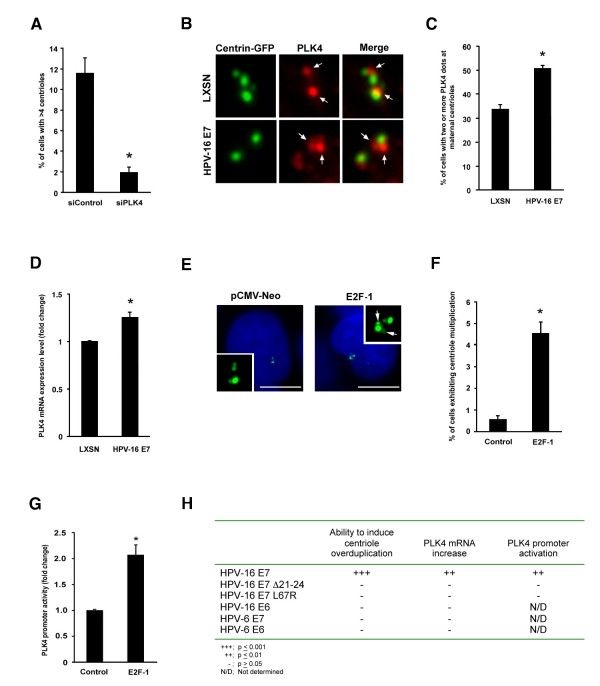
Here, we show that human keratinocytes engineered to stably express the HPV-16 E7 oncoprotein exhibit aberrant Polo-like kinase 4 (PLK4) protein expression at maternal centrioles. Real-time quantitative reverse transcriptase (qRT-PCR) analysis of these cells revealed an increase of PLK4 mRNA levels compared to control cells. Importantly, the ability of the HPV-16 E7 oncoprotein to induce centriole multiplication was found to correlate with its ability to activate the PLK4 promoter and to up-regulate PLK4 mRNA.
These results highlight the critical role of PLK4 transcriptional deregulation in centriole multiplication in HPV-16 E7-expressing cells. Our findings encourage further experiments to test transcriptional inhibitors or small molecules targeting PLK4 to prevent centriole abnormalities, mitotic infidelity and malignant progression in HPV-associated neoplasms and other tumors in which PLK4 regulation is disrupted.
高危型人乳头瘤病毒(HPV)如 HPV-16 的感染与肛门生殖器部位的鳞状细胞癌(SCC)和一部分口咽癌密切相关。这些病变,包括前浸润性前体,经常表现出多极有丝分裂和非整倍性。高危型 HPV-16 编码的 E7 癌蛋白已被证明可迅速诱导中心体异常,从而导致额外有丝分裂纺锤体极的形成,并增加染色体错误分离的风险。已经发现 HPV-16 E7 通过在单个母中心体上同时形成多个子中心体(中心体倍增),迅速诱导中心粒过度复制。然而,HPV-16 E7 诱导中心粒倍增的确切分子机制仍知之甚少。
在这里,我们表明,稳定表达 HPV-16 E7 癌蛋白的人角质形成细胞在母中心体上表现出异常的 Polo 样激酶 4(PLK4)蛋白表达。对这些细胞进行实时定量逆转录(qRT-PCR)分析显示,PLK4 mRNA 水平与对照细胞相比增加。重要的是,HPV-16 E7 癌蛋白诱导中心粒倍增的能力与其激活 PLK4 启动子和上调 PLK4 mRNA 的能力相关。
这些结果强调了 PLK4 转录失调在 HPV-16 E7 表达细胞中中心粒倍增中的关键作用。我们的发现鼓励进一步的实验来测试针对 PLK4 的转录抑制剂或小分子,以防止 HPV 相关肿瘤和其他 PLK4 调节失调的肿瘤中的中心体异常、有丝分裂不准确性和恶性进展。