Faculty of Veterinary Science, The University of Sydney, NSW 2006, Australia.
BMC Evol Biol. 2011 May 24;11:139. doi: 10.1186/1471-2148-11-139.
Porcine endogenous retroviruses (PERVs) represent remnants of an exogenous form that have become integrated in the domestic pig (Sus scrofa) genome. Although they are usually inactive, the capacity of γ1 ERVs to infect human cells in vitro has raised concerns about xenotransplantation because the viruses could cross the species barrier to humans. Here we have analyzed the evolution of γ1 ERVs in ten species of Suidae (suids, pigs and hogs) from Eurasia and Africa using DNA sequences for their coding domains (gag, pro/pol and env genes). For comparison with γ1 PERVs, we have also analysed γ2 ERVs which in domestic pigs are known to be inactive and do not pose a risk to xenotransplantation.
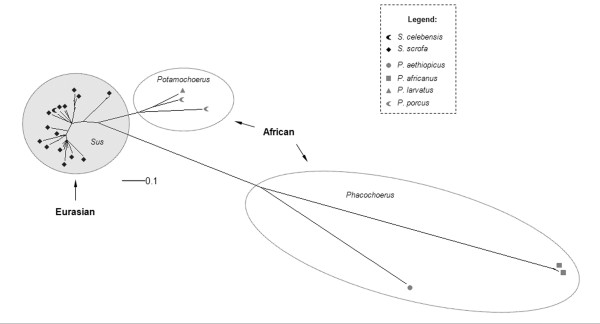
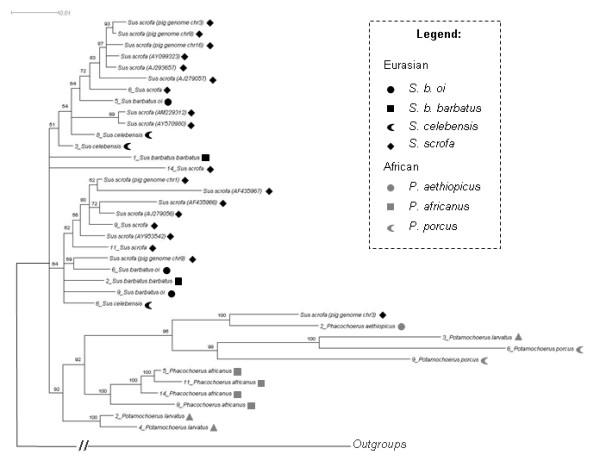
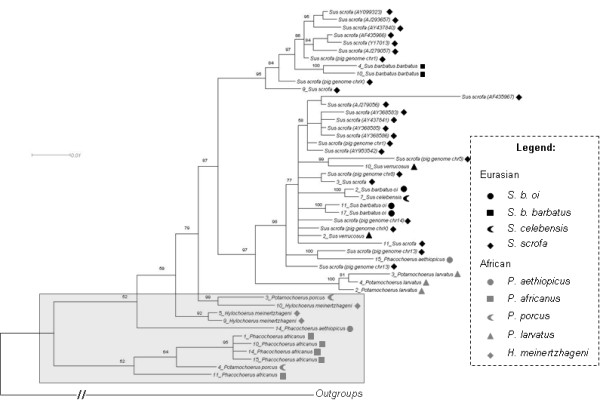
Phylogenetic analysis using Bayesian inference showed that γ1 and γ2 ERVs have distinctive evolutionary histories. Firstly, two different viral lineages of γ1 ERVs were found and a coevolutionary analysis demonstrated that they correspond broadly to their host phylogeny, one of Eurasian and another of African species, and show no evidence of horizontal transmission. γ2 ERVs, however, show a bush-like evolution, suggesting a rapid viral radiation from a single common ancestor with no correspondence between host and viral evolutionary trees. Furthermore, though γ1 ERV env genes do not possess frequent stop codons, γ2 env genes do. To understand whether γ1 suid ERVs may be still replicating, we have also evaluated their likely mechanism of proliferation by statistically testing internal to terminal branches using nonsynonymous versus synonymous substitution ratios. Our results suggest that γ1 ERVs are increasing in copy number by reinfection, which requires the translocation of the virus from one cell to another.
Evidence of at least two viral subpopulations was observed in γ1 ERVs from Eurasian and African host species. These results should be taken into account in xenotransplantation since γ1 ERVs appear to be codiverging with their host and maintaining ongoing capacity to infect somatic and germ cells.
猪内源性逆转录病毒(PERVs)是一种外源性逆转录病毒的残余物,已整合到家猪(Sus scrofa)基因组中。尽管它们通常处于非活跃状态,但 γ1 ERV 能够在体外感染人类细胞的能力引起了人们对异种移植的关注,因为这些病毒可能越过物种屏障感染人类。在这里,我们使用编码域( gag 、 pro / pol 和 env 基因)的 DNA 序列分析了欧亚大陆和非洲的 10 种猪科(猪科、猪科和猪科)物种中 γ1 ERV 的进化。为了与 γ1 PERVs 进行比较,我们还分析了 γ2 ERV ,在猪中,γ2 ERV 已知是不活跃的,不会对异种移植构成风险。
使用贝叶斯推断的系统发育分析表明,γ1 和 γ2 ERV 具有独特的进化历史。首先,发现了两种不同的 γ1 ERV 病毒株系,共进化分析表明,它们与宿主的进化关系大致相符,一种是欧亚大陆的,另一种是非洲的,没有水平传播的证据。然而,γ2 ERV 表现出类似于灌木丛的进化,表明从一个共同的祖先迅速发生了病毒辐射,宿主和病毒进化树之间没有对应关系。此外,尽管 γ1 ERV env 基因没有频繁的终止密码子,但 γ2 env 基因确实有。为了了解 γ1 猪科 ERV 是否仍在复制,我们还通过统计测试内部到末端分支,使用非同义与同义替换比率,评估了它们可能的增殖机制。我们的研究结果表明,γ1 ERV 通过再感染增加了拷贝数,这需要病毒从一个细胞转移到另一个细胞。
在欧亚大陆和非洲宿主物种的 γ1 ERV 中观察到至少有两个病毒亚群。在异种移植中应该考虑到这些结果,因为 γ1 ERV 似乎与宿主共同进化,并保持着感染体细胞和生殖细胞的能力。