Porter Neuroscience Research Center, Molecular Physiology and Biophysics Section, National Institute of Neurological Disorders and Stroke, National Institutes of Health, Bethesda, MD 20892, USA. kawatet@ninds.nih.gov
J Gen Physiol. 2011 Jun;137(6):579-90. doi: 10.1085/jgp.201010593.
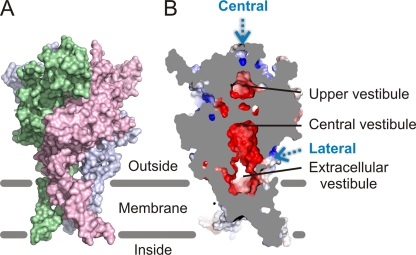
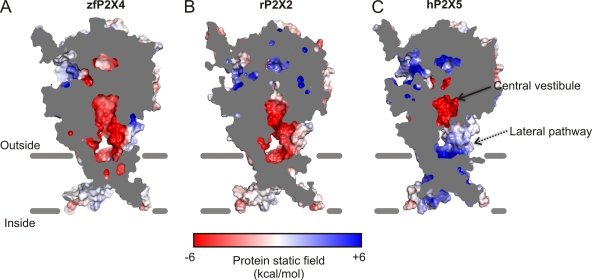
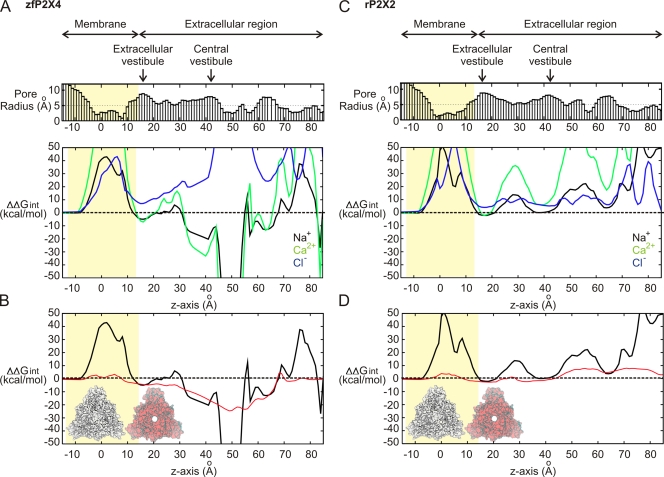
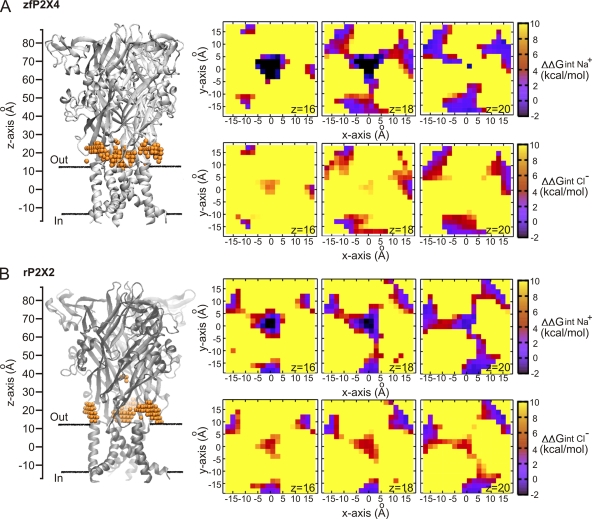
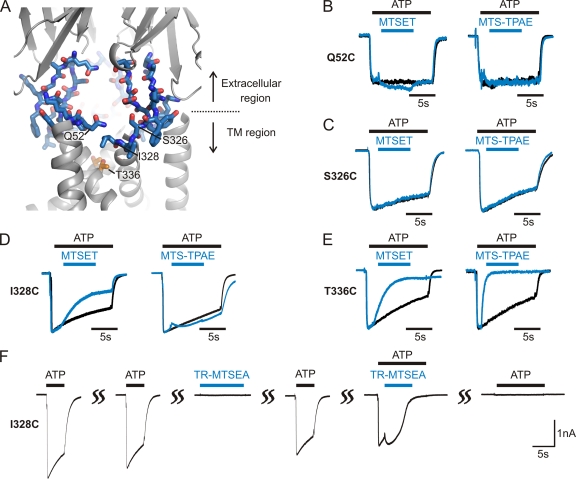
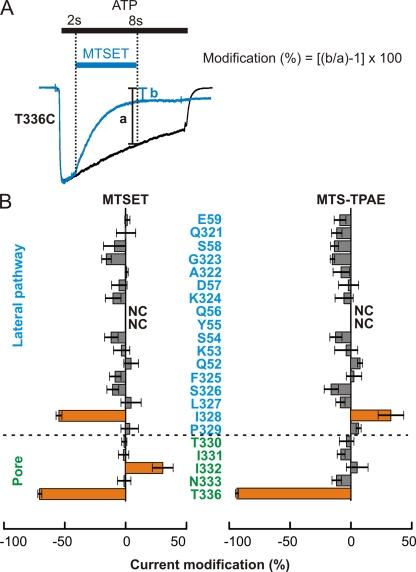
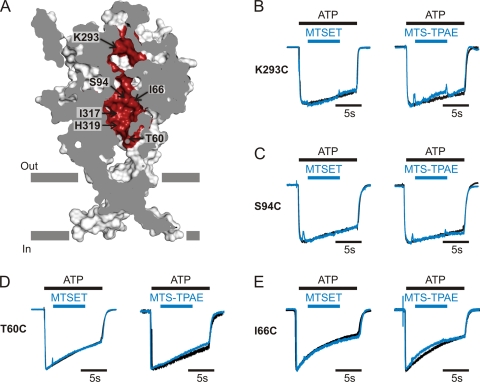
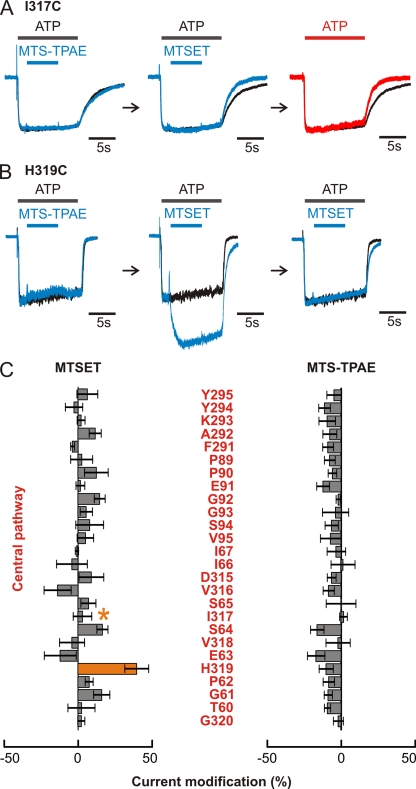
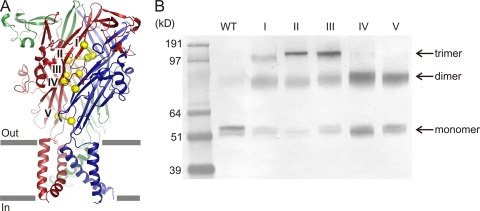
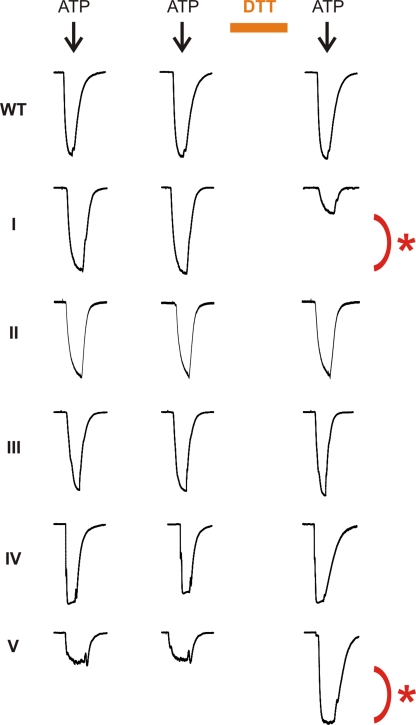
P2X receptors are trimeric cation channels that open in response to the binding of adenosine triphosphate (ATP) to a large extracellular domain. The x-ray structure of the P2X4 receptor from zebrafish (zfP2X4) receptor reveals that the extracellular vestibule above the gate opens to the outside through lateral fenestrations, providing a potential pathway for ions to enter and exit the pore. The extracellular region also contains a void at the central axis, providing a second potential pathway. To investigate the energetics of each potential ion permeation pathway, we calculated the electrostatic free energy by solving the Poisson-Boltzmann equation along each of these pathways in the zfP2X4 crystal structure and a homology model of rat P2X2 (rP2X2). We found that the lateral fenestrations are energetically favorable for monovalent cations even in the closed-state structure, whereas the central pathway presents strong electrostatic barriers that would require structural rearrangements to allow for ion accessibility. To probe ion accessibility along these pathways in the rP2X2 receptor, we investigated the modification of introduced Cys residues by methanethiosulfonate (MTS) reagents and constrained structural changes by introducing disulfide bridges. Our results show that MTS reagents can permeate the lateral fenestrations, and that these become larger after ATP binding. Although relatively small MTS reagents can access residues in one of the vestibules within the central pathway, no reactive positions were identified in the upper region of this pathway, and disulfide bridges that constrain movements in that region do not prevent ion conduction. Collectively, these results suggest that ions access the pore using the lateral fenestrations, and that these breathe as the channel opens. The accessibility of ions to one of the chambers in the central pathway likely serves a regulatory function.
P2X 受体是三聚体阳离子通道,当三磷酸腺苷 (ATP) 与大的细胞外结构域结合时会打开。来自斑马鱼 (zfP2X4) 受体的 P2X4 受体的 X 射线结构表明,门上方的细胞外前庭通过侧向窗孔向外部打开,为离子进入和离开孔提供了潜在途径。细胞外区域还在中心轴上包含一个空隙,提供了第二条潜在途径。为了研究每个潜在离子渗透途径的能量学,我们通过在 zfP2X4 晶体结构和大鼠 P2X2(rP2X2)同源模型中沿着这些途径求解泊松-玻尔兹曼方程来计算静电自由能。我们发现,即使在关闭状态结构中,侧向窗孔对于单价阳离子也是有利的,而中心途径则存在强烈的静电障碍,需要结构重排才能允许离子进入。为了在 rP2X2 受体中沿这些途径探测离子可及性,我们研究了引入的 Cys 残基被甲硫磺酸酯 (MTS) 试剂修饰的情况,并通过引入二硫键来限制结构变化。我们的结果表明,MTS 试剂可以渗透到侧向窗孔中,并且在 ATP 结合后这些窗孔会变大。尽管相对较小的 MTS 试剂可以进入中心途径一个前庭中的残基,但在上部区域没有鉴定到反应位置,并且限制该区域运动的二硫键不会阻止离子传导。总之,这些结果表明离子通过侧向窗孔进入孔道,并且随着通道打开,这些窗孔会呼吸。离子进入中央途径一个腔室的可及性可能具有调节功能。