McMaster Ancient DNA Centre, Department of Anthropology, McMaster University, 1280 Main Street West, Hamilton, Ontario L8S 4L9, Canada.
Genome Biol. 2011;12(5):R51. doi: 10.1186/gb-2011-12-5-r51. Epub 2011 May 31.
Late Pleistocene North America hosted at least two divergent and ecologically distinct species of mammoth: the periglacial woolly mammoth (Mammuthus primigenius) and the subglacial Columbian mammoth (Mammuthus columbi). To date, mammoth genetic research has been entirely restricted to woolly mammoths, rendering their genetic evolution difficult to contextualize within broader Pleistocene paleoecology and biogeography. Here, we take an interspecific approach to clarifying mammoth phylogeny by targeting Columbian mammoth remains for mitogenomic sequencing.
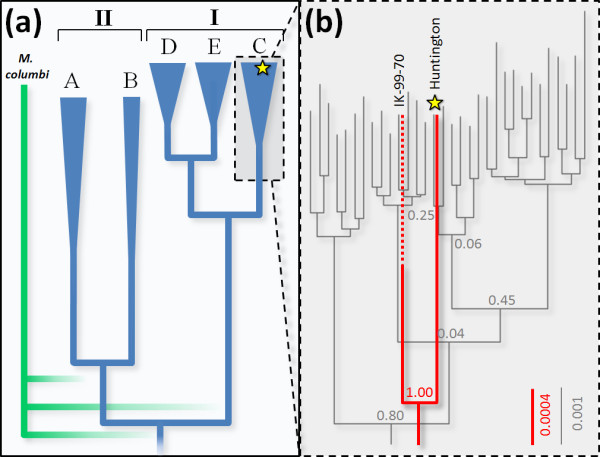
We sequenced the first complete mitochondrial genome of a classic Columbian mammoth, as well as the first complete mitochondrial genome of a North American woolly mammoth. Somewhat contrary to conventional paleontological models, which posit that the two species were highly divergent, the M. columbi mitogenome we obtained falls securely within a subclade of endemic North American M. primigenius.
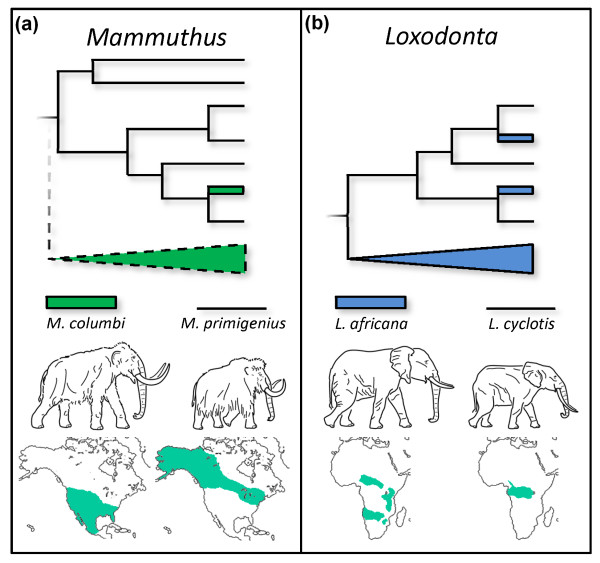
Though limited, our data suggest that the two species interbred at some point in their evolutionary histories. One potential explanation is that woolly mammoth haplotypes entered Columbian mammoth populations via introgression at subglacial ecotones, a scenario with compelling parallels in extant elephants and consistent with certain regional paleontological observations. This highlights the need for multi-genomic data to sufficiently characterize mammoth evolutionary history. Our results demonstrate that the use of next-generation sequencing technologies holds promise in obtaining such data, even from non-cave, non-permafrost Pleistocene depositional contexts.
更新世晚期的北美洲至少存在两种截然不同且生态特征各异的猛犸象:冰缘地区的长毛猛犸象(Mammuthus primigenius)和亚冰期的哥伦比亚猛犸象(Mammuthus columbi)。迄今为止,猛犸象的遗传研究完全局限于长毛猛犸象,这使得它们的遗传进化难以在更广泛的更新世古生态学和生物地理学背景下进行研究。在这里,我们通过针对哥伦比亚猛犸象遗骸进行线粒体基因组测序,采用种间方法来阐明猛犸象的系统发育。
我们对一只典型的哥伦比亚猛犸象进行了首次完整的线粒体基因组测序,同时也是首次对北美长毛猛犸象的线粒体基因组进行了完整测序。与传统古生物学模型所提出的观点有些相悖,该模型认为这两个物种具有高度的分化,我们获得的 M. columbi 线粒体基因组完全属于北美特有的 M. primigenius 的一个亚分支。
尽管数据有限,但我们的数据表明这两个物种在其进化历史的某个阶段发生了杂交。一个潜在的解释是,长毛猛犸象的单倍型通过亚冰缘的基因渗入进入了哥伦比亚猛犸象种群,这种情况在现存的大象中具有令人信服的相似之处,并且与某些地区的古生物学观察结果一致。这突出表明需要多基因组数据来充分描述猛犸象的进化历史。我们的研究结果表明,即使在非洞穴、非永久冻土的更新世沉积环境中,使用下一代测序技术也有望获得这些数据。