Rogers Rebekah L, Slatkin Montgomery
Department of Integrative Biology, University of California, Berkeley, Berkeley, California, United States of America.
PLoS Genet. 2017 Mar 2;13(3):e1006601. doi: 10.1371/journal.pgen.1006601. eCollection 2017 Mar.
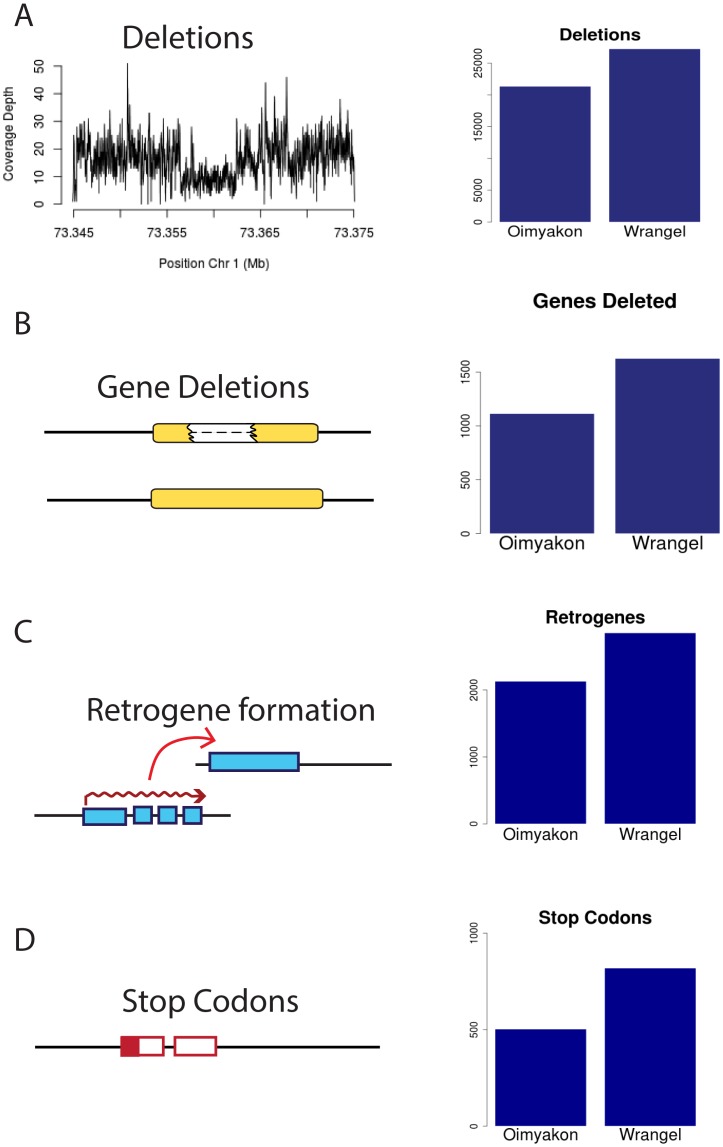
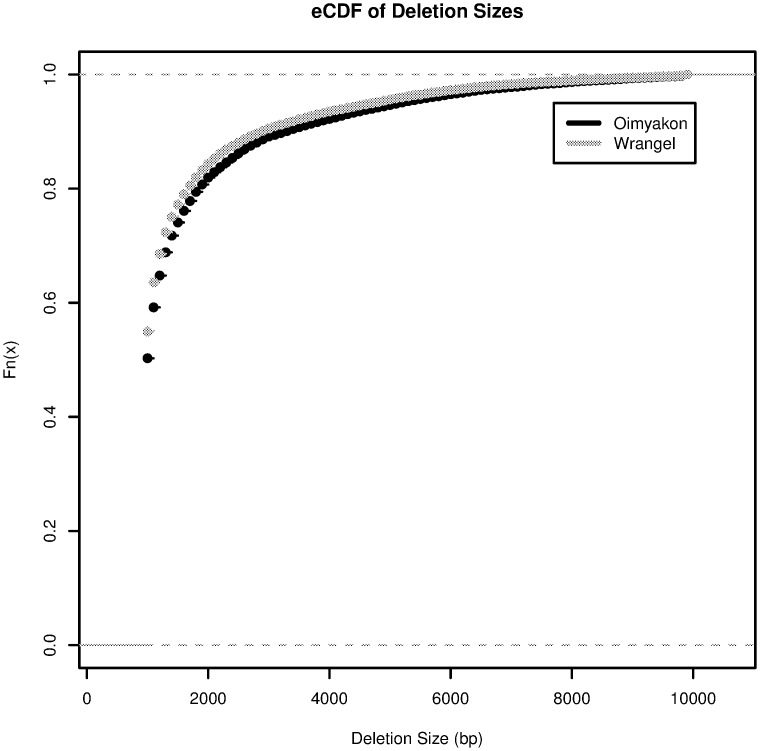
Woolly mammoths (Mammuthus primigenius) populated Siberia, Beringia, and North America during the Pleistocene and early Holocene. Recent breakthroughs in ancient DNA sequencing have allowed for complete genome sequencing for two specimens of woolly mammoths (Palkopoulou et al. 2015). One mammoth specimen is from a mainland population 45,000 years ago when mammoths were plentiful. The second, a 4300 yr old specimen, is derived from an isolated population on Wrangel island where mammoths subsisted with small effective population size more than 43-fold lower than previous populations. These extreme differences in effective population size offer a rare opportunity to test nearly neutral models of genome architecture evolution within a single species. Using these previously published mammoth sequences, we identify deletions, retrogenes, and non-functionalizing point mutations. In the Wrangel island mammoth, we identify a greater number of deletions, a larger proportion of deletions affecting gene sequences, a greater number of candidate retrogenes, and an increased number of premature stop codons. This accumulation of detrimental mutations is consistent with genomic meltdown in response to low effective population sizes in the dwindling mammoth population on Wrangel island. In addition, we observe high rates of loss of olfactory receptors and urinary proteins, either because these loci are non-essential or because they were favored by divergent selective pressures in island environments. Finally, at the locus of FOXQ1 we observe two independent loss-of-function mutations, which would confer a satin coat phenotype in this island woolly mammoth.
猛犸象(Mammuthus primigenius)在更新世和全新世早期生活在西伯利亚、白令陆桥和北美洲。古代DNA测序的最新突破使得对两个猛犸象标本进行全基因组测序成为可能(帕尔科普洛乌等人,2015年)。一个猛犸象标本来自45000年前的大陆种群,当时猛犸象数量众多。另一个标本有4300年历史,来自弗兰格尔岛上的一个孤立种群,那里的猛犸象生存时有效种群规模很小,比之前的种群低43倍多。有效种群规模的这些极端差异提供了一个难得的机会,来检验单一物种内基因组结构进化的近中性模型。利用这些先前发表的猛犸象序列,我们识别出缺失、反转录基因和无功能化点突变。在弗兰格尔岛猛犸象中,我们识别出更多的缺失、影响基因序列的缺失比例更大、更多的候选反转录基因以及增加的过早终止密码子数量。这种有害突变的积累与弗兰格尔岛上数量不断减少的猛犸象种群因有效种群规模小而导致的基因组崩溃一致。此外,我们观察到嗅觉受体和尿液蛋白的丢失率很高,要么是因为这些基因座非必需,要么是因为它们在岛屿环境中受到不同选择压力的青睐。最后,在FOXQ1基因座上,我们观察到两个独立的功能丧失突变,这将使这种岛屿猛犸象呈现缎面皮毛表型。