Moh Calvin, Kubiak Jacek Z, Bajic Vladan P, Zhu Xiongwei, Smith Mark A, Lee Hyoung-Gon
Department of Pathology, Case Western Reserve University, 2103 Cornell Road, Cleveland, OH 44106, USA.
Results Probl Cell Differ. 2011;53:565-76. doi: 10.1007/978-3-642-19065-0_23.
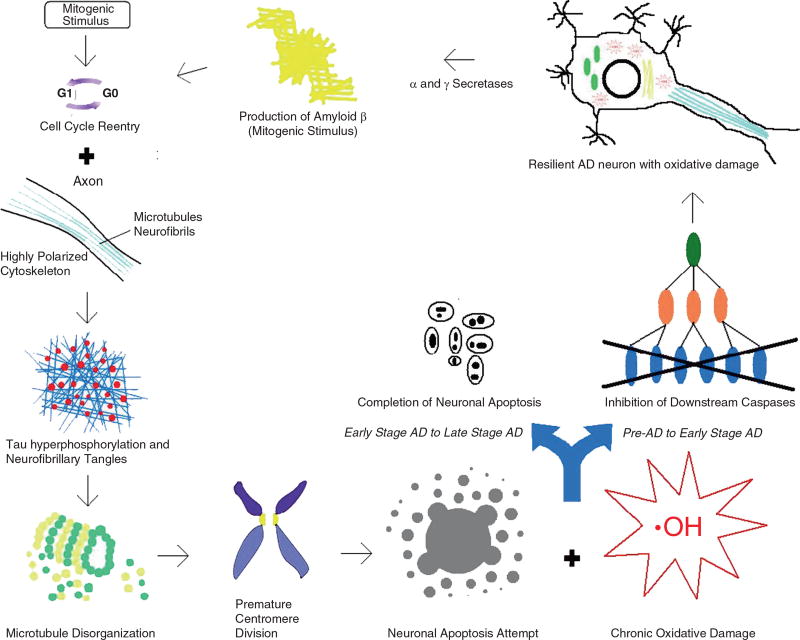
The cell cycle consists of four main phases: G(1), S, G(2), and M. Most cells undergo these cycles up to 40-60 times in their life. However, neurons remain in a nondividing, nonreplicating phase, G(0). Neurons initiate but do not complete cell division, eventually entering apoptosis. Research has suggested that like cancer, Alzheimer's disease (AD) involves dysfunction in neuronal cell cycle reentry, leading to the development of the two-hit hypothesis of AD. The first hit is abnormal cell cycle reentry, which typically results in neuronal apoptosis and prevention of AD. However, with the second hit of chronic oxidative damage preventing apoptosis, neurons gain "immortality" analogous to tumor cells. Once both of these hits are activated, AD can develop and produce senile plaques and neurofibrillary tangles throughout brain tissue. In this review, we propose a mechanism for neuronal cell cycle reentry and the development of AD.
G(1)期、S期、G(2)期和M期。大多数细胞在其生命周期中经历这些周期达40 - 60次。然而,神经元处于非分裂、非复制阶段,即G(0)期。神经元启动但未完成细胞分裂,最终进入凋亡过程。研究表明,与癌症一样,阿尔茨海默病(AD)涉及神经元细胞周期重新进入的功能障碍,从而导致AD的双击假说的提出。第一次打击是异常的细胞周期重新进入,这通常导致神经元凋亡并预防AD。然而,第二次慢性氧化损伤打击阻止了凋亡,神经元获得了类似于肿瘤细胞的“永生”。一旦这两次打击都被激活,AD就会发展并在整个脑组织中产生老年斑和神经原纤维缠结。在这篇综述中,我们提出了一种神经元细胞周期重新进入和AD发展的机制。