St, Mary Soledad Catholic Hospital, Mankon, Bamenda, P,O,Box 157, Cameroon.
BMC Int Health Hum Rights. 2011 Jun 3;11:6. doi: 10.1186/1472-698X-11-6.
There is a global consensus towards universal access to human immunodeficiency virus (HIV) services consequent to the increasing availability of antiretroviral therapy. However, to benefit from these services, knowledge of one's HIV status is critical. Partner notification for HIV is an important component of HIV counselling because it is an effective strategy to prevent secondary transmission, and promote early diagnosis and prompt treatment of HIV patients' sexual partners. However, counsellors are often frustrated by the reluctance of HIV-positive patients to voluntarily notify their sexual partners. This study aimed to explore tuberculosis (TB)/HIV counsellors' perspectives regarding confidentiality and partner notification.
Qualitative research interviews were conducted in the Northwest Region of Cameroon with 30 TB/HIV counsellors in 4 treatment centres, and 2 legal professionals between September and December 2009. Situational Analysis (positional map) was used for data analysis.
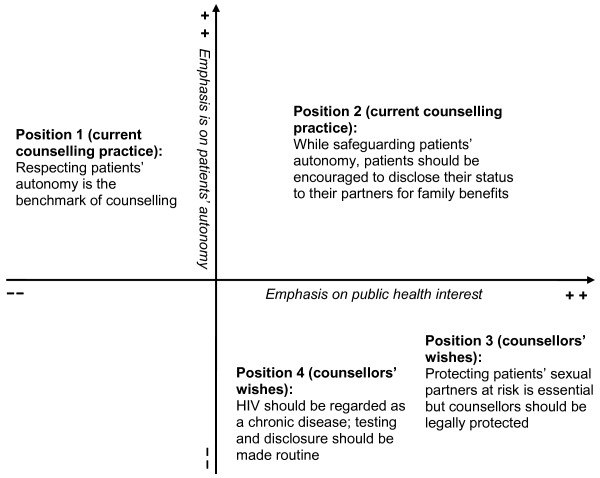
Confidentiality issues were perceived to be handled properly despite concerns about patients' reluctance to report cases of violation due to apprehension of reprisals from health care staffs. All the respondents encouraged voluntary partner notification, and held four varying positions when confronted with patients who refused to voluntarily notify their partners. Position one focused on absolute respect of patients' autonomy; position two balanced between the respect of patients' autonomy and their partners' safety; position three wished for protection of sexual partners at risk of HIV infection and legal protection for counsellors; and position four requested making HIV testing and partner notification routine processes.
Counsellors regularly encounter ethical, legal and moral dilemmas between respecting patients' confidentiality and autonomy, and protecting patients' sexual partners at risk of HIV infection.This reflects the complexity of partner notification and demonstrates that no single approach is optimal, but instead certain contextual factors and a combination of different approaches should be considered. Meanwhile, adopting a human rights perspective in HIV programmes will balance the interests of both patients and their partners, and ultimately enhance universal access to HIV services.
随着抗逆转录病毒疗法的不断普及,全球已达成普及艾滋病毒服务的共识。然而,要从这些服务中受益,了解自己的艾滋病毒状况至关重要。艾滋病毒伴侣通知是艾滋病毒咨询的一个重要组成部分,因为它是预防二次传播、促进艾滋病毒患者性伴侣早期诊断和及时治疗的有效策略。然而,咨询员经常对艾滋病毒阳性患者不愿自愿通知其性伴侣感到沮丧。本研究旨在探讨结核/艾滋病毒咨询员对保密性和伴侣通知的看法。
2009 年 9 月至 12 月,在喀麦隆西北部地区的 4 个治疗中心,对 30 名结核/艾滋病毒咨询员和 2 名法律专业人员进行了定性研究访谈。采用情境分析(位置图)进行数据分析。
尽管对患者因担心医护人员报复而不愿报告违反规定的情况表示关注,但保密性问题被认为得到了妥善处理。所有受访者都鼓励自愿通知伴侣,并在面对拒绝自愿通知其伴侣的患者时,持有四种不同的立场。立场一是绝对尊重患者的自主权;立场二是在尊重患者自主权和其伴侣的安全之间取得平衡;立场三是希望保护有感染艾滋病毒风险的性伴侣,并为咨询员提供法律保护;立场四是要求将艾滋病毒检测和伴侣通知作为常规程序。
咨询员经常在尊重患者的保密性和自主权与保护有感染艾滋病毒风险的患者性伴侣之间遇到伦理、法律和道德困境。这反映了伴侣通知的复杂性,并表明没有一种方法是最优的,而是应该考虑某些背景因素和不同方法的组合。同时,在艾滋病毒规划中采用人权视角将平衡患者及其伴侣的利益,最终增强艾滋病毒服务的普及程度。