Vervelde Lonneke, de Geus Eveline, Jansen Christine, Heller Dan E
Dept of Animal Sciences, Faculty of Agricultural, Food and Environmental Quality, The Hebrew University of Jerusalem, P,O,Box 12, Rehovot 76100, Israel.
BMC Proc. 2011 Jun 3;5 Suppl 4(Suppl 4):S5. doi: 10.1186/1753-6561-5-S4-S5.
The knowledge on the immune responses to LPAI is limited. The purpose of this study was to investigate the immune responses of two divergently selected lines of broilers, a line responding with high antibody response to antigens (HH), and a line responding with low antibody titers (LL) to antigen.
Day old chicks from each line were divided in two groups, one vaccinated with inactivated H9N2 vaccine and one non-vaccinated. At 21 days of age all the chicks were challenged with field isolate of H9N2, 1X106.5 ELD50 per chick by drops to the eye, nose and beak. Twenty four hours and 14 days post challenge (PC), the chickens were weighed blood spleen and lungs were taken and leukocytes were isolated. The leukocytes were stained with monoclonal antibodies for surface markers and analyzed by flow cytometry. We used Elispot assay to identify the number of antibody producing cells in each of the organs. mRNA was extracted using TRIsol reagent in order to assess the cytokine production level by qRT-PCR using the SYBR green methods.
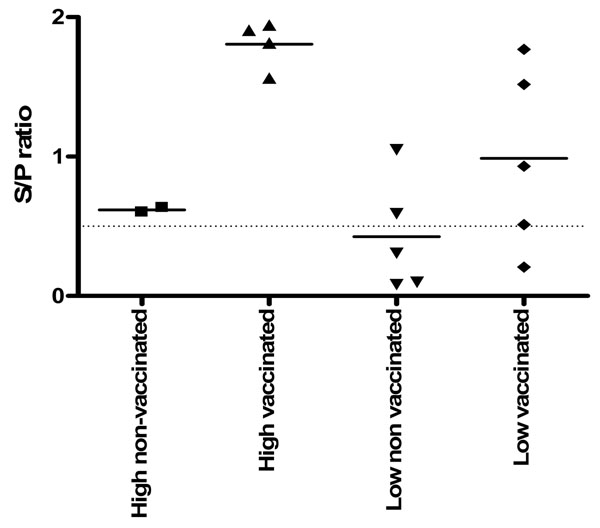
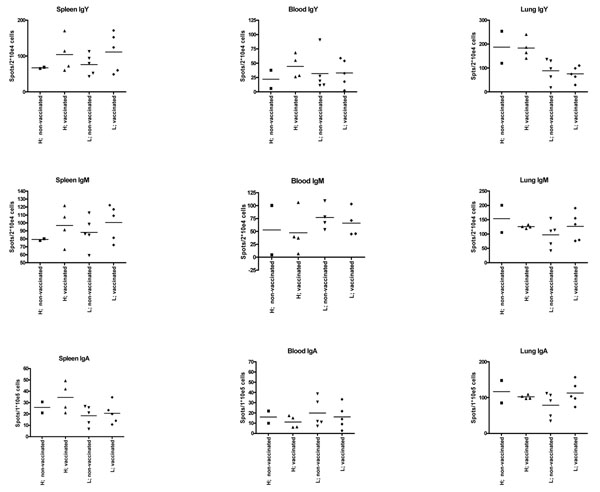
Our results showed that LL-vaccinated group gained more weight than any of the other group. Using IDEXX kit, no antibody titers could be identified in vaccinated chicks 21 days post vaccination while 14 days PC vaccinated HH chickens demonstrated the highest average antibody titers. LL vaccinated chickens demonstrated higher average antibody titer than non-vaccinated LL. Using the Elispot assay no difference were found between the groups either cells producing IgA, IgM or IgY beside of a high number of IgY producing cells in the lungs of vaccinated HH birds.
Further data on leukocytes subpopulations using flow cytometry, cytokines production (IFNγ, IL-6, IL-18, IL-2 and IL-4) isotype specific antibody responses and number and functionality of NK cells are in process.
关于低致病性禽流感(LPAI)免疫反应的知识有限。本研究的目的是调查两个经过不同选择的肉鸡品系的免疫反应,一个品系对抗抗原产生高抗体反应(HH),另一个品系对抗抗原产生低抗体滴度(LL)。
每个品系的一日龄雏鸡分为两组,一组接种灭活H9N2疫苗,另一组不接种。在21日龄时,所有雏鸡用H9N2的田间分离株进行攻毒,每只雏鸡经眼、鼻和喙滴入1×10⁶.⁵ELD₅₀。攻毒后24小时和14天(PC),对鸡称重,采集血液、脾脏和肺脏,并分离白细胞。用单克隆抗体对白细胞进行表面标志物染色,并用流式细胞术进行分析。我们使用酶联免疫斑点分析(Elispot assay)来确定每个器官中产生抗体的细胞数量。使用TRIsol试剂提取mRNA,以便通过SYBR green方法进行qRT-PCR来评估细胞因子的产生水平。
我们的结果表明,接种疫苗的LL组比其他任何组增重更多。使用IDEXX试剂盒,接种疫苗后21天的雏鸡中未检测到抗体滴度,而攻毒后14天,接种疫苗的HH鸡表现出最高的平均抗体滴度。接种疫苗的LL鸡的平均抗体滴度高于未接种疫苗的LL鸡。使用Elispot分析,除了接种疫苗的HH鸡肺部有大量产生IgY的细胞外,各实验组之间产生IgA、IgM或IgY的细胞没有差异。
关于使用流式细胞术分析白细胞亚群、细胞因子产生(IFNγ、IL-6、IL-18、IL-2和IL-4)、同种型特异性抗体反应以及NK细胞的数量和功能的进一步数据正在研究中。