Institute of Pharmacy and Biochemistry, Johannes Gutenberg University Mainz, Staudinger Weg 5, D-55128 Mainz, Germany.
Nucleic Acids Res. 2011 Sep 1;39(16):7348-60. doi: 10.1093/nar/gkr449. Epub 2011 Jun 6.
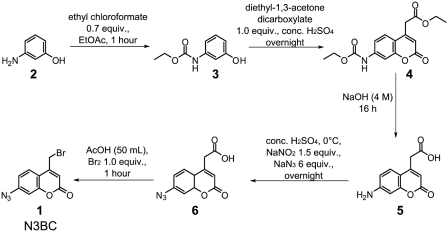
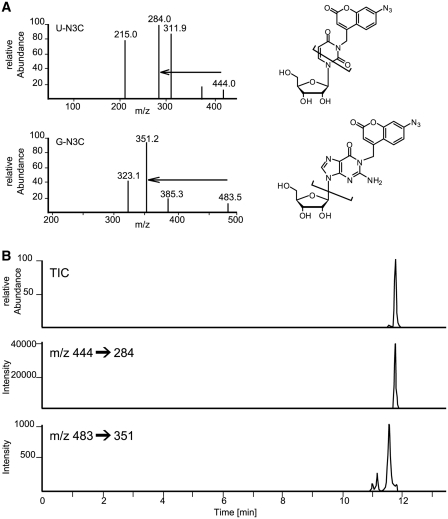
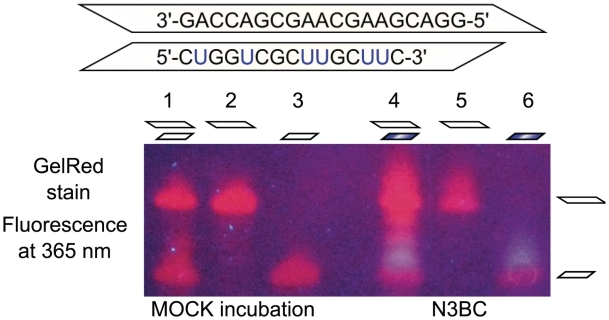
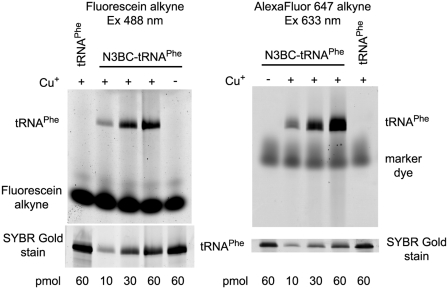
A multifunctional reagent based on a coumarin scaffold was developed for derivatization of naive RNA. The alkylating agent N3BC [7-azido-4-(bromomethyl)coumarin], obtained by Pechmann condensation, is selective for uridine. N3BC and its RNA conjugates are pre-fluorophores which permits controlled modular and stepwise RNA derivatization. The success of RNA alkylation by N3BC can be monitored by photolysis of the azido moiety, which generates a coumarin fluorophore that can be excited with UV light of 320 nm. The azidocoumarin-modified RNA can be flexibly employed in structure-function studies. Versatile applications include direct use in photo-crosslinking studies to cognate proteins, as demonstrated with tRNA and RNA fragments from the MS2 phage and the HIV genome. Alternatively, the azide function can be used for further derivatization by click-chemistry. This allows e.g. the introduction of an additional fluorophore for excitation with visible light.
一种基于香豆素骨架的多功能试剂被开发用于原始 RNA 的衍生化。通过 Pechmann 缩合得到的烷化试剂 N3BC [7-叠氮-4-(溴甲基)香豆素] 对尿嘧啶具有选择性。N3BC 及其 RNA 缀合物是预荧光团,允许对 RNA 进行可控的模块化和逐步衍生化。N3BC 对 RNA 的烷化成功可以通过叠氮部分的光解来监测,这会产生一个香豆素荧光团,可以用 320nm 的紫外光激发。修饰后的 RNA 可以灵活地用于结构-功能研究。多种应用包括直接用于与同源蛋白的光交联研究,如 tRNA 和 MS2 噬菌体和 HIV 基因组的 RNA 片段的研究。或者,叠氮基团可以用于点击化学的进一步衍生化。例如,这允许引入另一个用于可见光激发的荧光团。