Department of Surgery, Division of Surgical Oncology, University of Groningen, [corrected] University Medical Center Groningen, Groningen, the Netherlands.
Cell Oncol (Dordr). 2012 Feb;35(1):9-18. doi: 10.1007/s13402-011-0052-6. Epub 2011 Jun 7.
Folate receptor alpha (FR-α) has been identified as a potential target in ovarian cancer for diagnostic and therapeutic purposes, based on its overexpression in serous epithelial ovarian carcinoma. The effect of chemotherapy on FR-α expression may be important in the applicability of FR-α directed agents in the case of residual tumor tissue. The objective of this study was to assess FR-α expression in ovarian carcinoma and to evaluate whether FR-α expression is altered by chemotherapy.
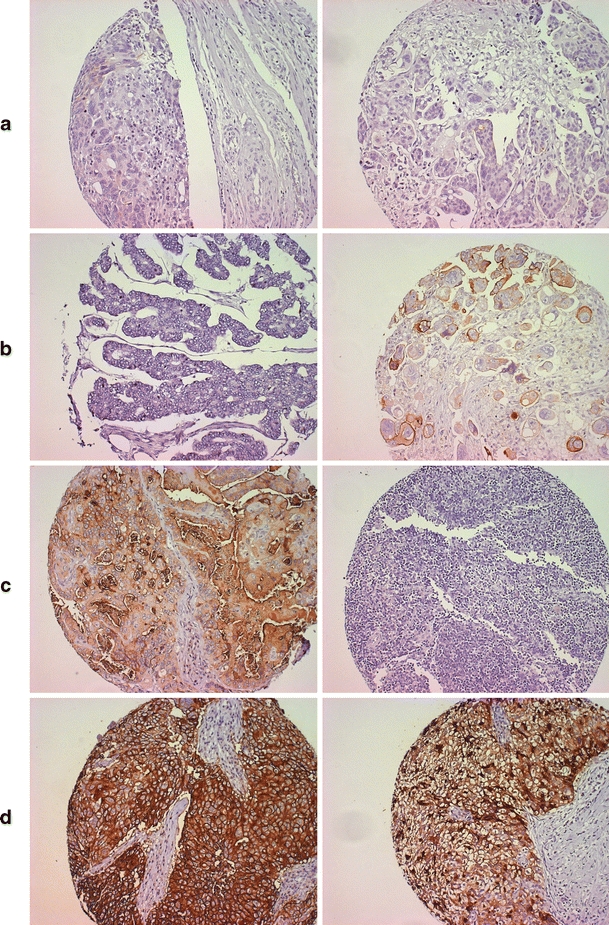
MATERIALS & METHODS: FR-α expression was analyzed by semi-quantitative scoring of immunohistochemical staining on tissue microarrays (TMAs) from a database containing 361 ovarian cancer tissue samples, of which 210 serous and 116 non-serous carcinoma (35 missing). Serous carcinoma samples included 28 matched samples with tissue from both primary surgery and interval debulking surgery, and 12 matched samples with tissue from both primary surgery and surgery for recurrent disease.
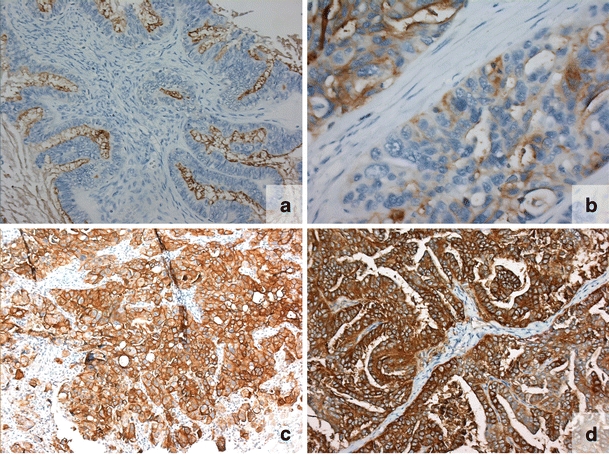
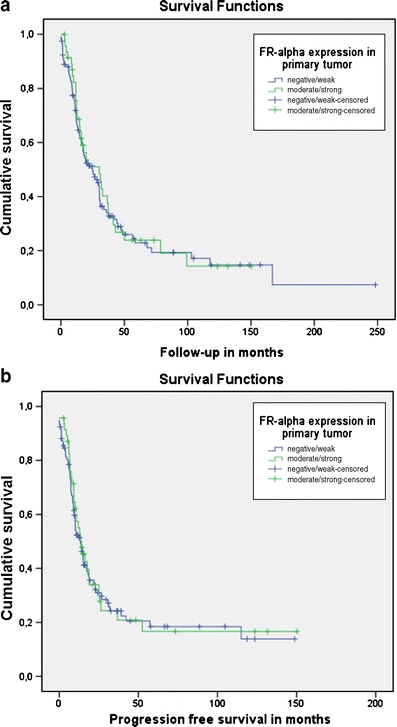
FR-α expression was seen in 81.8% of serous ovarian cancers versus 39.9% of non-serous carcinomas (p < 0.001). In matched serous carcinoma samples, no significant change in FR-α expression in vital tumor tissue after chemotherapy was observed (p = 0.1). FR-α expression was not a prognostic marker of progression free survival (p = 0.8) or overall survival (p = 0.7).
FR-α was expressed in the majority of serous ovarian tumors, although >50% of cases showed only weak expression. Chemotherapy did not alter expression rates in remaining vital tumor tissue, indicating that folate-targeted agents may have a place in the treatment for ovarian cancer, before as well as after chemotherapy. Furthermore, FR-α status did not influence survival.
基于在浆液性上皮性卵巢癌中过表达,叶酸受体α(FR-α)已被确定为卵巢癌诊断和治疗的潜在靶点。化疗对 FR-α 表达的影响可能对残留肿瘤组织中 FR-α 靶向药物的适用性很重要。本研究旨在评估卵巢癌中 FR-α 的表达,并评估 FR-α 的表达是否因化疗而改变。
使用组织微阵列(TMA)上的免疫组织化学染色半定量评分分析 FR-α 表达,该 TMA 数据库包含 361 个卵巢癌组织样本,其中 210 个为浆液性癌,116 个为非浆液性癌(35 个缺失)。浆液性癌样本包括 28 个配对样本,其组织分别来自初次手术和间隔减瘤手术,以及 12 个配对样本,其组织分别来自初次手术和复发性疾病手术。
在浆液性卵巢癌中,FR-α 的表达率为 81.8%,而非浆液性癌中为 39.9%(p<0.001)。在配对的浆液性癌样本中,化疗后存活肿瘤组织中 FR-α 表达无明显变化(p=0.1)。FR-α 表达不是无进展生存期(p=0.8)或总生存期(p=0.7)的预后标志物。
FR-α 在大多数浆液性卵巢肿瘤中表达,尽管超过 50%的病例仅表现为弱表达。化疗并未改变存活肿瘤组织中的表达率,表明叶酸靶向药物在卵巢癌治疗中可能具有一定的地位,包括化疗前和化疗后。此外,FR-α 状态并未影响生存。