Han Zhou, Papermaster David S
Department of Neuroscience, University of Connecticut Health Center, Farmington, CT 06030, USA.
Mol Vis. 2011;17:1381-96. Epub 2011 May 25.
Prominin is a family of pentaspan transmembrane glycoproteins. They are expressed in various types of cells, including many stem/progenitor cells. Prominin-1 plays an important role in generating and maintaining the structure of the photoreceptors. In this study, we identified three prominin homologs in Xenopus laevis, a model animal widely used in vision research, and characterized their messenger RNA (mRNA) expression in selected tissues of this frog.
Reverse-transcription PCR (RT-PCR) and rapid amplification of cDNA ends (RACE) were used to isolate cDNAs of prominin homologs. Semiquantitative RT-PCR was used to measure the relative expression levels of mRNAs of the three prominin homologs in four X. laevis tissues, specifically those of the retina, brain, testis, and kidney. Sequences of prominin homologs were analyzed with bioinformatic software.
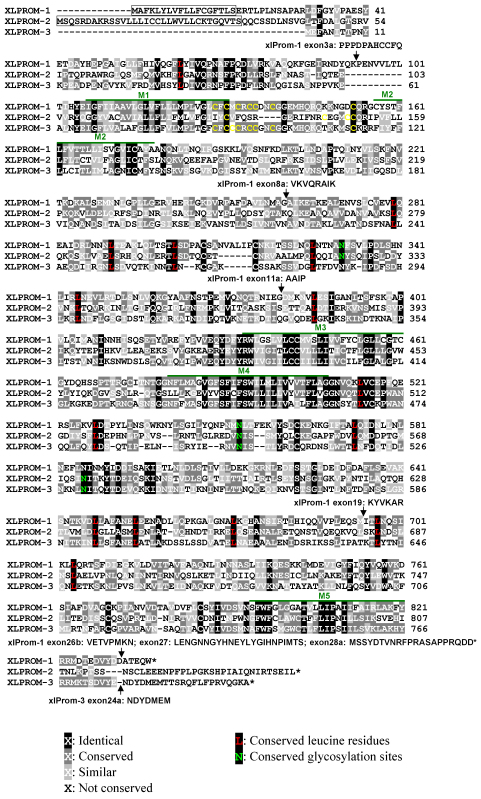
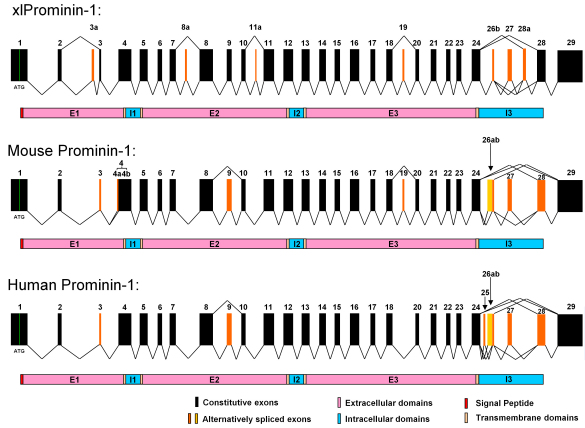
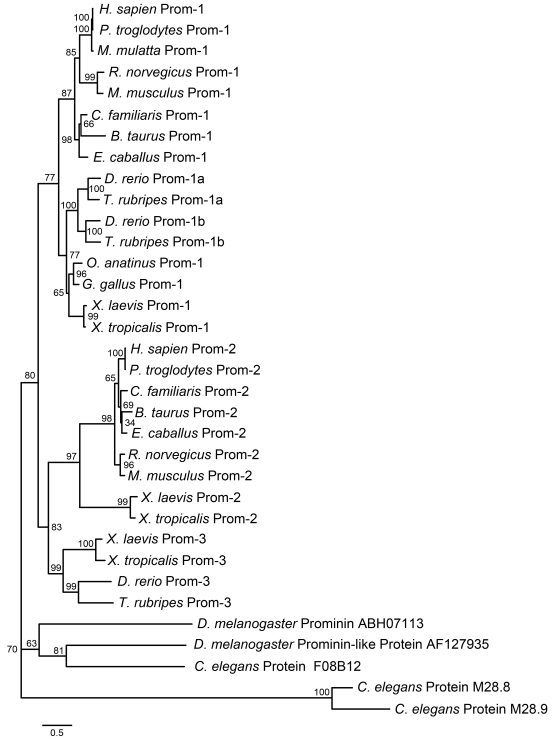
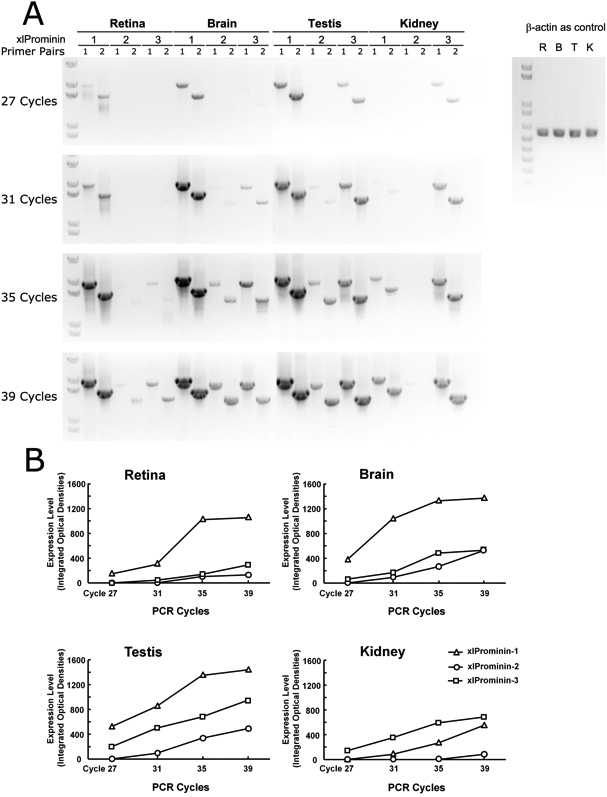
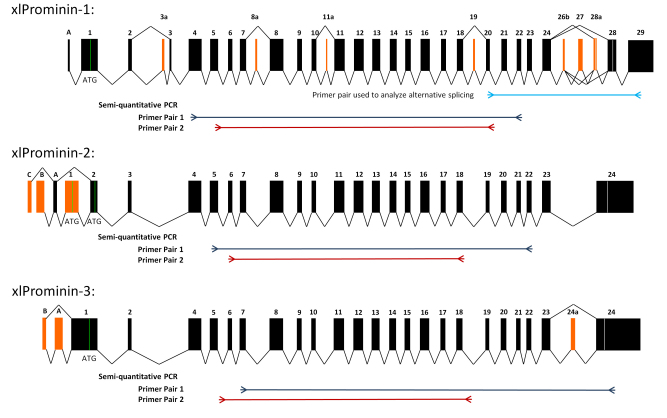
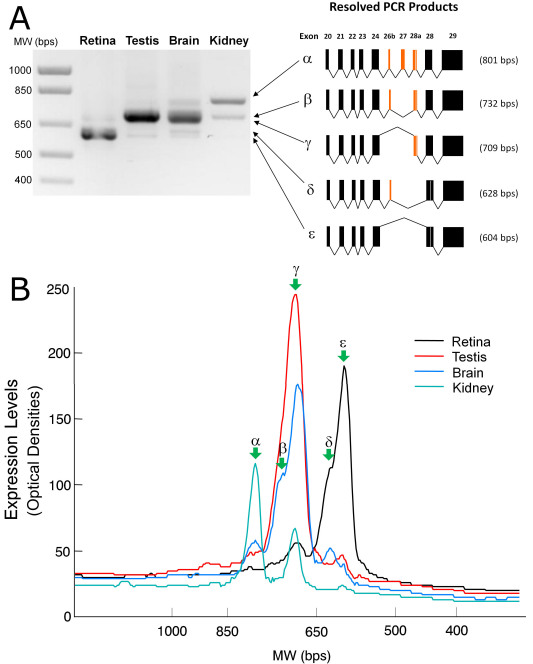
We isolated cDNAs of three prominin homologs from X. laevis tissues and compared their sequences with previously described prominin-1, 2, and 3 sequences from other species using phylogenetic analysis. Two of these homologs are likely to be the X. laevis orthologs of mammalian prominin-1 and 2, respectively, while the third homolog is likely to be the X. laevis ortholog of prominin-3, which was only found in nonmammalian vertebrates and the platypus. We identified alternatively spliced exons in mRNAs of all three prominin homologs. Similar to mammalian prominin-1, we found that exons 26b, 27, and 28a of the X. laevis prominin-1 gene are alternatively spliced, and that the splice isoforms of mRNA show tissue-specific expression profiles. We found that prominin-1 was the most abundant homolog expressed in the retina, brain, and testis, while prominin-3 was the most abundant homolog in the kidney. The expression level of prominin-2 was the lowest of the three prominin homologs in all four examined tissues of this frog.
Our results suggest that the mRNAs of prominin homologs are expressed in many tissues of X. laevis, but differ in their expression levels and mRNA splicing. Prominin-1 is the most abundant of the three prominin homologs expressed in the frog retina.
Prominin是一个五跨膜糖蛋白家族。它们在多种类型的细胞中表达,包括许多干细胞/祖细胞。Prominin-1在光感受器结构的形成和维持中起重要作用。在本研究中,我们在非洲爪蟾(一种广泛用于视觉研究的模式动物)中鉴定出三个Prominin同源物,并对其在该蛙选定组织中的信使核糖核酸(mRNA)表达进行了表征。
采用逆转录聚合酶链反应(RT-PCR)和cDNA末端快速扩增(RACE)技术分离Prominin同源物的cDNA。使用半定量RT-PCR测定三个Prominin同源物的mRNA在四种非洲爪蟾组织(即视网膜、脑、睾丸和肾脏组织)中的相对表达水平。利用生物信息学软件分析Prominin同源物的序列。
我们从非洲爪蟾组织中分离出三个Prominin同源物的cDNA,并通过系统发育分析将它们的序列与先前描述的其他物种的Prominin-1、2和3序列进行比较。其中两个同源物可能分别是哺乳动物Prominin-1和2在非洲爪蟾中的直系同源物,而第三个同源物可能是Prominin-3在非洲爪蟾中的直系同源物,Prominin-3仅在非哺乳动物脊椎动物和鸭嘴兽中发现。我们在所有三个Prominin同源物的mRNA中鉴定出选择性剪接外显子。与哺乳动物Prominin-1类似,我们发现非洲爪蟾Prominin-1基因的外显子26b、27和28a存在选择性剪接,且mRNA的剪接异构体呈现组织特异性表达谱。我们发现Prominin-1是在视网膜、脑和睾丸中表达最丰富的同源物,而Prominin-3是在肾脏中表达最丰富的同源物。在该蛙所有四个检测组织中,Prominin-2的表达水平是三个Prominin同源物中最低的。
我们的结果表明,Prominin同源物的mRNA在非洲爪蟾的许多组织中表达,但在表达水平和mRNA剪接方面存在差异。Prominin-1是在蛙视网膜中表达最丰富的三个Prominin同源物之一。