Pierce J H, Di Marco E, Cox G W, Lombardi D, Ruggiero M, Varesio L, Wang L M, Choudhury G G, Sakaguchi A Y, Di Fiore P P
Laboratory of Cellular and Molecular Biology, National Cancer Institute, Bethesda, MD 20892.
Proc Natl Acad Sci U S A. 1990 Aug;87(15):5613-7. doi: 10.1073/pnas.87.15.5613.
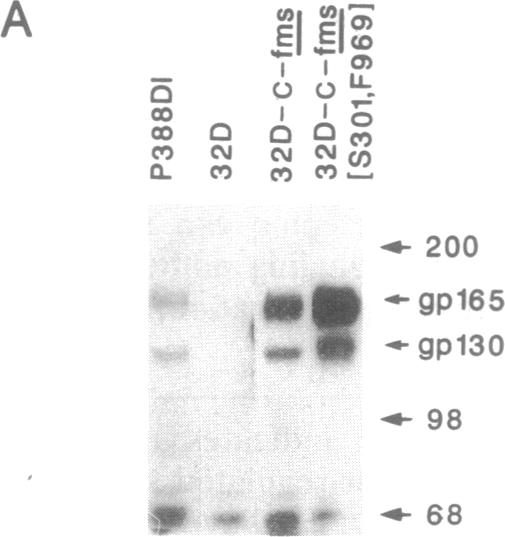
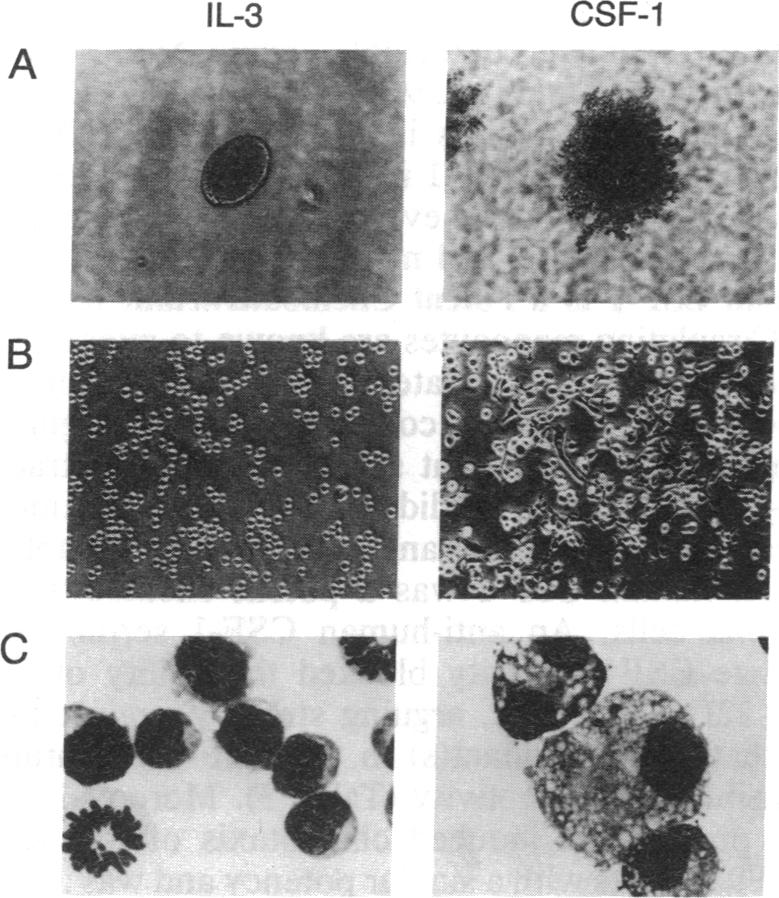
The c-fms protooncogene encodes the receptor for macrophage-colony-stimulating factor (CSF-1). Expression vectors containing either normal or oncogenic point-mutated human c-fms genes were transfected into interleukin 3 (IL-3)-dependent 32D cells in order to determine the effects of CSF-1 signaling in this murine clonal myeloid progenitor cell line. CSF-1 was shown to trigger proliferation in association with monocytic differentiation of the 32D-c-fms cells. Monocytic differentiation was reversible upon removal of CSF-1, implying that CSF-1 was required for maintenance of the monocyte phenotype but was not sufficient to induce an irrevocable commitment to differentiation. Human CSF-1 was also shown to be a potent chemoattractant for 32D-c-fms cells, suggesting that CSF-1 may serve to recruit monocytes from the circulation to tissue sites of inflammation or injury. Although c-fms did not release 32D cells from factor dependence, point-mutated c-fms[S301,F969] (Leu-301----Ser, Tyr-969----Phe) was able to abrogate their IL-3 requirement and induce tumorigenicity. IL-3-independent 32D-c-fms[S301,F969] cells also displayed a mature monocyte phenotype, implying that differentiation did not interfere with progression of these cells to the malignant state. All of these findings demonstrate that a single growth factor receptor can specifically couple with multiple intracellular signaling pathways and play a critical role in modulating cell proliferation, differentiation, and migration.
c-fms原癌基因编码巨噬细胞集落刺激因子(CSF-1)的受体。将含有正常或致癌点突变型人c-fms基因的表达载体转染到依赖白细胞介素3(IL-3)的32D细胞中,以确定CSF-1信号在这种小鼠克隆性髓系祖细胞系中的作用。结果显示,CSF-1可触发32D-c-fms细胞的增殖并伴有单核细胞分化。去除CSF-1后,单核细胞分化是可逆的,这意味着CSF-1是维持单核细胞表型所必需的,但不足以诱导不可逆转的分化。人CSF-1还被证明是32D-c-fms细胞的有效趋化因子,这表明CSF-1可能有助于将单核细胞从循环中募集到炎症或损伤的组织部位。虽然c-fms不能使32D细胞摆脱对因子的依赖,但点突变的c-fms[S301,F969](Leu-301----Ser,Tyr-969----Phe)能够消除它们对IL-3的需求并诱导致瘤性。不依赖IL-3的32D-c-fms[S301,F969]细胞也表现出成熟的单核细胞表型,这意味着分化并不干扰这些细胞向恶性状态的进展。所有这些发现表明,单一的生长因子受体可以特异性地与多种细胞内信号通路偶联,并在调节细胞增殖、分化和迁移中起关键作用。